What Color Is a Burgundy Wedding Dress?
Burgundy is red darkened with brown and a small amount of purple, named for the wines of the Burgundy region of France. On a wedding dress it sits several steps deeper than crimson and behaves almost like a dark neutral, which is why it photographs as formal rather than loud. The depth is what makes it wearable.
That neutrality has a practical consequence. A bright red gown fixes the entire visual weight of a wedding on the bride's dress, and everything else in frame has to work around it. Burgundy does not do that. It holds its own against a black-tie room or a bank of deep autumn florals without flattening either, and it sits comfortably next to gold, blush, deep green, and ivory rather than fighting them.
Maroon, Wine, Oxblood, and Merlot: How the Shades Differ
Bridal salons use these names loosely, and the same gown gets three labels across three websites. The differences are real, and they matter once a swatch is next to your skin.
Burgundy is the reference point: a balanced wine red carrying roughly equal weight of brown and purple. It flatters the widest span of complexions and is the sensible swatch to start from. Maroon adds brown and drops most of the purple, which makes it flatter and earthier, and it holds up better than the rest in daylight against warm and olive skin. Oxblood is the deepest of the five and goes nearly brown once the light drops, which is exactly what makes it the winter and black-tie choice.
Merlot moves the other way. More red, a little lighter, the brightest of the group, and the one shade in this family that works for a spring or summer evening in a lighter fabric. Wine sits cooler and more purple than burgundy, which suits fair and cool complexions and slots neatly into a jewel-tone palette.
Order swatches rather than trusting a product photo. Dye lots on colored bridal fabric vary far more than on ivory, and screen calibration does the rest of the damage. Two gowns both listed as burgundy can sit a full shade apart in person.
If the swatch you keep coming back to is brighter and truer than any of these, you are looking for a red wedding dress rather than a burgundy one, and that collection is the better place to start.
Burgundy and White Wedding Dress Combinations
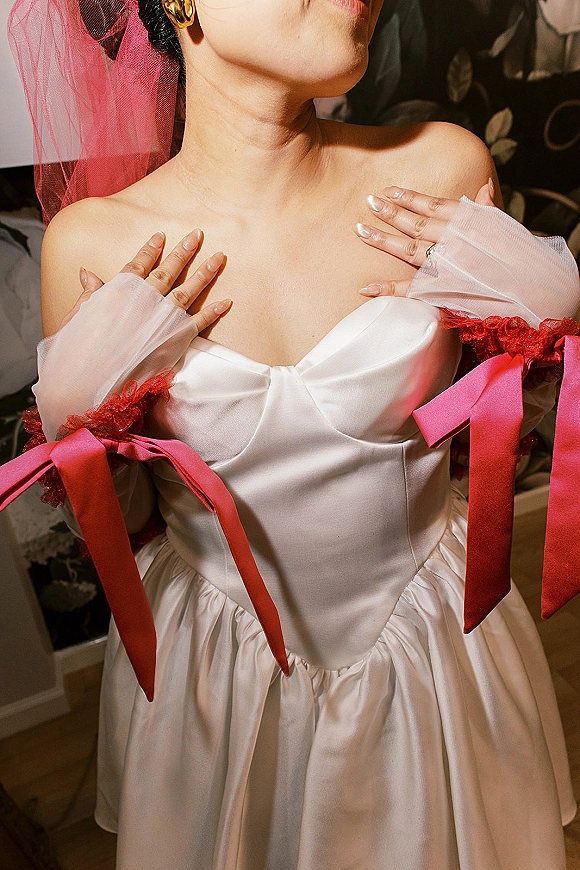
Two-tone gowns solve a specific problem: wanting color without giving up a white wedding dress. Four constructions cover nearly everything brides actually wear. A white gown with a burgundy sash or belt is the lightest touch and the only fully reversible one. Burgundy lace appliqué over an ivory base puts the color in the pattern instead of the ground, so it reads as detail rather than as a colored dress. An ombré skirt runs white at the bodice into wine at the hem. And a burgundy underlay beneath white lace tints the entire silhouette without printing on it.
The underlay version is the one most brides underestimate. Because the color sits beneath the lace rather than in it, the intensity changes with the light through the day, and the same gown photographs pale at an afternoon ceremony and deep wine by the time the dancing starts.
Sash and appliqué versions also solve the family-expectation problem more cleanly than a full burgundy gown does. The dress is still white in every photograph a grandmother will look at, and the color is unmistakably a choice rather than a compromise.
Black and Burgundy Wedding Dresses
Black and burgundy is the darkest combination in bridal, and it needs contrast in texture to avoid collapsing into a single mass in photographs. Matte black lace over burgundy satin works because the two fabrics catch light differently.
Keep one of the two dominant. A burgundy gown with black lace detailing stays recognizably a color dress; a black gown with a burgundy underskirt or veil is a black dress with warmth in it. Splitting the difference at fifty-fifty is the version that tends to disappoint in photos. For the fuller treatment of that pairing, the black and red wedding dress looks cover where the contrast runs brighter.
Velvet, Satin, Lace, and Crepe: How Fabric Changes Burgundy
Fabric changes burgundy more than silhouette does. Velvet absorbs light instead of reflecting it, which pushes the color to its deepest and richest point and makes it the strongest choice for winter and candlelit evening ceremonies. Silk satin and mikado do the opposite: they bounce light off every curve, so the gown shifts between near-black in the folds and bright wine on the highlights. Lace over a burgundy lining is the softest reading of the color, breaking it into pattern rather than presenting it as a solid field. Crepe holds burgundy completely flat and matte, which suits a modern column but gives the color nothing to do. Chiffon and tulle lighten it toward merlot through sheer layering.
Weight matters as much as sheen. A velvet gown in a September ceremony in Texas is a different decision than the same gown in November in Chicago, and burgundy's association with autumn tempts brides into velvet regardless of climate. Satin and mikado carry the same depth at a fraction of the thermal load.
Designers render the same shade in noticeably different ways across these fabrics, and comparing them side by side is the only reliable way to choose. The wedding dress designers in our directory list which ones produce colored gowns rather than ivory-only lines.
Silhouettes for a Burgundy Bridal Gown
Deep color reads slimming the way a dark neutral does, so silhouette choice opens up rather than narrows with burgundy.
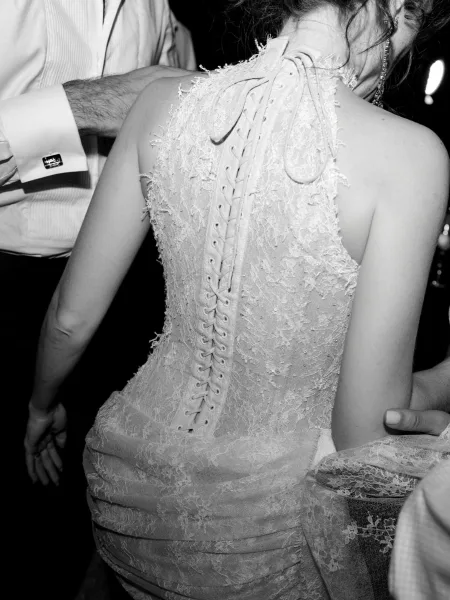
Fitted shapes gain drama and volume gains richness. A mermaid or trumpet in burgundy satin is the most dramatic version, because the shine tracks the body line the whole way down. A ball gown turns the color ceremonial and is the right choice for a formal or black-tie evening. A column in crepe or matte satin is the modern reading. An A-line sits in the middle and is the most forgiving across body types and venues. A corset bodice in burgundy is worth trying on even if you ruled it out in ivory, since the structure that can look severe in white looks intentional in a deep shade.
Plus Size Burgundy Wedding Dresses
Colored bridal gowns are more often made-to-order than ivory ones, which is an advantage rather than an obstacle at extended sizes. A made-to-order burgundy gown is cut to measurements from the start instead of being graded up from a sample and then altered, and it usually arrives closer to a finished fit than a sample-size gown ever gets to. Sample-size bridal stock tops out well below where most extended-size brides actually shop, so the try-on problem and the fit problem tend to be the same problem.
Fabric choice does the rest. Structured satin and mikado hold a clean line and respond well to precise fitting, though they show every construction decision. Velvet is forgiving through the body but adds visual weight, which is worth accounting for when the color is already this deep. Lace over a burgundy lining gives the most flexibility, since seam placement can be hidden in the pattern.
Build in more time than a white gown needs. Colored fabric has to be sourced in a matched dye lot before construction starts, and a mismatched lot discovered late is not a fixable alteration.
How Much Does a Burgundy Wedding Dress Cost?
A burgundy wedding dress costs what a white one costs at the same tier. Dye is not the price driver; fabric and construction are. What changes with burgundy is where you can buy one, because the mainstream bridal middle does not stock the color at all.
The market has a hole in it, and that hole explains why shopping for burgundy feels strange. At the online end, Alinanova lists 129 burgundy bridal gowns between $210 and $598, with most sitting around $240 to $300. Independent makers on Etsy run roughly $140 to $730 for a finished gown and climb past $2,500 for gothic and heavily customized work. Viniodress prices its burgundy bridal styles between $913 and $1,061. Then the trail goes cold. David's Bridal and Azazie both carry burgundy across their bridesmaid and prom lines, and neither runs a burgundy bridal collection.
So the salon route is a sourcing question rather than a pricing one. A burgundy gown from a salon is usually a special order against a designer whose published line is ivory, which means the price follows that designer's standard band and not a color premium: roughly $1,295 to $3,600 in the mid-market, and $2,000 to $9,000 at designer level. Our average wedding dress cost breakdown sets out how those bands are built and what sits inside each one.
Two costs do rise on a colored gown. A custom dye lot is quoted as a special order and adds weeks before construction begins. And alterations on velvet or heavy satin take more hours than the same work on tulle or chiffon, which is a labor line worth setting before you fall for a fabric.
When a Burgundy Wedding Dress Works: Season and Ceremony
Autumn and winter are burgundy's natural home, and evening is its natural hour. The color needs low light to do its best work, because depth is the whole point and bright midday sun flattens it toward brown. A candlelit reception, a black-tie evening, a November ceremony, a vineyard in harvest season: all of these give burgundy something to play against. A noon garden ceremony in July does not.
Ceremony context is the other question, and it comes up more than most bridal sites acknowledge. Burgundy is generally accepted at most Christian and civil ceremonies, and it carries genuine auspicious meaning in Chinese and Indian wedding traditions, where red is the traditional bridal color rather than a departure from one. Where it does raise questions is at more traditional or conservative congregations, and the answer there is a conversation with your officiant rather than a rule.
Building a Wedding Palette Around Burgundy
A burgundy gown sets the palette whether or not you plan it to, so the wider scheme is worth deciding early. Burgundy with gold and ivory is the warm, ceremonial version. With deep green and plum it turns jewel-toned. With blush and dusty rose it softens considerably. Decide before stationery and florals are ordered, because those are the two lines where a palette change stops being a preference and starts being a reprint and a re-source.
Weddings in the Carats & Cake dataset carry a median of three color tags, which is the correction most worth making here. Burgundy almost never runs alone in practice, and treating it as the single color of a wedding is the most common way a rich palette turns heavy. Give it two companions and it holds.
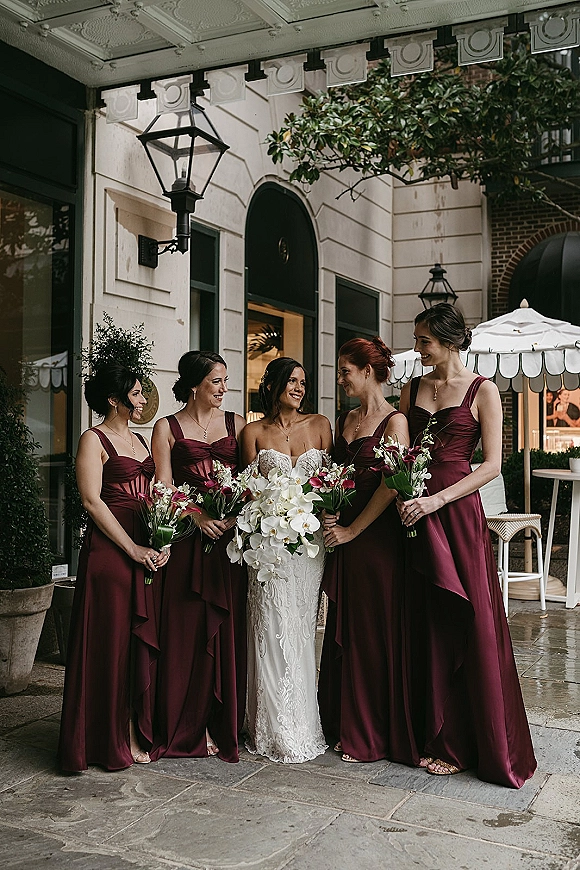
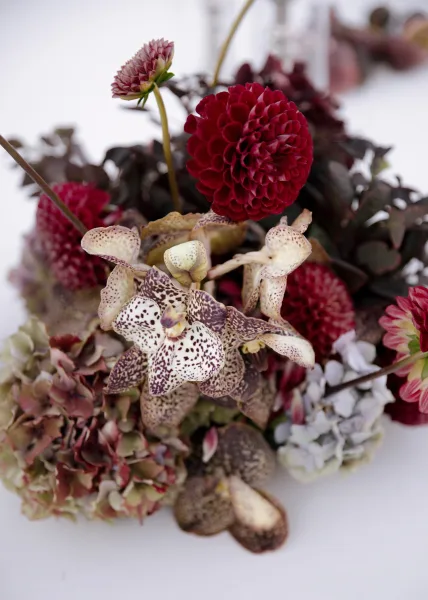
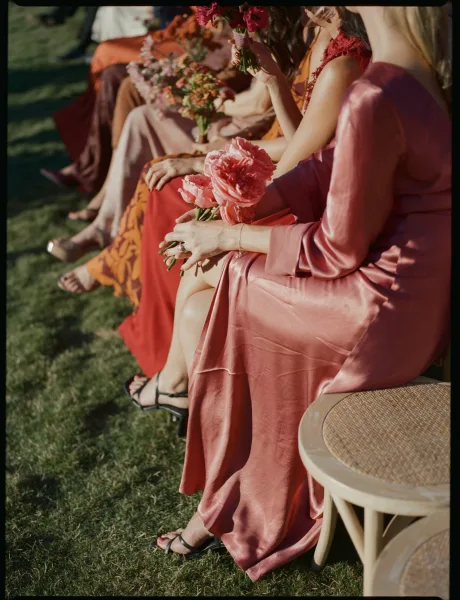
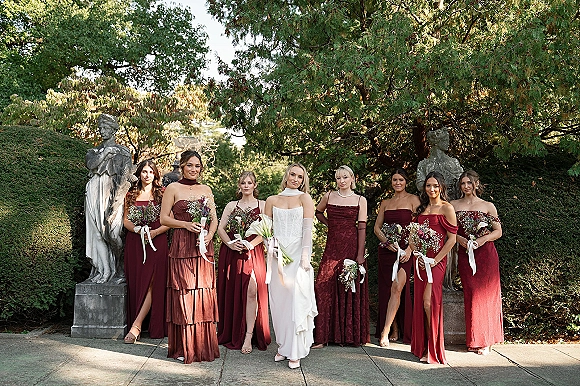
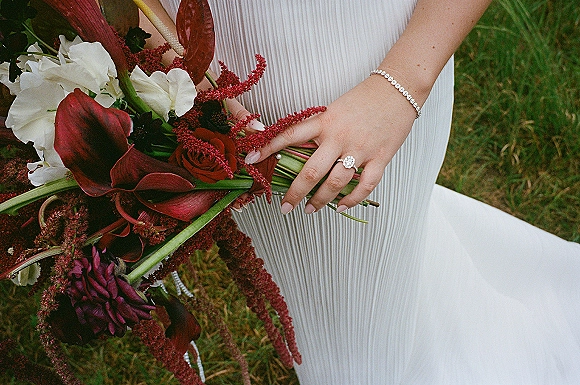
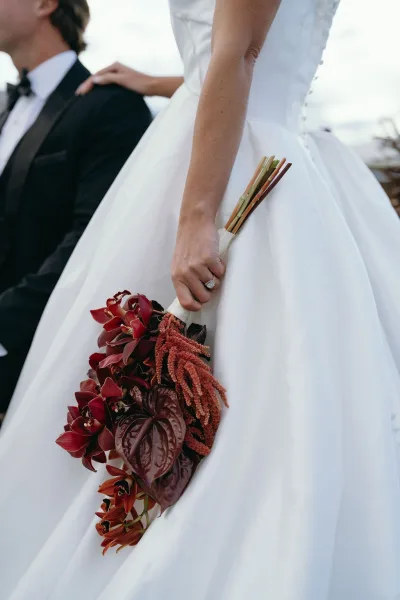
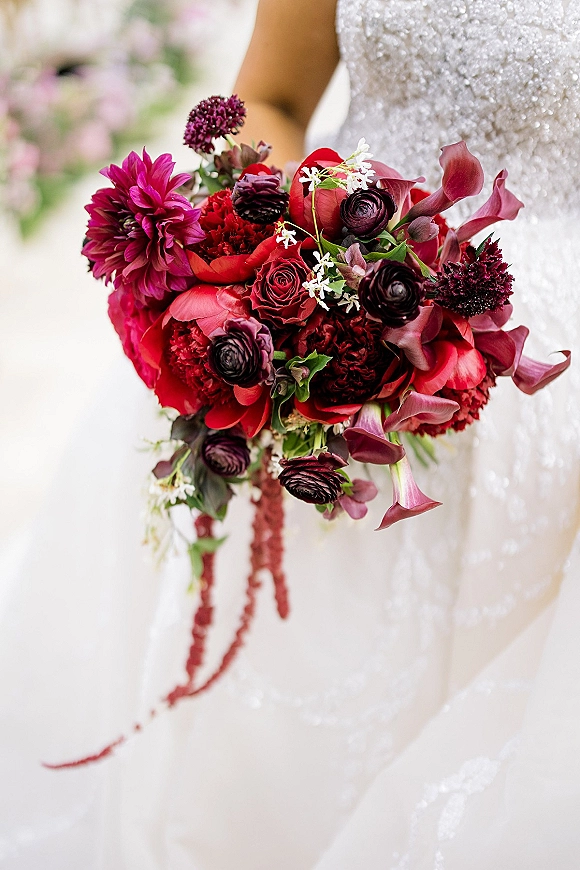
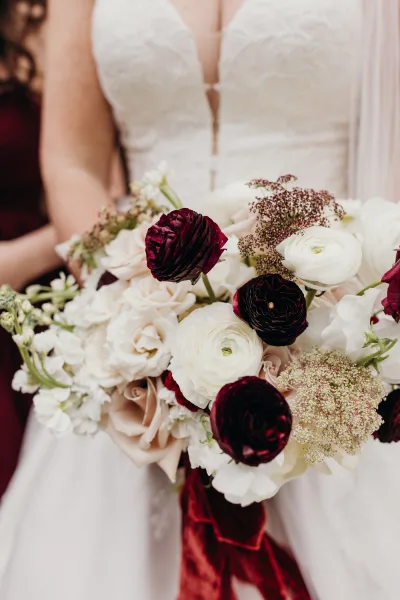
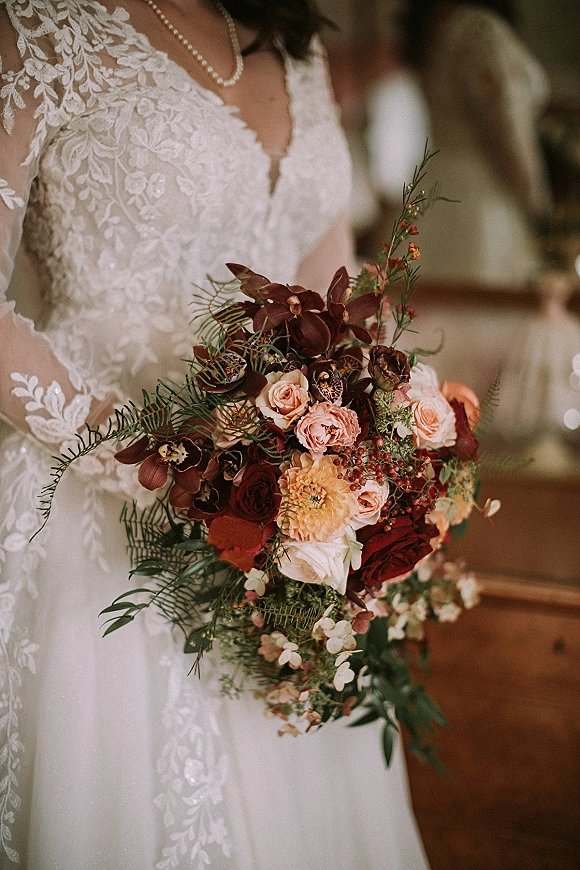
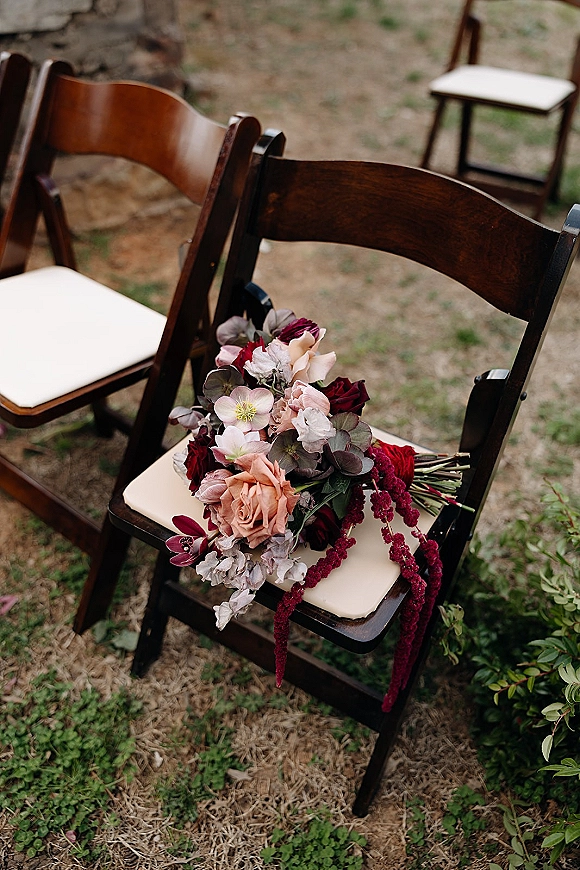
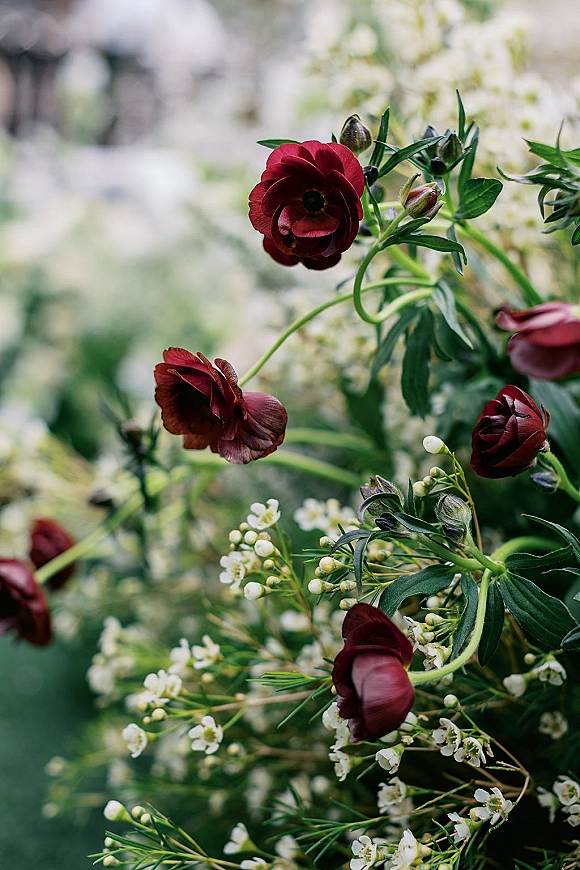
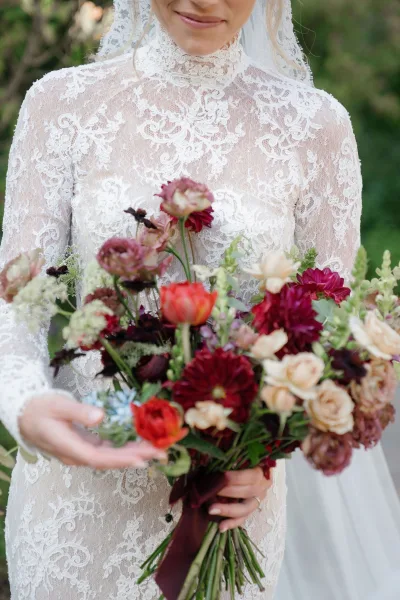
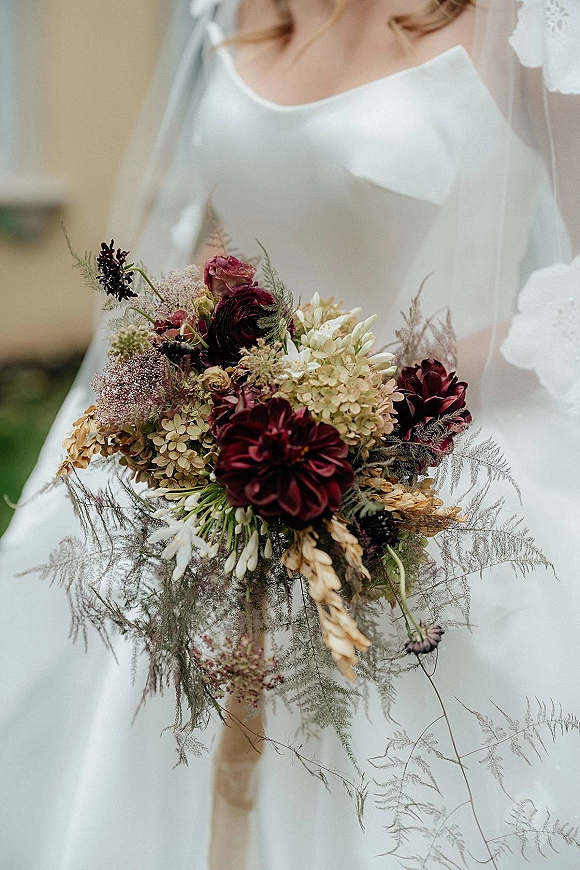
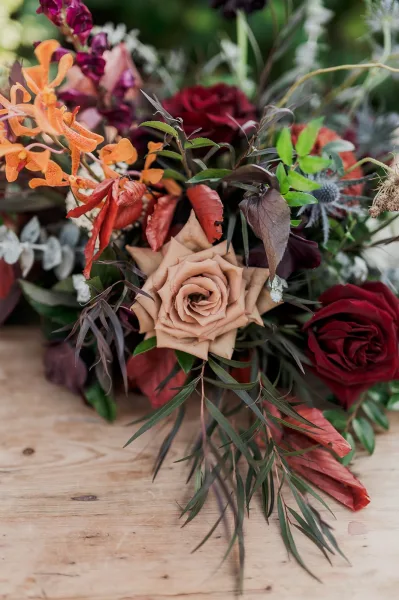
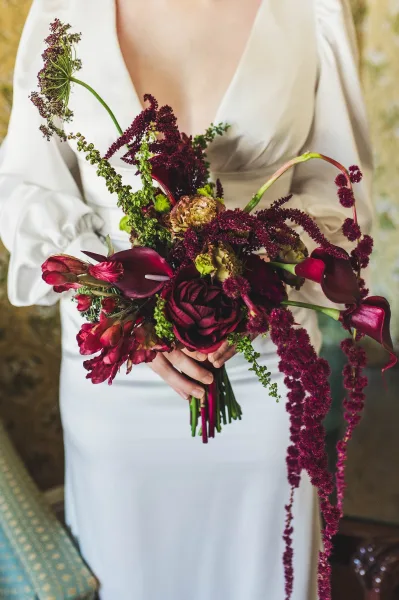
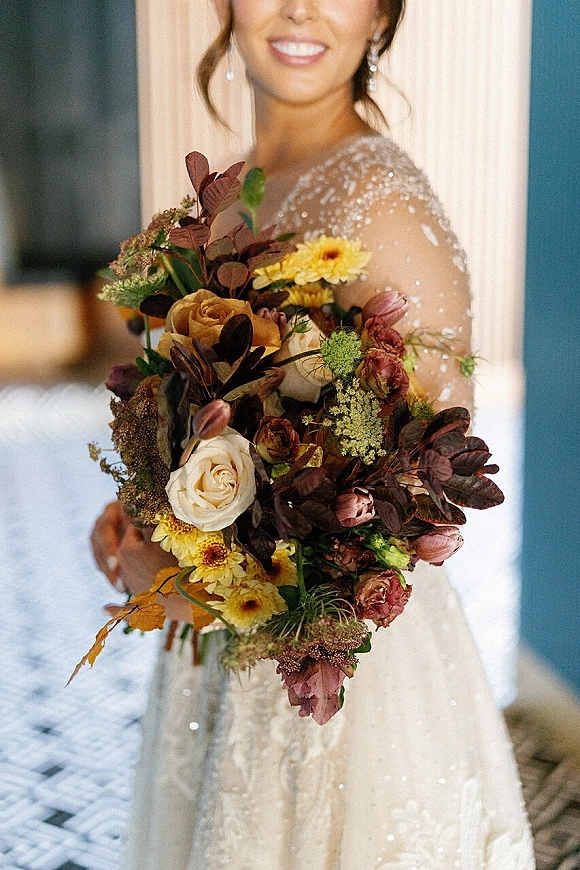
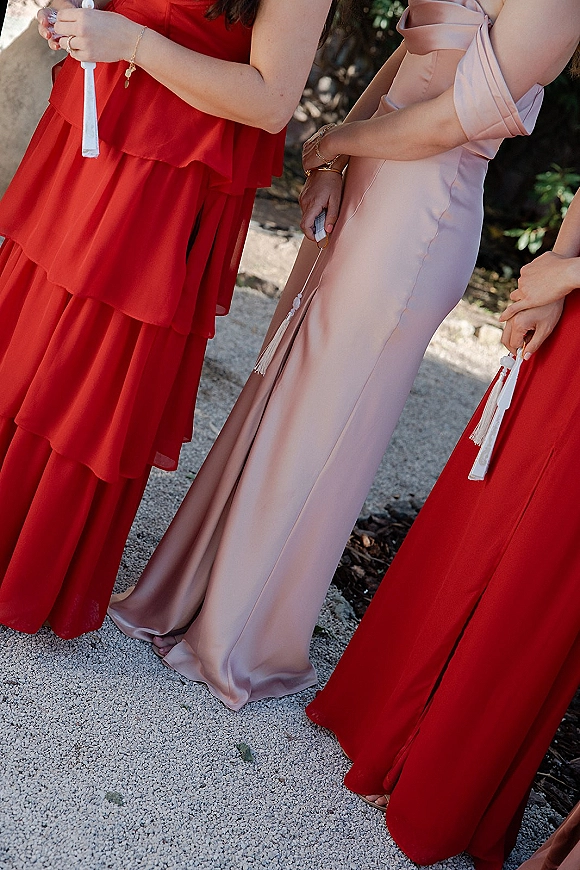
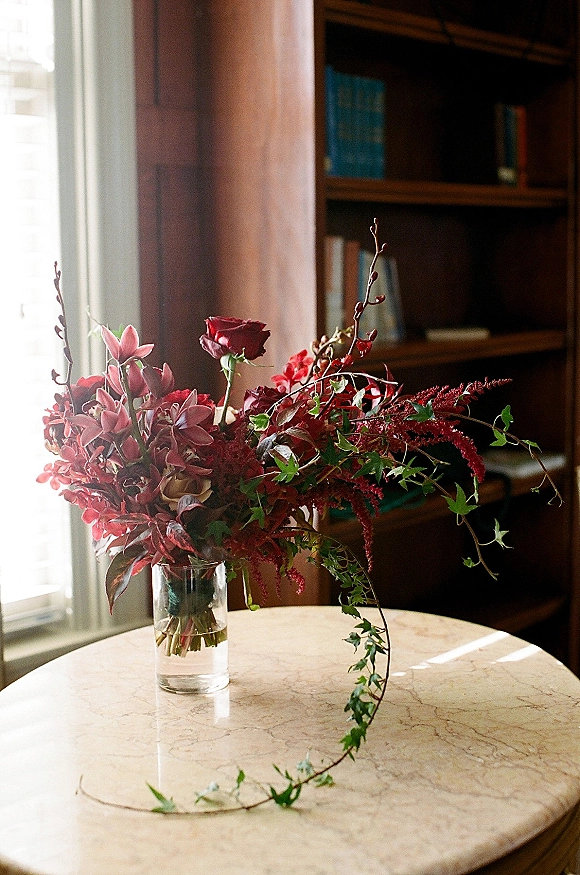
For the wedding party, burgundy bridesmaid dresses in a slightly lighter merlot keep the party cohesive while leaving the bride distinct, which works better than matching the gown exactly. Florals follow the same principle: autumn bouquets built on dahlias and copper foliage pick up the gown's warmth without repeating its exact tone.
Frequently Asked Questions
What color is burgundy?
Burgundy is a deep wine red, made by darkening red with brown and a small amount of purple. It is named for the red wines of the Burgundy region of France. The depth lets it function almost as a dark neutral while keeping red's warmth.
Is burgundy the same as maroon?
No. Maroon carries more brown and less purple than burgundy, which makes it flatter and earthier. Burgundy holds more of red's richness and reads more formal. Retailers use the two names interchangeably, so order swatches rather than trusting a product listing.
Can a bride wear burgundy to a church or traditional ceremony?
Burgundy is generally accepted at most Christian and civil ceremonies, and red is the traditional bridal color in Chinese and Indian weddings. More conservative congregations vary. Ask your officiant directly rather than assuming, and ask before ordering.
What season is a burgundy wedding dress best for?
Autumn and winter, and evening in any season. Burgundy's depth needs low light to show, and bright midday sun flattens it toward brown. For a spring or summer wedding, a lighter merlot in chiffon or tulle holds up better than a deep oxblood in velvet.
What shoes and jewelry go with a burgundy wedding dress?
Gold and champagne metallics warm burgundy and are the most common pairing. Nude and metallic shoes lengthen the leg line better than black. Silver and crystal give a cooler contrast that suits wine and plum-leaning shades more than brick-leaning ones.
Do burgundy wedding dresses come in plus sizes?
Yes, and colored gowns are more often made-to-order than ivory ones, which usually means a better fit at extended sizes. Allow extra lead time. Colored fabric must be sourced in a matched dye lot before construction begins.