Who Wears an Emerald Green Wedding Dress
Three different people search this phrase and only one of them is the bride. Emerald is a wedding-party color first, so the search fills with attendants and guests who left the word guest out of it.
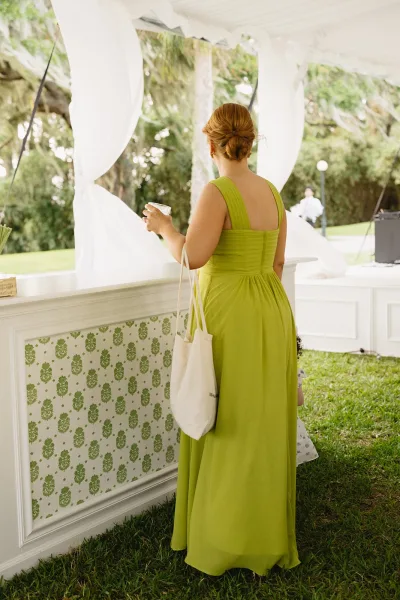
If you are shopping for something to wear to someone else's wedding, search wedding guest dresses rather than wedding dresses. The inventory sits in a different part of every retailer's site, and the length and coverage conventions are different. Attendants have it easiest, since emerald green bridesmaid dresses are one of the deepest categories in the industry.
For the bride, emerald is the deepest and most formal green available, and the hardest to actually buy. Bridal salons do not stock it, so nearly every emerald gown is made to order or dyed. The rest of this page is about that gown.
Emerald Green vs. Forest, Hunter, Jade, and Sage
Emerald is the green that reads as a gemstone rather than as a plant. It carries a blue undertone that keeps it cold and clear, and enough depth that it holds its color when the light drops. Across a room it is unmistakably a color; forest and hunter at the same distance both collapse toward black. That coldness is the whole character of the shade, and it is what separates emerald from every warmer green in the family.
The reference values put emerald at #50C878, forest at #228B22, hunter at #1B4332, jade at #00A86B, kelly at #4CBB17, and sage at #8FBC8F. What arrives rarely matches. Sellers use emerald as a catch-all for the entire deep-green end of the range, and the gown that shows up usually lands closer to hunter than to the reference. The word alone gives a maker nothing to work from.
Sage runs the opposite direction and is the shade most often confused with emerald in a planning document, despite being pale, grey-cast, and warm. The two do not photograph alike and cannot be substituted. Sage is also the shade with real bridal supply behind it, which is why a sage green wedding dress is far easier to find in a salon. If you want the whole spectrum before you commit, the green wedding dress collection runs from mint through forest.
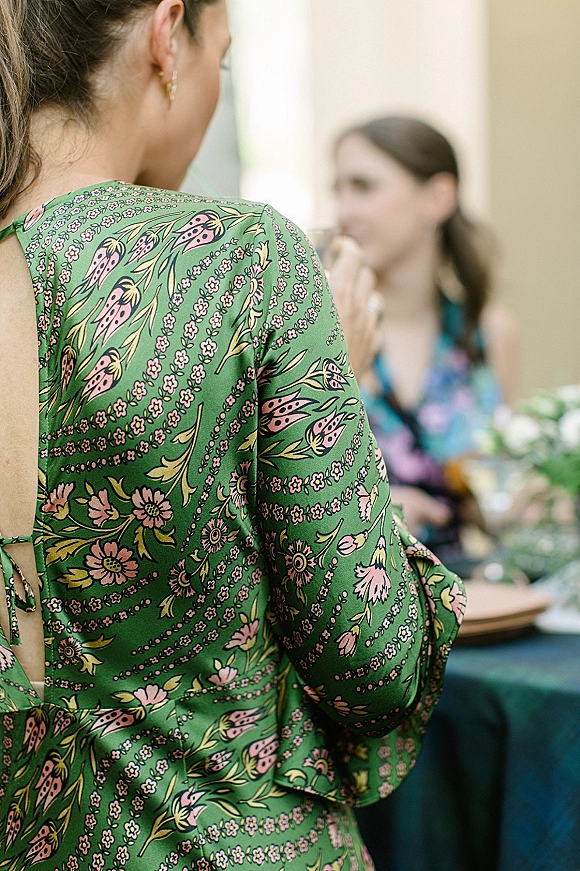
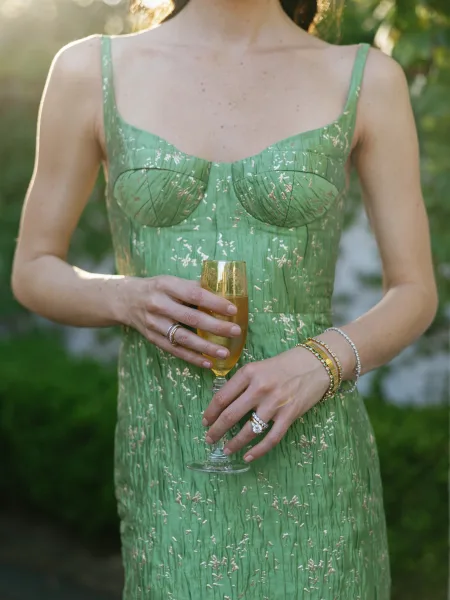
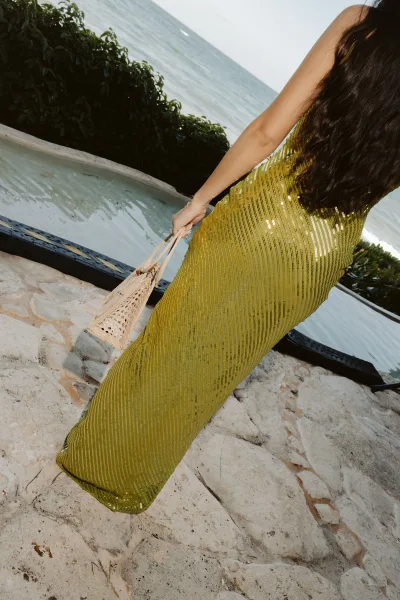
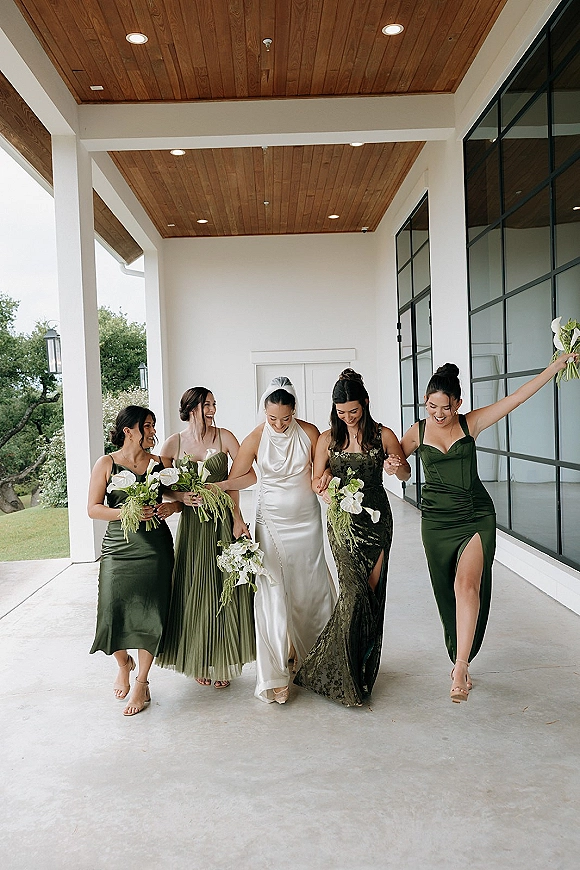
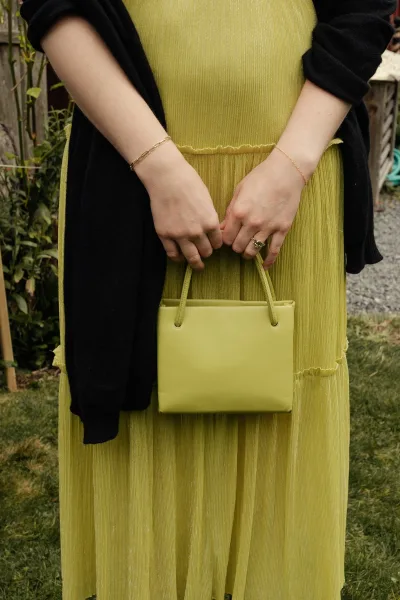
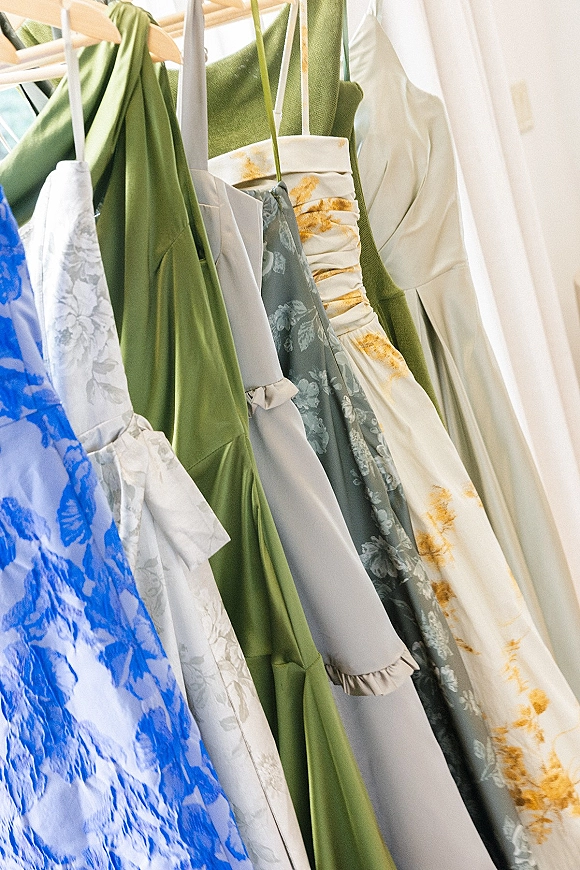
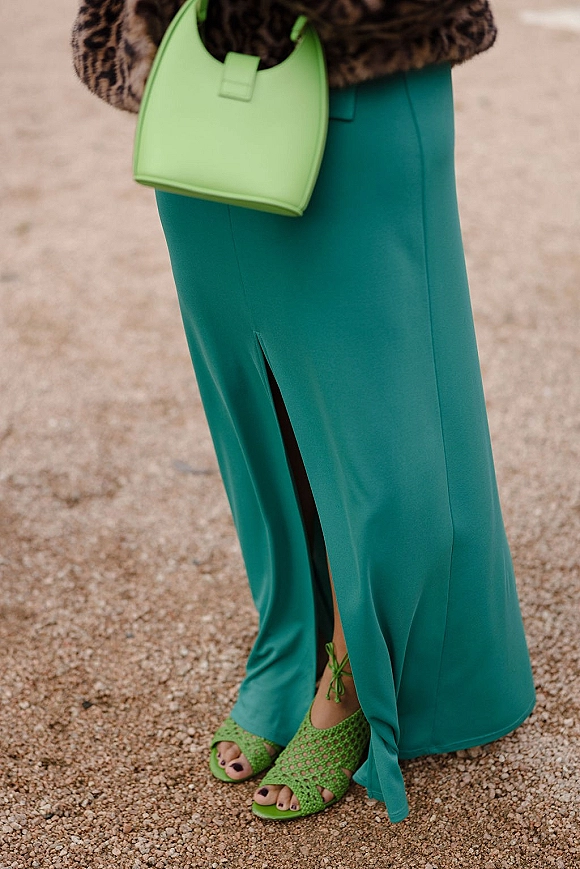
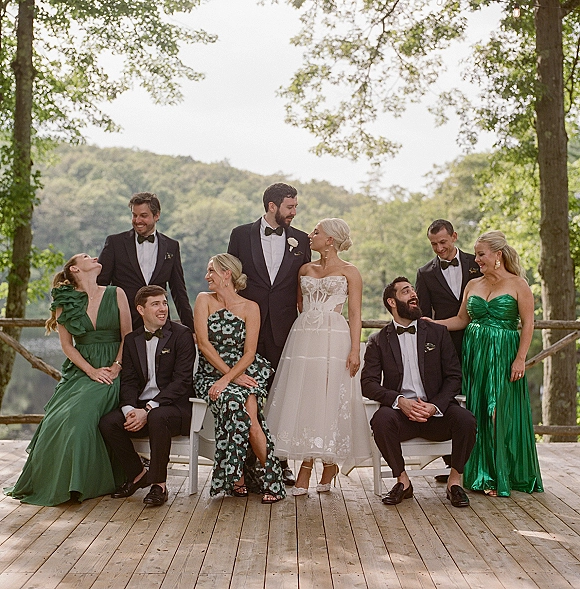
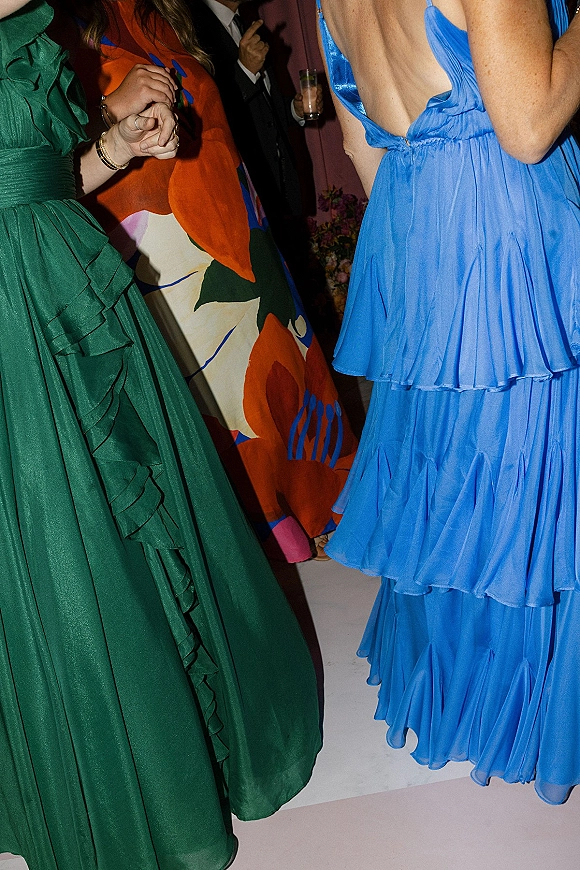
Watch where the green sits in the gowns below, and how much of each dress it actually covers. Placement changes the weight of the color more than the shade name does.
Satin, Velvet, Tulle, and Lace: How Fabric Changes Emerald
Fabric does more to emerald than silhouette does. Duchess satin and mikado throw hard highlights, so the gown swings between near-black in the folds and almost lit on the curves, and it moves in sheets, not ripples. Velvet absorbs light instead of returning it, holding one even depth from every angle, and the pile shifts a full tone lighter where a hand or a seat has brushed it against the nap. Crepe keeps emerald matte and modern, so the dress reads as a single flat plane at any distance.
Sheer fabrics lift it. Tulle and organza over an emerald lining read several steps paler than the swatch, closer to a soft jade, and the intensity climbs with every added layer. Lace over an emerald underlay breaks the color into pattern rather than presenting it as a field: from across a room it registers as shadow in the lacework, and up close the green resolves through the open ground of the motif and along the scalloped edge.
If you want one recommendation instead of four, order emerald in velvet. Saturated color at this level tends to read as evening wear, and velvet is the one fabric with enough bridal history and enough optical depth to read as a gown instead. It also flatters more bodies than satin does, because it absorbs the light that satin uses to trace every line underneath. The trade-off is real. Velvet is a cold-weather fabric, it crushes wherever you sit, and it photographs heavier than it looks in the mirror. If your wedding is in July, order satin instead.
Emerald Green and White Wedding Dresses
Two-tone is how most brides actually wear this color, and the constructions are not interchangeable. An emerald underlay beneath white lace is the quietest version and the one that changes most as you move: shadow in the lacework from a distance, clear green up close through the open pattern. A green-embroidered bodice on an ivory skirt puts the color at eye level and keeps it there, which photographs well seated. An emerald sash reads as a single decisive line and nothing more. A full emerald train falling from a white gown is the most dramatic option, because the color only appears when you turn.
Scale is what separates the versions that work from the ones that disappear. Thin piping and narrow edging vanish beyond the first row of guests; anything meant to be seen from the back of a room needs to be a panel or a full train. Two-tone is also the version mainstream bridal will actually make, since a colored detail on a white gown is a construction most salons already handle and a fully colored gown is not. Ask before you conclude the color is out of reach.
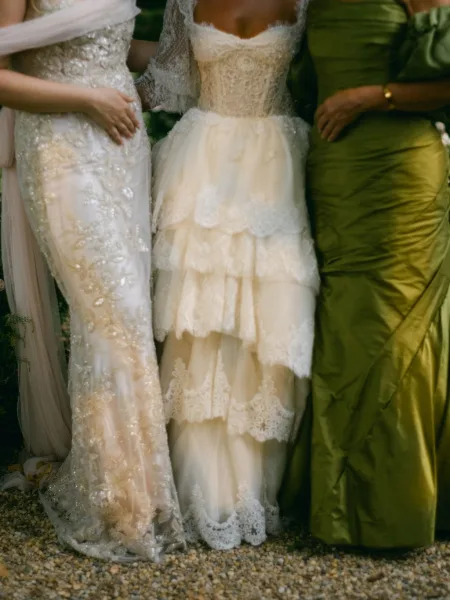
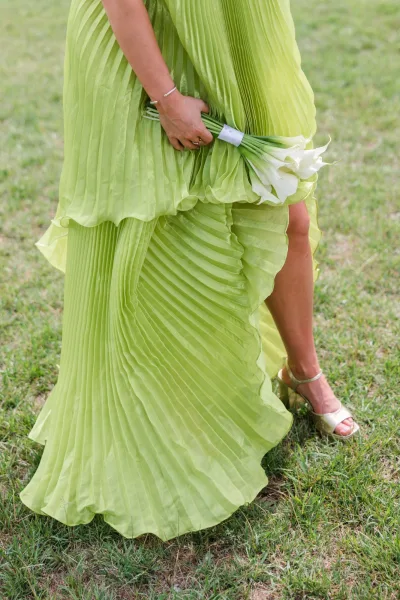
Look at how much of each gown below is actually green, and where the eye lands first.
How Much an Emerald Green Wedding Dress Costs
Most emerald gowns run $90 to $350, because they come from made-to-order online specialists rather than salons. A custom commission from a bridal designer runs closer to $2,500, and that is the realistic route to emerald in silk rather than polyester satin. Nothing much exists in between.
That gap matters more than either number. The $1,200 to $2,500 salon tier where most brides shop barely carries this color at all, so the constraint is channel rather than price. The mainstream benchmarks in our guide to what wedding dresses cost are worth reading alongside these.
Dyeing a gown you already own is the fourth route, and the one to take if you have found the right dress in the wrong color. Send it to the dye lab before you have it altered, because dyeing shrinks some fabrics and every seam moves. Nylon tulle and some silks take color best; a heavily structured gown with fused interfacing takes it worst.
Build in the time. Made-to-order production runs three to five weeks plus shipping, and most sellers do not include tailoring in that estimate. A commission runs twelve to fourteen weeks before alterations start. Order six months out, not three.
What to Ask Before You Order an Emerald Green Wedding Dress
Five questions, and none of them are about the dress you can see in the photograph. Ask what color the lining is, because an ivory lining under emerald reads as a pale ghost at every hem and armhole. Ask whether the color is in the fabric or in an overlay, since an overlay can be adjusted later and a dyed base cannot. Both answers change what your alterations person is able to fix later.
Ask for a swatch cut from your own dye lot rather than a reference card. Colored bridal fabric varies far more between lots than ivory does, and the reference swatch was cut from a run that no longer exists. Ask whether production time includes tailoring, because it usually does not and that is the single most common reason a colored gown arrives late.
Then ask the question nobody thinks of until the last fitting: does your alterations person work in color, and will they source matching thread. Most bridal alterations rooms stock white and ivory in quantity and almost nothing else. Emerald topstitching done in off-white is visible from across a room, and it is discovered at the final fitting when there is no time to redo it.
What Goes Wrong With an Emerald Green Wedding Dress
The failures are all things ivory hides and saturated dye does not. Construction shows: seam allowances shadow darker than the face fabric, boning channels read as vertical lines under a bright dye, and interfacing cut proud of the seam telegraphs through. Look for it in daylight at your second fitting, not in shop lighting.
Undergarments are the second problem, and the fix is counterintuitive. Nude and white both show through emerald; the shade that disappears is one matched to the dress, not to your skin. Order it at the same time as the gown, from the same maker if they will do it.
Marks are the third. Deodorant marks and water spotting from a steamer both show far more on dark saturated fabric than on ivory, and a dark gown cannot be spot-cleaned discreetly on the day. Have the steaming done well in advance, keep a dark cloth rather than a white one in the emergency kit, and dress after your makeup is fully set.
How an Emerald Green Wedding Dress Photographs
Emerald holds its color better than most saturated shades, but the room still moves it. Warm tungsten and gold ballroom fixtures push it toward olive and drain the blue that made you choose it. Open shade renders it most faithfully of all.
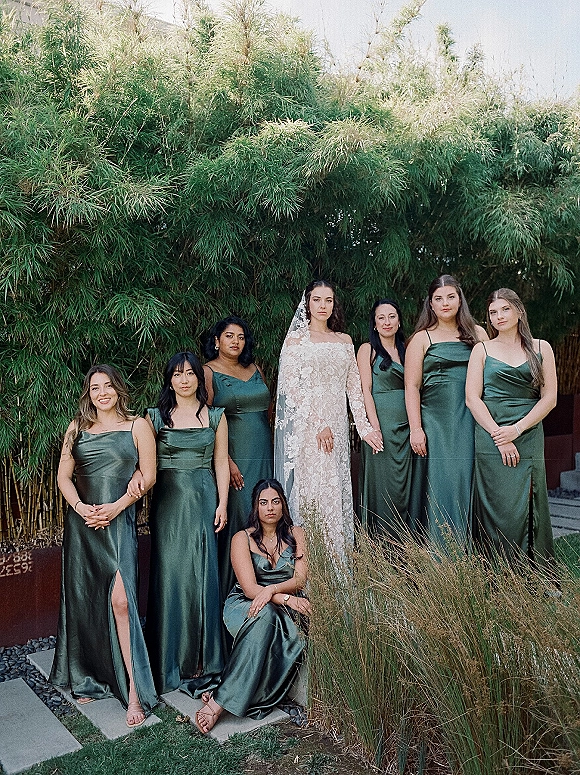
Greenery is the real problem and it catches people out. An emerald gown in front of a hedge or a wall of foliage merges into the background instead of standing against it, which is a genuine constraint at garden and estate venues. Ask your photographer for stone, pale walls, water, or dark timber instead of lawn. Emerald sits opposite red on the wheel, so it holds up beautifully against warm wood, brass, terracotta, and candlelight.
Deep colors lose shadow detail. In a dim reception the folds of an emerald skirt crush to black on camera, and the gown that looked dimensional at noon flattens by the time the dancing starts. A photographer who knows it is coming will light for the dress; one who finds out in the edit will not.
Is It Bad Luck to Wear a Green Wedding Dress?
No, though someone in your family may raise it before the day. The traditional English rhyme on dress colors runs "Married in green, ashamed to be seen," and Irish folklore treats the color as belonging to the fairies and unlucky on a bride. Neither tradition has standing in a modern wedding, and the rhyme condemns most of the spectrum anyway.
Green gowns run through centuries of bridal portraiture. The useful thing is knowing the line exists before someone recites it at a fitting, and hearing it as trivia rather than as a verdict.
Emerald Green with Gold, Black, and White Wedding Palettes
Gold is the strongest pairing, because warm metal against cold green is a true complementary contrast that survives the ballroom light emerald otherwise fights.
Polished yellow gold reads the most traditional; brass and antique gold go warmer and quieter. Black and emerald is the sharpest version and the most modern, which is why the pairing has a following among brides planning gothic and black-tie weddings. If that is where you are heading, the black and green wedding dress collection is a closer match to what you are picturing.
White and ivory are what most emerald weddings actually run, because they give the eye somewhere to rest and keep the palette from turning heavy. Silver and platinum go cool and wintry, which suits velvet. Blush is the quiet surprise, softening emerald in a way gold never does.
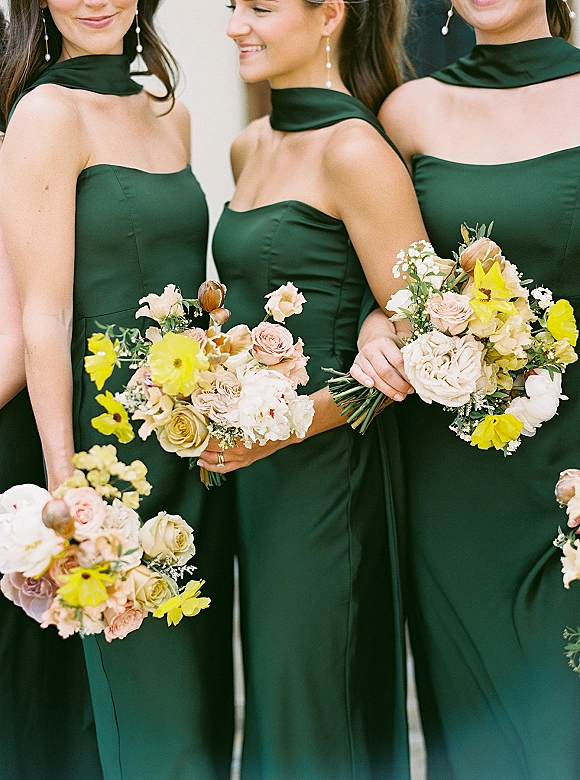
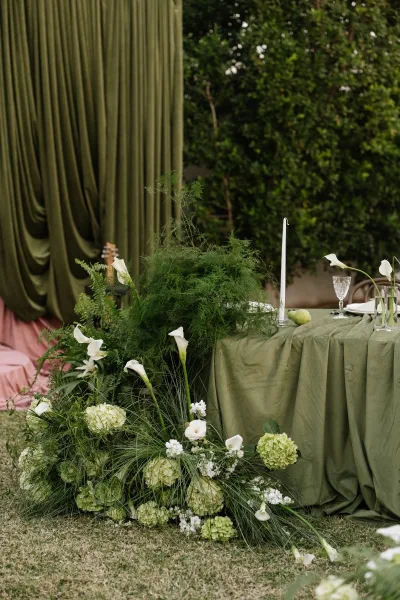
For flowers, contrast beats coordination. A white bouquet with structural foliage stands clear of an emerald gown at any distance, while a green-on-green bouquet vanishes into it. If your florals lean heavily on wedding greenery, that is an argument for a paler gown or a two-tone one.
Dressing the Wedding Party Around an Emerald Gown
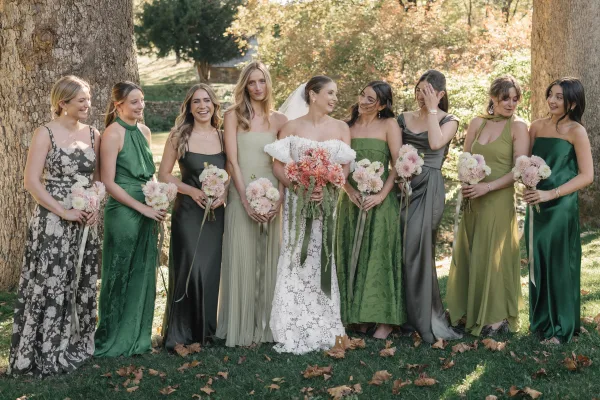
Wearing emerald changes what your attendants can wear, and the usual instinct is wrong. Matching them to the gown produces a wall of identical green in every group photograph.
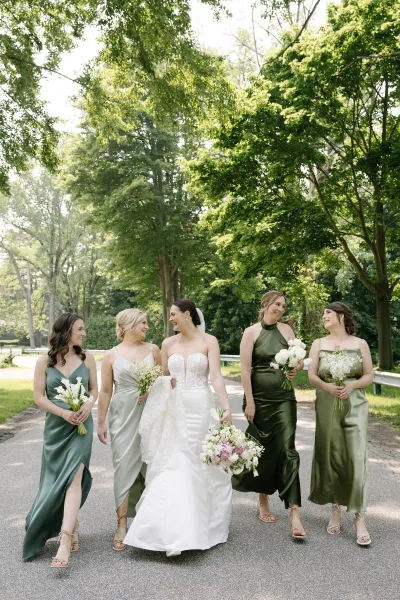
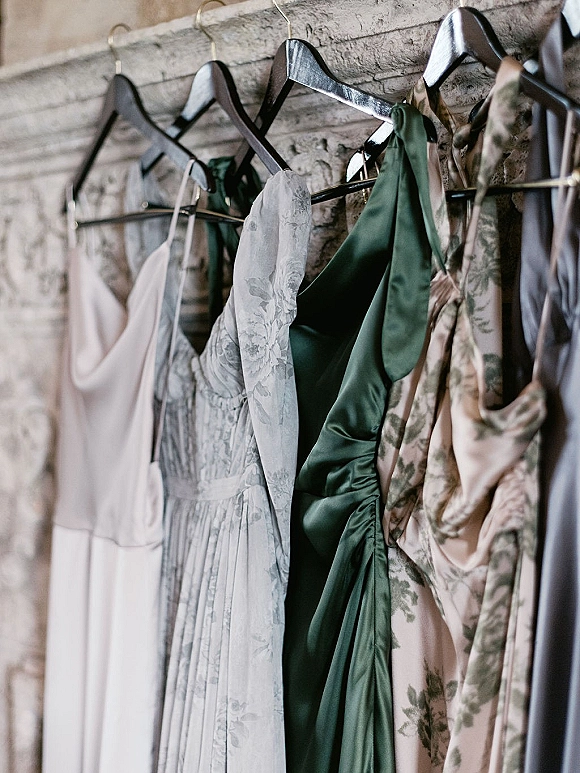
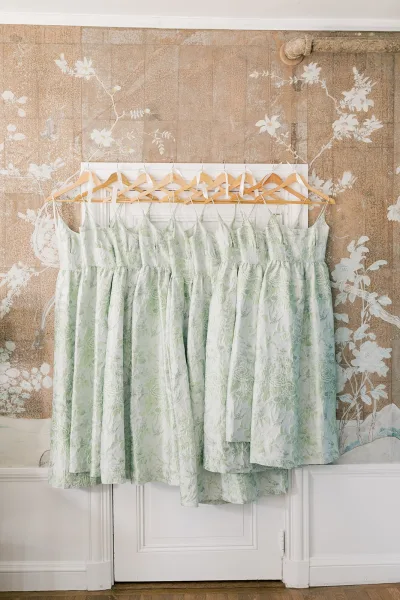
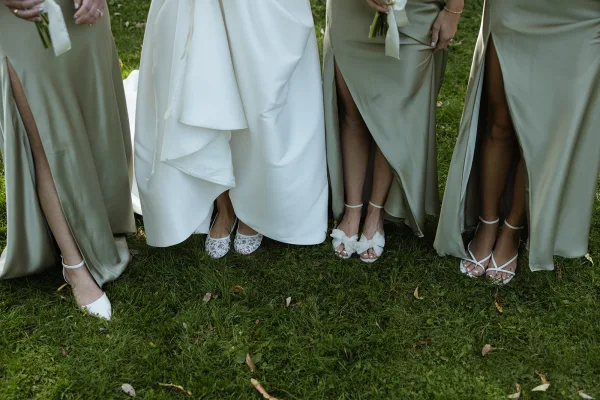
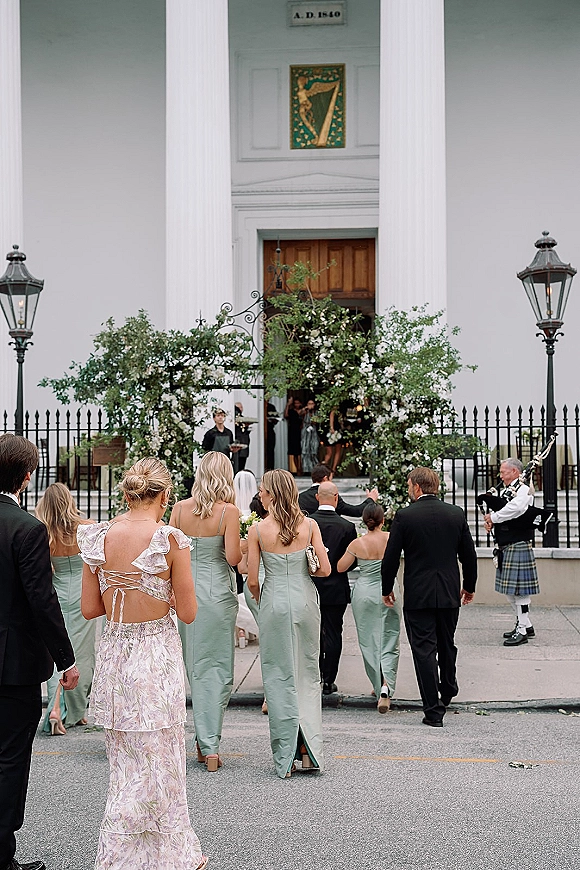
Three approaches work. Drop the party a full step in value, to sage or olive, so the palette stays green and you remain the deepest point in it. Move them to a neutral, since champagne behind emerald reads as deliberate rather than as a miss. Or graduate the green across the party, which is the most forgiving option because no two suppliers dye emerald alike in the first place.
Order every swatch before anything else. A bridal maker's emerald and a bridesmaid label's emerald can be visibly different colors in the same photograph. The gown is the anchor, so match everything to it rather than the reverse. If the party stays in the green family, sage green bridesmaid dresses sit at the pale end of that decision, and most bridesmaid labels will send swatches free.
Emerald Green as a Reception Dress or Second Look
Plenty of brides who want emerald never wear it for the ceremony. They save it for the reception.
The logic holds up. A ceremony gown is photographed in daylight, watched by every relative with an opinion, and worn for ninety minutes. A reception dress lives under warm indoor light for the rest of the night, which is where a shorter, sharper emerald silhouette outperforms a train. It also takes the risk out of a decision you make months before you can feel it. Real second looks tend to be bolder than first ones for that reason.
Budget accordingly. An emerald reception dress can come from evening wear rather than bridal, which is where this color is abundant and cheap.
What to Wear With an Emerald Green Wedding Dress
Metallics beat color for every accessory. Champagne and antique gold shoes warm emerald and keep the look classic; silver and pewter keep it cool and contemporary; nude lengthens the leg without competing. Matching your shoes to the gown is the one choice that consistently disappoints, since two makers' emeralds rarely agree and a near-miss reads as an error in a way a deliberate contrast never does.
Jewelry follows the same logic. Pearls and clear crystal read bridal against emerald and hold their brightness in a dim room. Actual emeralds and other green stones disappear into the gown rather than registering as jewelry, which is the most common styling mistake with this color. Keep metals to one register rather than mixing warm and cool in the same look.
An ivory or soft white veil over emerald creates a haze at the edges of the color that photographs beautifully, while a matching green veil flattens it entirely. When you are ready to find out what is achievable in your size and timeline, wedding dress designers who take custom color orders are the fastest place to start.
Frequently Asked Questions
Can a bride wear an emerald green wedding dress?
Yes. No etiquette rule requires a white wedding dress, and colored bridal gowns have a long history across cultures and centuries. Emerald is uncommon rather than improper, and the constraint is inventory rather than tradition. Expect to shop made-to-order or custom rather than off a salon rack.
Is an emerald green wedding dress for the bride or for guests?
Both phrases share a search term, but they are different products. A bride's emerald gown is bridal construction in bridal sizing and is sold almost exclusively made-to-order. An emerald wedding guest dress is cocktail or evening wear, widely stocked and far cheaper.
What is the difference between emerald green and forest green?
Emerald carries a blue undertone that keeps it cold and clear; forest is warmer and more yellow and reads as a natural tone rather than a gemstone. Emerald keeps its brightness when the light drops; forest goes nearly black indoors. Reference values put emerald at #50C878 and forest at #228B22.
Is it bad luck to wear a green wedding dress?
No. The English rhyme "Married in green, ashamed to be seen" and the Irish belief that green belongs to the fairies are folk traditions rather than rules. Neither has standing in a modern wedding, and green gowns appear throughout historical bridal portraiture.
How much does an emerald green wedding dress cost?
Most made-to-order emerald gowns run $90 to $350. A custom commission from a bridal designer runs closer to $2,500, and dyeing a gown you already own sits between the two. Almost nothing exists in the $1,200 to $2,500 salon range where most brides shop.
What fabric is best for an emerald green wedding dress?
Velvet, for a cold-weather wedding. It has the bridal history and the optical depth to read as a gown rather than evening wear, and it absorbs the light satin uses to trace every line underneath. For warm weather, order satin instead and accept that it shows more.
What color shoes go with an emerald green wedding dress?
Metallics work best. Champagne and antique gold warm the green and keep the look traditional, while silver and pewter keep it cool and modern. Nude lengthens the leg without competing. Avoid matching your shoes to the gown, since emeralds from different makers rarely agree.
What flowers go with an emerald green wedding dress?
White and cream flowers with structural foliage hold the clearest contrast against emerald from across a room. Deep burgundy and warm rust also read strongly. Green-toned bouquets and heavy eucalyptus disappear into the gown rather than complementing it.
How long does it take to order an emerald green wedding dress?
Plan on four to six months. Made-to-order production runs three to five weeks plus shipping, and most sellers exclude tailoring from that estimate. A custom commission takes twelve to fourteen weeks before alterations begin. Fittings sit on top of every one of those figures.