How Much Purple Goes on a Purple and White Wedding Dress
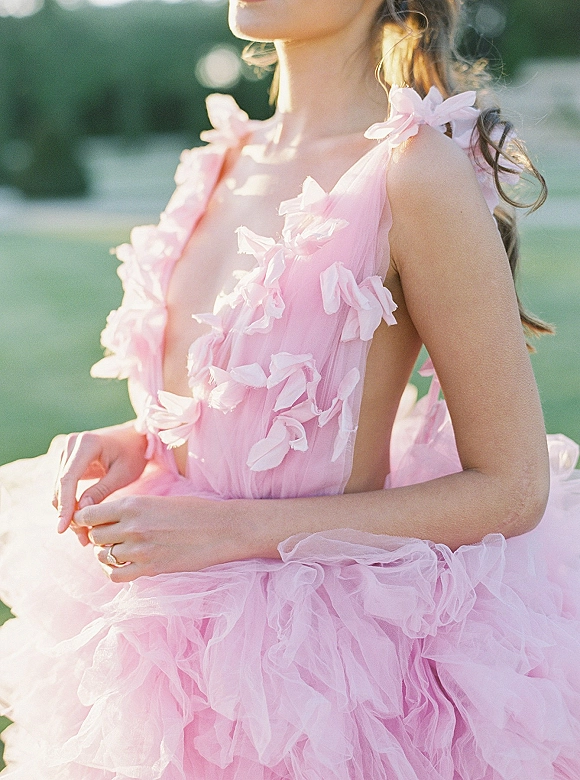
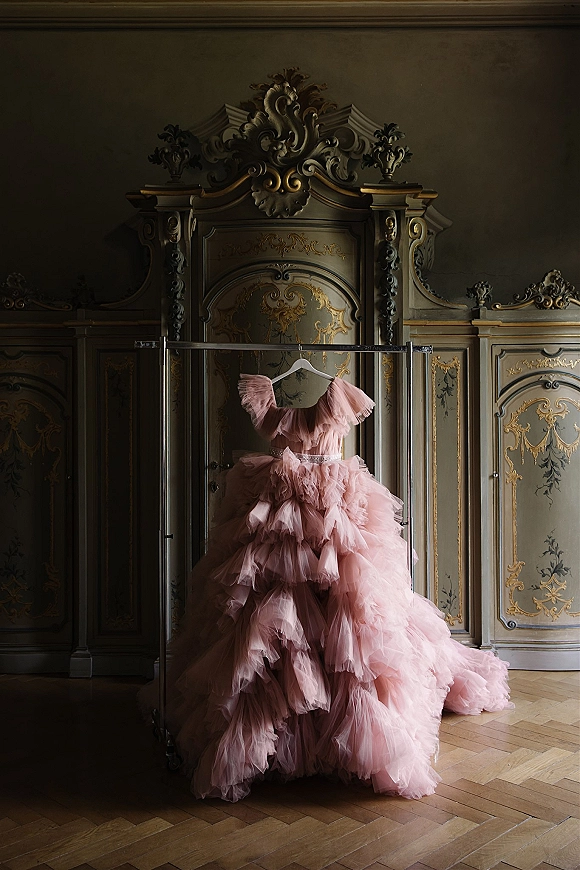
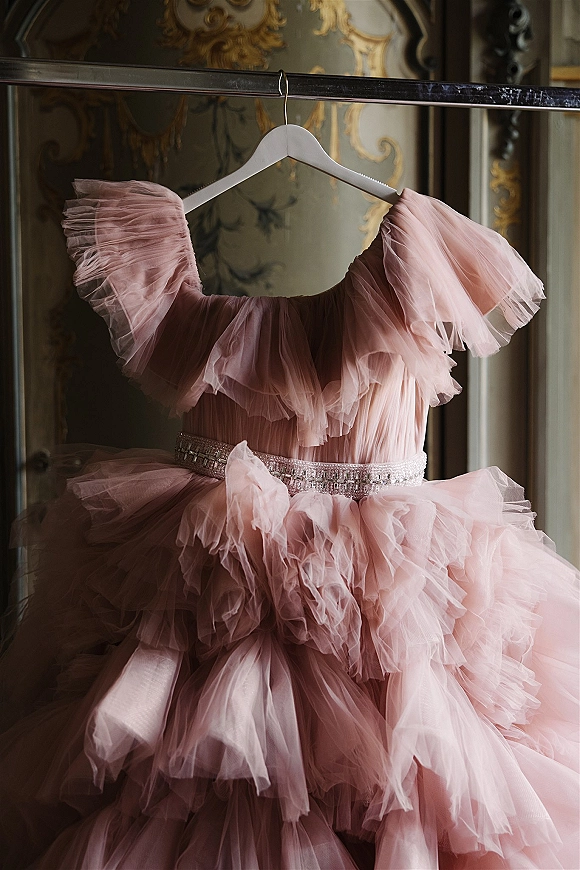
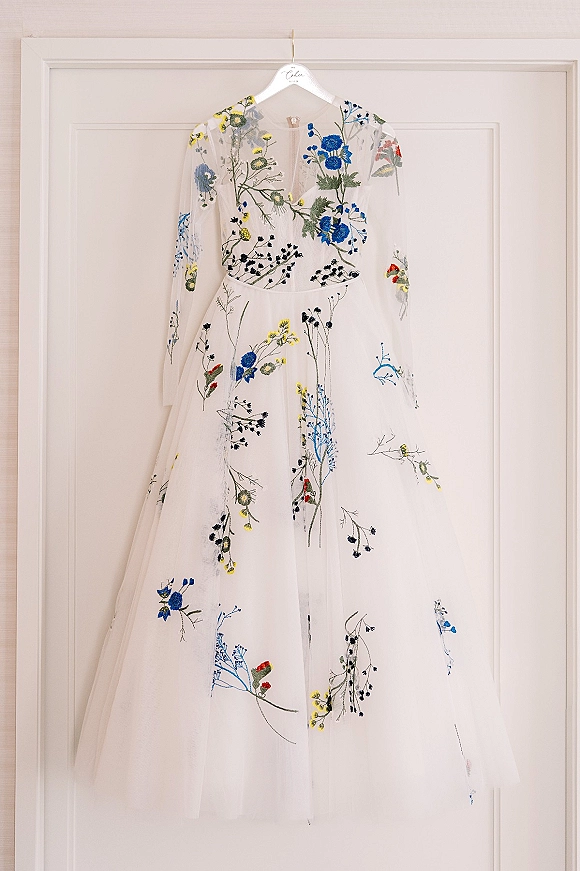
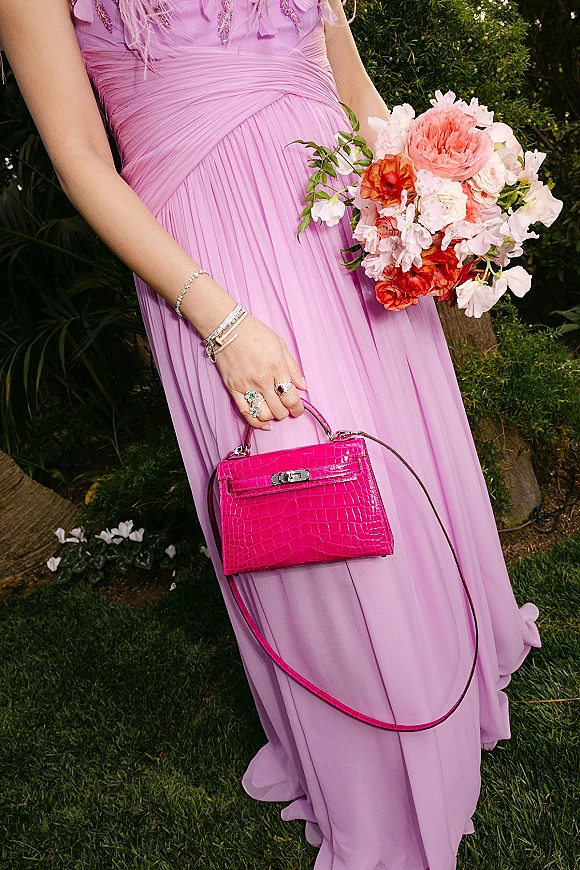
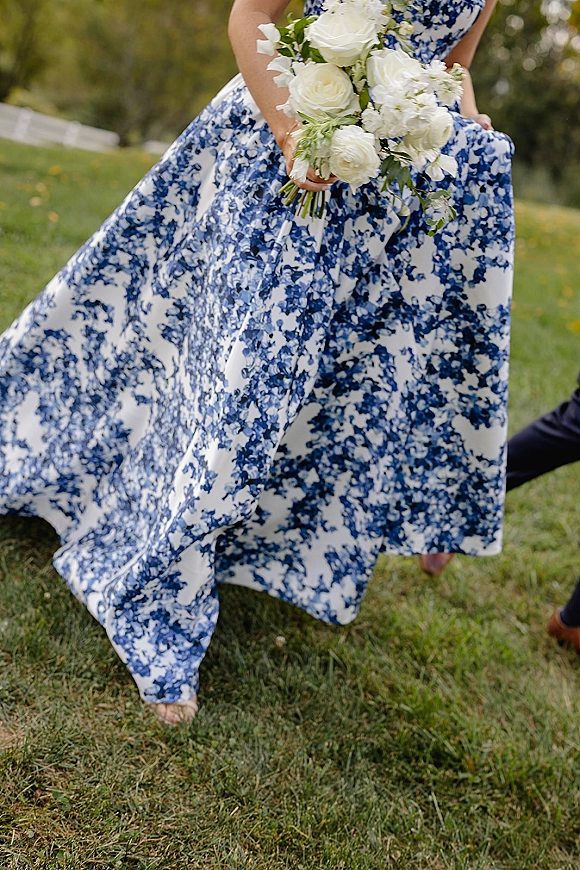
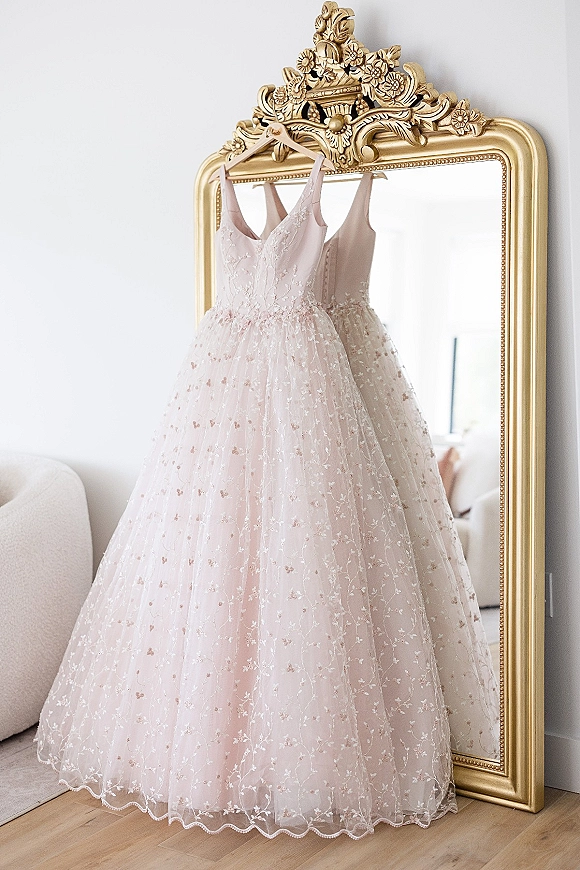
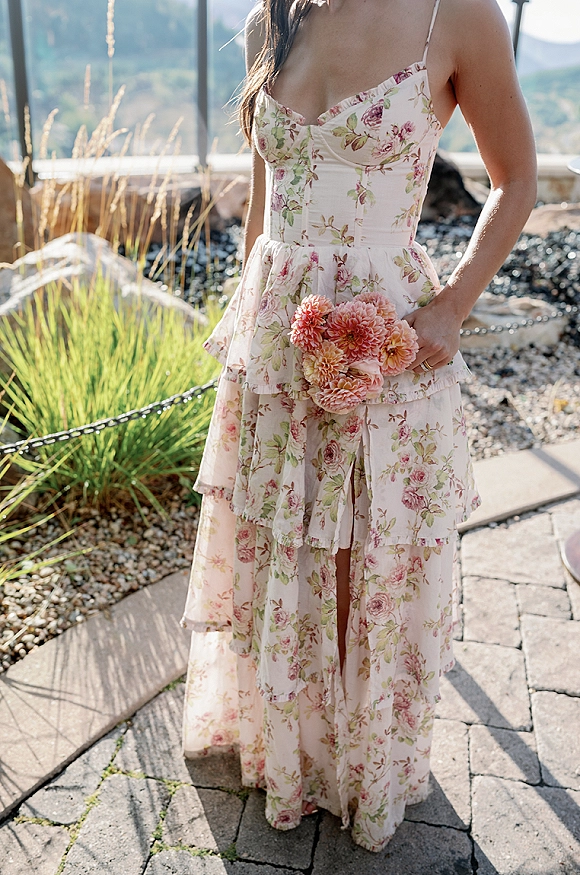
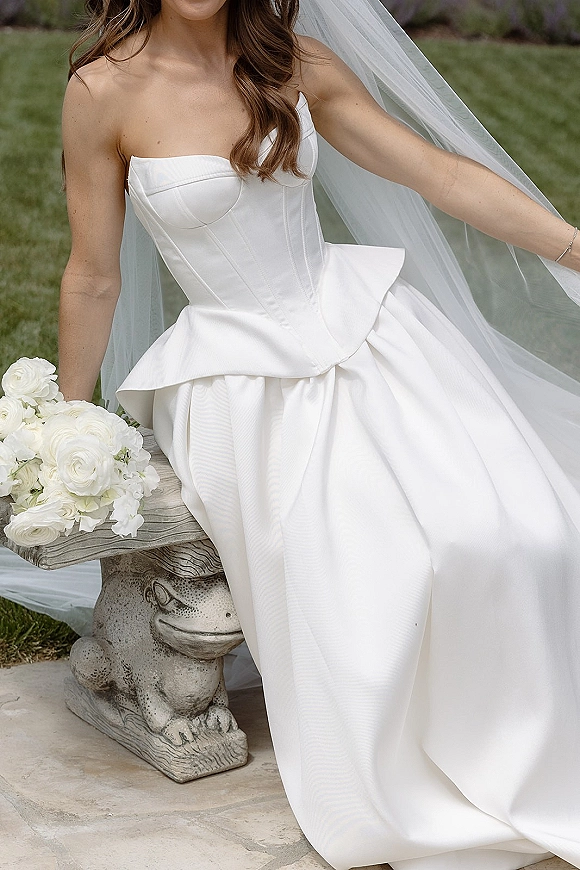
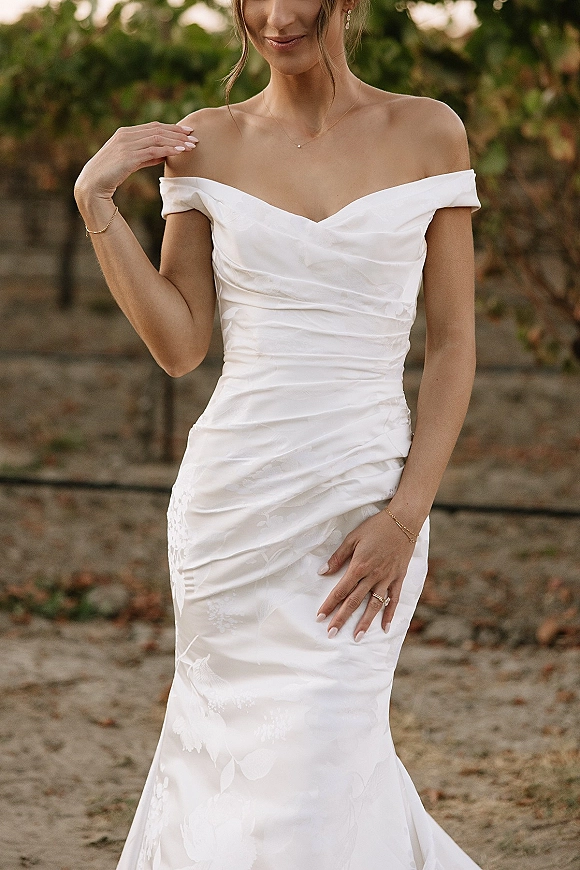
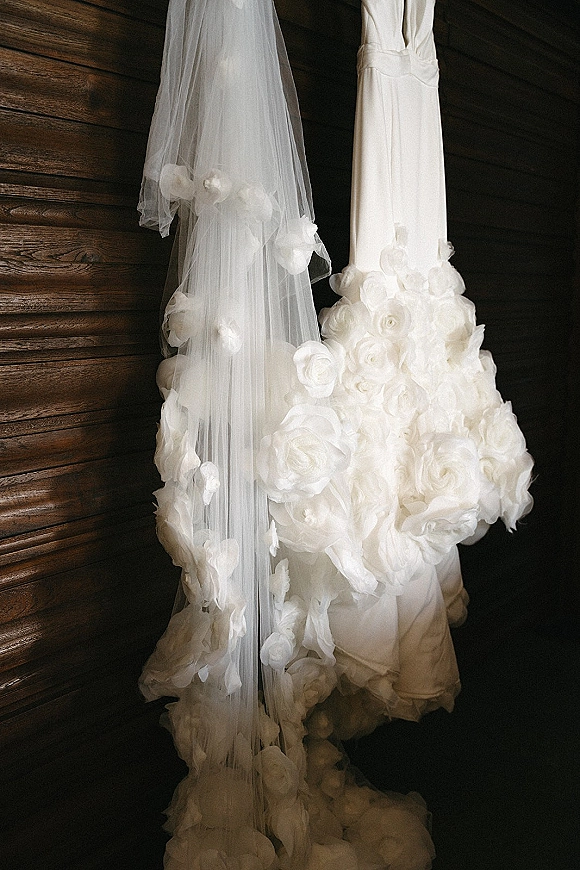
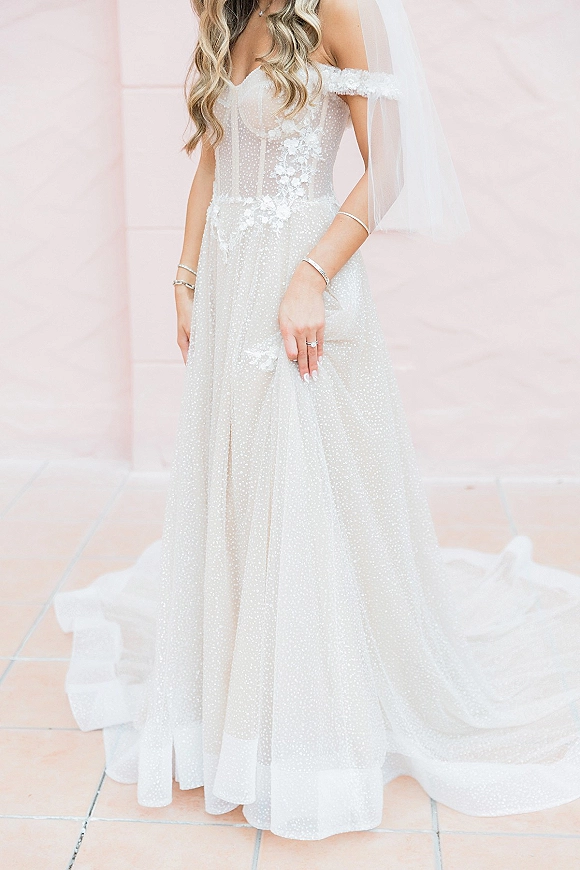
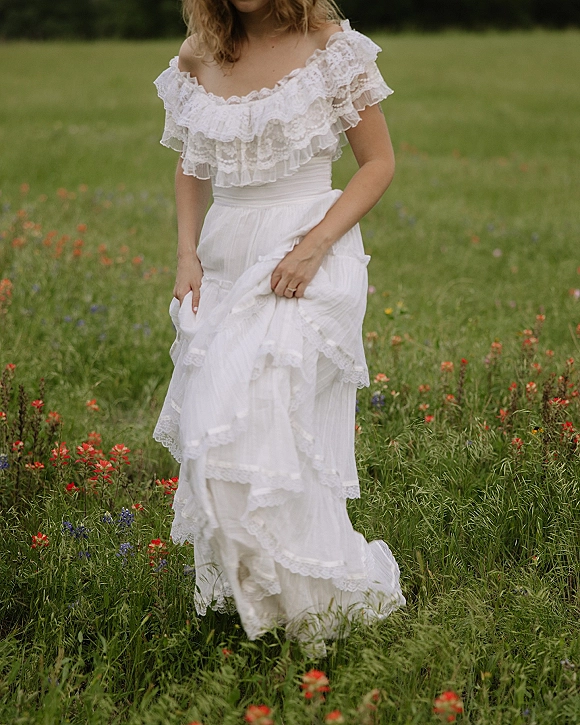
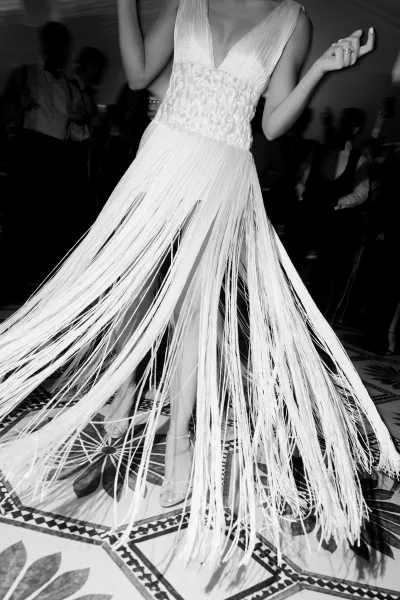
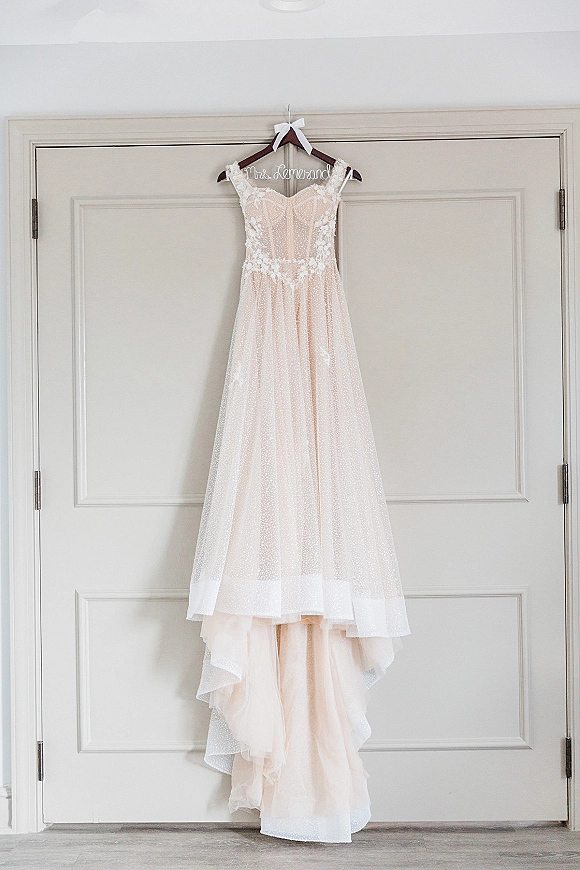
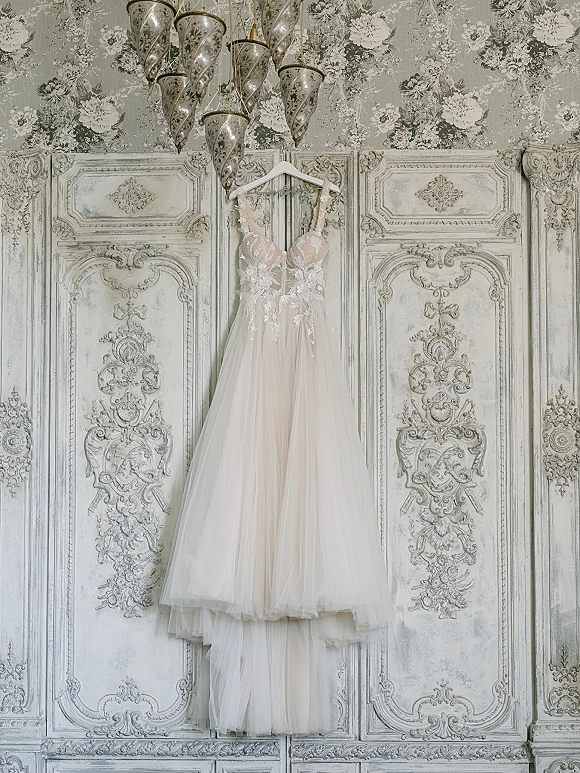
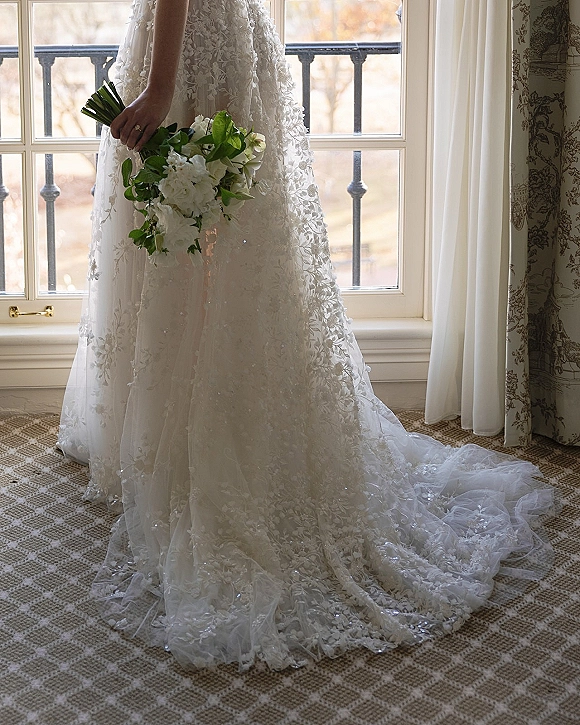
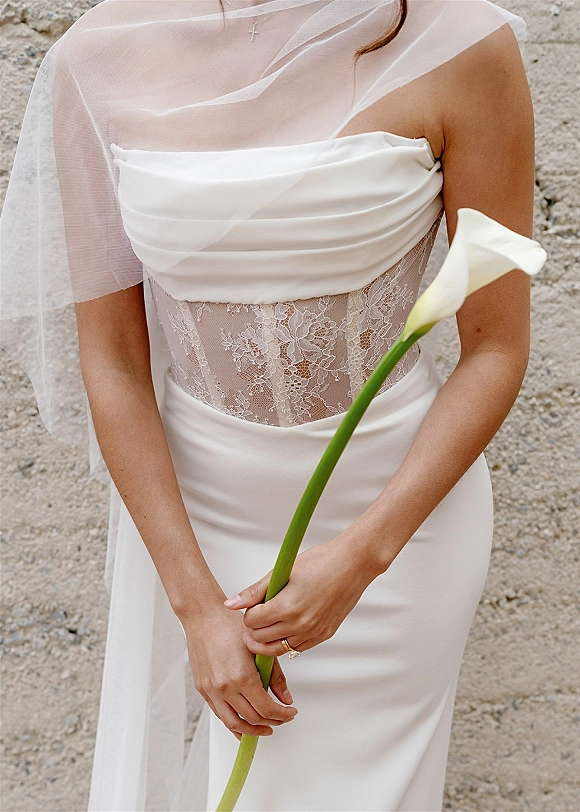
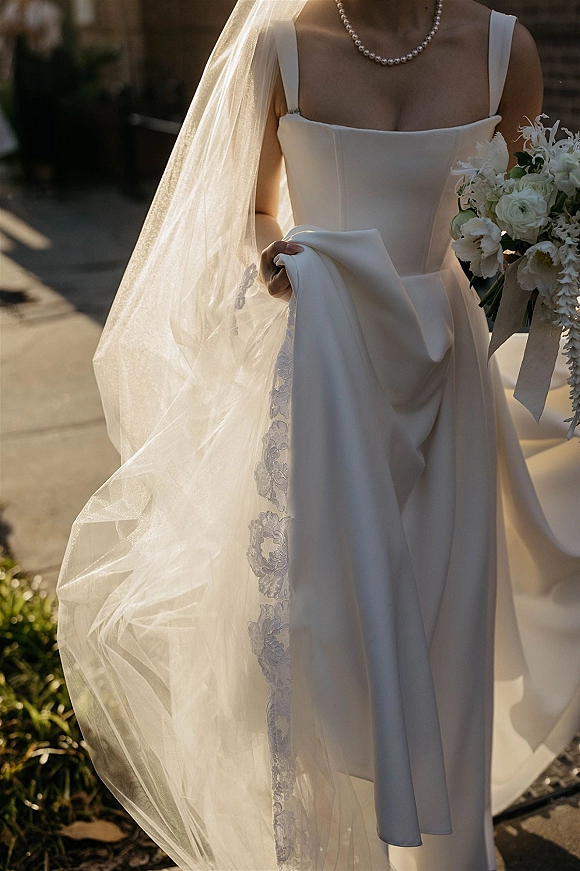
Purple and white covers five dresses, and most people asking for one want the least purple. They run from a scatter of embroidery up to a solid purple bodice. Look at where the color falls in the gowns below before deciding which you want.
Purple on white is the most common version and the least committed. Silk thread worked through ivory lace, applique climbing a bodice, or a scatter of small purple florals over the shoulders. From the back of a church it registers as pattern rather than color, the way a shadow in lacework does. Up close the individual petals resolve and the gown turns purple. It is the only version on this list a seamstress can add to a dress you already own.
A sash or hem band draws a hard line, and it is the one you can undo. A band of color at the natural waist cuts the body in two horizontally, which shortens a long torso and lengthens a short one. It also stays still while the skirt moves, so it photographs as a fixed stripe rather than as part of the dress. That is the trade for being the only construction a bride can remove on the day.
Lace over a purple underlay is the quietest and the one that changes most as she moves. From across a room it reads as depth in the lacework, closer to shadow than to color. Up close the purple resolves through the open ground of the lace and along the scalloped edge at the hem. Because two layers are shifting against each other, the color appears and recedes as she walks, which no other version on this list does.
An ombre hem gives the color weight and pulls the eye to the floor. The gradient starts somewhere on the skirt and deepens toward the ground, and in movement it smears and re-forms rather than holding a fixed edge. On a full skirt the effect is closer to watercolor. On a column it reads as a dipped hem, which is a different dress entirely.
A purple bodice over a white skirt is the boldest and the most expensive to fit. From a distance it looks like two garments, because the waist seam is the design. That seam has to land exactly on the body, and moving it later means re-cutting both colors. Order this one from measurements taken by a seamstress rather than by a friend with a tape. A corset wedding dress in a single color is far easier to alter.
Which Purple and White Wedding Dress to Choose
If you want one recommendation instead of five, take lace over a purple underlay.
It is the only version that solves three problems at once. It stays unmistakably bridal from a distance, which matters when family expectations are part of the decision. It survives both daylight and warm reception light, because the color is filtered through white rather than sitting exposed against it. And it is the only one that does something as she moves, which is the difference between a dress that photographs well and a dress that photographs well once.
The trade is real. It is the least visible of the five. If the point is that people see purple, this is the wrong choice and the ombre hem is the right one. Anyone who wants the color to register in a photograph taken from thirty feet away should take the hem or the bodice and accept the fitting cost that comes with them.
Lilac, Lavender, Plum, and Violet: What the Shade Names Actually Mean
Two of these names mean the same thing to everyone and two of them do not, which is why the word you say to a seamstress matters less than the swatch you hand her. Lavender is fixed at hex #E6E6FA, the palest of the family and close enough to white to disappear against ivory. Amethyst is reliable at #9966CC, a clear mid-tone with visible blue in it.
Plum and violet are the traps, and they fail in the same direction. The web-standard value called plum is a pale pink-lavender; the plum most people picture is a deep brownish wine-purple roughly twice as dark. Violet splits the same way, with the standard value landing on a pale pink-mauve while true violet is a deep blue-purple. Ask two people for a plum gown and one pictures the fruit while the other pictures a pastel.
Lilac is worse, because it has no agreed value at all. Four mainstream color references give four different answers, spanning a near-white pastel through a grayed mid-tone. Mauve, eggplant, and aubergine are equally unfixed. Order swatches from whoever is cutting the gown, and order them early enough that a second round still fits inside your timeline.
Purple and White Ombre Wedding Dresses: What to Ask Before You Order
Ombre is the version people picture and the hardest to order. Three questions decide whether it arrives looking like its photograph.
Where does the gradient start? A gown that begins fading at the hip is a purple dress with a white top. One that begins at the knee is a white dress with a purple hem. The listing photo rarely makes this clear because it is shot straight on, and the difference changes the whole gown. Ask for the measurement from the floor, not a description.
How many layers sit over the lining, and what color is the lining? Sheer gradients lighten with every layer. Six layers of organza over a white lining can arrive several steps paler than the swatch, closer to a blush of purple than to the color you chose. A colored lining under the same six layers holds the shade.
Is the gradient dyed or printed? A dip-dyed gradient follows the drape, so it shifts every time the fabric moves and looks different from every angle. A printed one is fixed and will show its seams where panels meet, most visibly across the back where the eye has an uninterrupted run of fabric to travel. Neither is wrong. Only one of them survives being photographed from behind.
What Goes Wrong With a Two-Tone Gown, and When to Catch It
Two-tone gowns fail in ways single-color gowns do not, and almost all of it is catchable at the first fitting rather than the last. The failures cluster around the seam, the dye lot, and the light.
The seam is the first thing to check. Ask the seamstress to mark the waistline before anything is cut, then look at it in a full-length mirror from ten feet rather than up close. A two-tone seam half an inch off center is invisible at arm's length and obvious in every photograph taken from the front.
Colored bridal fabric varies more between dye lots than ivory does. If the gown and a matching sash, jacket, or overskirt are ordered separately, they can arrive as two different purples. Order every purple element in one go from one maker, and if that is impossible, ask for cuttings from the same bolt in writing.
Purple shows alteration marks that white hides. Let-out seams leave a visible line on saturated fabric where the original stitching sat, and steam can shift the color slightly along a pressed edge. Order closer to your measurements than you would with ivory, and resist the urge to buy a size up for comfort.
The last one is timing. Anything dyed has to happen before alterations, not after, because dye shrinks some fabrics and moves every seam. Anything embroidered or appliqued happens after the fit is locked, because the placement is calculated against the finished shape.
How Much a Purple and White Wedding Dress Costs
Most purple and white wedding dresses land between $170 and $950. Custom two-tone gowns from independent online makers start at the bottom of that band. Made-to-order bridal houses that cut purple as a standing colorway sit at the top, and the gap is fit, fabric weight, and whether anyone will fix a mistake.
The tier that is missing is the middle. There is no $1,200 to $2,500 salon band for this color, because the salons carrying that band do not stock purple at all. Absence rather than price is what actually constrains the decision here, and it is why the purple band looks cheap next to what wedding dresses cost across the whole market. That is a symptom of who is making them, not a bargain.
Budget for alterations separately and generously. A two-tone gown needs more fitting work than a white one, and the seamstress doing it is solving a placement problem as well as a size problem.
Where to Buy a Purple and White Wedding Dress
Four routes exist and none is a store you can walk into. Made-to-order online specialists hold the real inventory. Independent makers handle custom two-tone and ombre. A seamstress can add purple to a white gown you already own, the cheapest route and the most overlooked. A dye house can recolor a finished dress. Salons are absent from that list for a structural reason: the industry sells purple to the wedding party and white to the bride.
Two-tone makes it harder again. A solid purple gown at least has a color filter to sit behind on a retailer's site. A gown that is white on top and purple below belongs to no filter anywhere and has to be found by looking at pictures, which is the actual reason this search feels impossible.
Shade names fragment it further, and they are mostly flowers and gemstones. One retailer will split purple more than a dozen ways across a single range while another uses five names for the same spectrum. Searching any one of those words finds one slice of what is actually available, and searching the flower names finds florists and bridal boutiques trading under the same name instead. Browse wedding dress designers who work outside ivory rather than searching a color word.
Build in months, not weeks. Made-to-order houses quote 8 to 12 weeks of production before shipping, and a swatch round on an unstandardized color adds a fortnight before that. Order nine months out and you have room for a second swatch and a real alterations schedule. Order at six and you are accepting whatever arrives.
Dyeing a White Wedding Dress Purple
Bridal dye specialists will recolor a finished white gown, with ombre work starting around $540 and a turnaround measured in months rather than weeks. This is the route when you already own the dress you want, or when the silhouette you love has never been cut in purple by anyone.
Send them the gown before you have it altered. Dyeing shrinks some fabrics and every seam moves, so a dress fitted first has to be fitted again afterward, and the second fitting is the expensive one.
Tell them the fiber before you ask for a quote. Polyester and silk take dye differently, and a gown with a polyester lining under a silk shell will come back as two shades of purple unless the dyer plans for it. Any house worth using will ask first. If they do not ask, that is the answer.
Ask for a swatch test on a hidden seam allowance before they commit the whole gown. Reputable dyers do this as standard and will send you a photograph of the result. It is also the only chance you get to change your mind.
Plus Size Purple and White Wedding Dresses
Above a size 18, made-to-order stops being the fallback and becomes the better route, because scarcity compounds across a size range rather than holding steady.
The scarcity that makes purple hard to find at all gets worse across a full size range, because a retailer stocking one purple gown is not stocking it in every size. Specialists who cut to measurement have the opposite problem and solve it, which is why the size range is the first thing to check rather than the last.
Look at how the plus-size upcharge is structured rather than whether one exists. A flat fee is a maker pricing the extra fabric. A percentage is a maker pricing your body. On a $900 gown that difference is real money, and it tells you something about the house before you have spoken to anyone there.
How Purple Photographs Against White
Purple is the trickiest color to photograph, and the reason is physical rather than aesthetic. There is no such thing as a wavelength of purple light. Every purple is a blend of red and blue, which means two purple fabrics can match under a window and separate under a reception fixture with neither one changing. That behavior has a name, illuminant metamerism, and it comes from two items being dyed with two different formulas.
Translated into a decision: the gown and its own sash are safe. The gown and the bridesmaid dresses ordered from a second label are not. Muted purples are the worst offenders, because near-neutral shades carry the widest range of possible mismatches, and mauve is named explicitly in the color-science literature on the problem.
Warm light is the second threat. Tungsten uplighting and candlelight push a pale lilac toward gray, and the effect is stronger on chiffon than on satin. A saturated plum holds its color under almost anything. Look at how differently the shades sit in the gowns below and you will see the range before you commit to one.
Tell your photographer the gown is two-tone before the day. A white balance set to render an ivory gown correctly will neutralize a pale purple entirely. That is a five-second fix on the day and an unfixable one in the gallery.
What a Purple Wedding Dress Means
Purple was the color you were not allowed to buy, and that is not a figure of speech. It was the most expensive dye in the ancient world, restricted by law at points in Roman history and reserved for European courts, and it stayed that way until synthetic dye arrived in the 1850s and put it in every shop window inside a decade.
That history is why the pairing with white works rather than merely looking nice. White is the color of the tradition and purple is the color of rank, and putting them on the same dress is a legible thing to do rather than a decorative one. It also explains why deep plum feels formal and pale lilac feels romantic when they are the same hue at different strengths.
Purple appears in neither of the two large published surveys of popular wedding colors, which puts it below the reporting threshold rather than merely out of fashion. For most brides choosing it, that is the entire appeal.
What to Wear With a Purple and White Wedding Dress
Contrast is the whole job, and the most common mistake is matching. Purple sits close enough to pink and gray that a near-miss looks like a mistake rather than a decision.
Bridesmaids should go darker or warmer, never the same purple. A lilac gown beside lilac bridesmaid dresses from a different label is the classic near-miss, and it photographs as a failed match rather than as a palette. Go two full steps down into plum or aubergine, or go warm. Lavender bridesmaid dresses work beside a deep plum gown and fight a pale lilac one. Mauve bridesmaid dresses sit far enough into the dusty range to stay legible against either.
Metals split by shade. Silver and platinum hold cool against lilac and lavender, and against any purple with blue in it. Gold and champagne warm a plum or aubergine gown and turn a cool lilac slightly muddy. Purple is the one bridal color where this choice is visible in photographs rather than a matter of taste.
Shoes go nude, metallic, or match the deepest purple in the gown. White shoes against a two-tone gown draw the eye to the floor and compete with the white already in the dress.
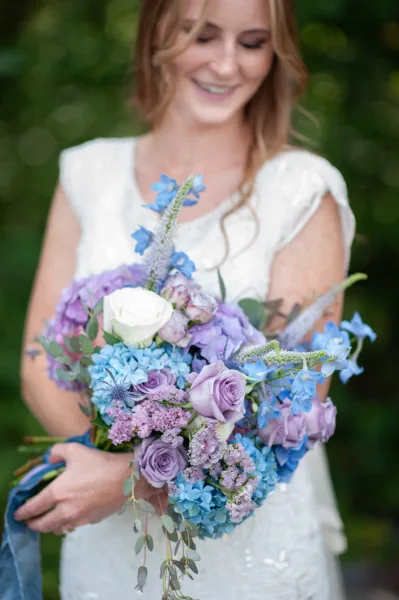
For flowers, cream with green foliage gives the cleanest contrast, and white wedding bouquets hold their shape against purple from any distance. Tonal purple bouquets work only when they go deeper than the gown. Pastel wedding bouquetsin the same lilac register blur into it. Browsing bridesmaid dress labels that publish swatch programs is the fastest way to solve the matching question before ordering anything.
If the two-tone version is not what you want, a solid purple wedding dress removes the matching problem entirely, and a black and purple wedding dress takes the same color somewhere gothic. Purple also works beautifully as a reception change, where a short wedding dress in plum costs a fraction of a full gown and lives in evening wear, where the color is abundant. Real second looks tend to be bolder than first ones for exactly that reason.
Frequently Asked Questions
Can a bride wear purple, or is it bad luck?
No superstition attaches to purple in Western wedding tradition. The old rhyme warns against green and yellow, not purple. Purple's historical association is with royalty and rank, which is why it appears in coronation and court dress across European history.
What color shoes go with a purple and white wedding dress?
Nude and metallic are the safest, and matching the deepest purple in the gown is the boldest. Avoid white, which competes with the white already in the dress. For an ombre gown, match the hem rather than the bodice, since the hem is what sits beside the shoe in every photograph.
What jewelry and metals suit a purple and white gown?
Cool metals for cool purples, warm metals for warm ones. Amethyst is the obvious stone, and it works when it sits a shade deeper than the gown rather than matching it exactly. Pearls are the safest choice across every purple, because they pick up whatever is around them instead of committing to a temperature.
What colors go with purple for a wedding?
Green, ivory, and gold are the three that hold up in photographs. Sage and eucalyptus sit opposite purple on the color wheel and keep it from reading heavy. Ivory ties the palette back to the gown's white. Gold warms the deeper purples, and silver does the same job for lilac and lavender. Pink is the one to watch, since it sits close enough to purple to look like a near-miss.
How long does a purple and white wedding dress take to arrive?
Plan on three to six months. Made-to-order houses quote 8 to 12 weeks of production, independent ombre makers quote 4 to 10 weeks depending on customization, and shipping adds one to three more. Dyeing an existing gown runs far longer, sometimes five months door to door.
Can you wear a purple and white dress to a wedding as a guest?
The white is the problem, not the purple. A predominantly purple dress with white detailing is fine at most weddings. A predominantly white dress with purple accents reads as bridal from a distance and is worth avoiding unless the couple has said otherwise.
Which shade of purple suits which skin tone?
Cool-toned lilac and lavender flatter cool undertones and can wash out warm ones. Warm-leaning purples carrying red in them, plum and aubergine especially, suit warm and olive undertones. Deep saturated purples work across every skin tone, which is why plum turns up more often than lilac in real weddings.