Blue Accents on a White Wedding Dress: Where the Color Goes
The blue on a blue and white wedding dress sits in one of six places: embroidery on the bodice, a painted or printed floral on the skirt, a sash or bows, a tinted lining under white lace, an ombre hem, or the veil. Placement decides how far away the blue can be seen and whether it comes off later.
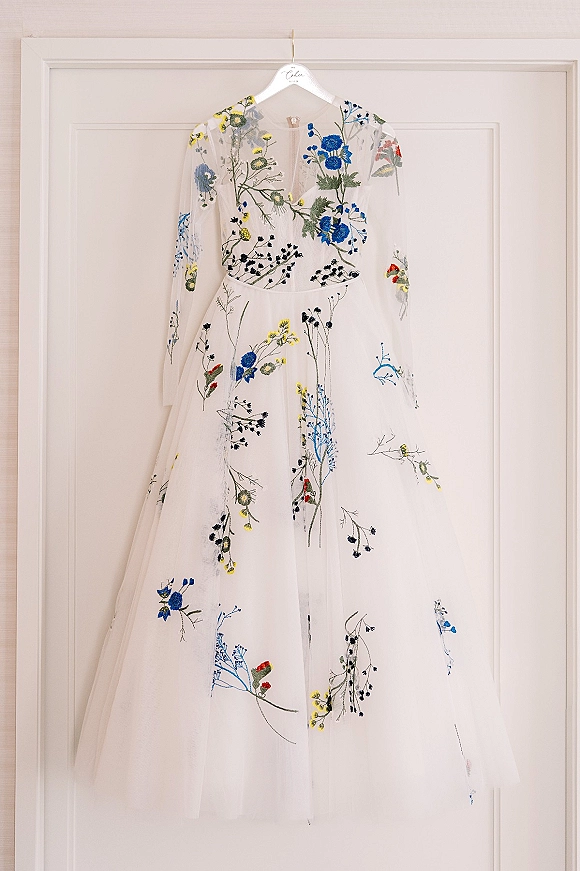
Embroidery and applique. Blue thread worked into white lace, or blue blossoms stitched onto the bodice and scattered down the skirt. The stitching is raised, so it catches light from the side and throws tiny shadows, and the flowers look dimensional in person and crisp in close-ups. On an illusion neckline the motifs appear to sit directly on the skin. This is also the version an embroiderer can add to a gown already hanging in your closet.
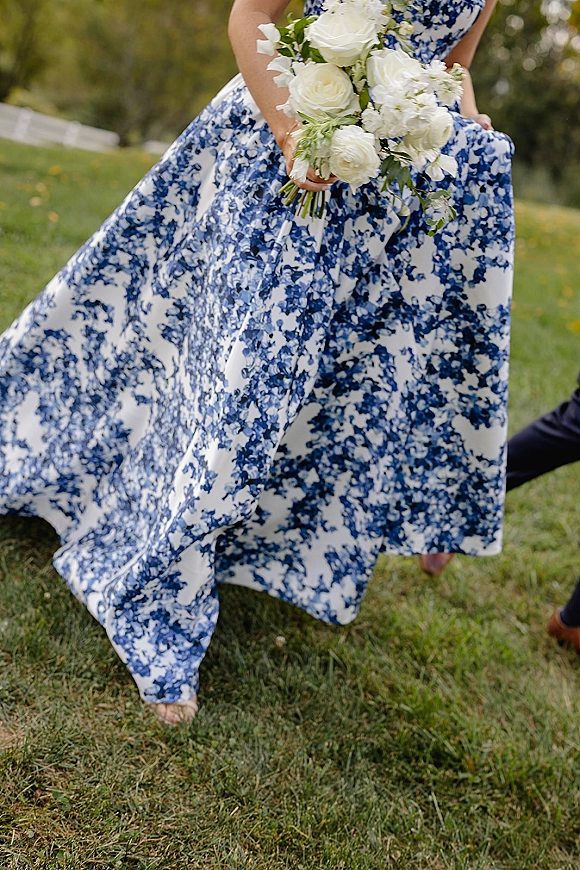
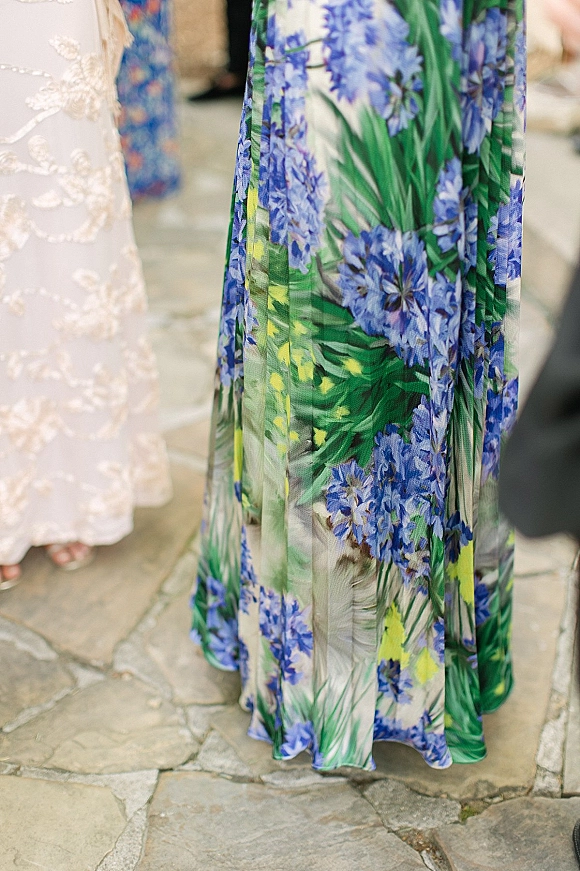
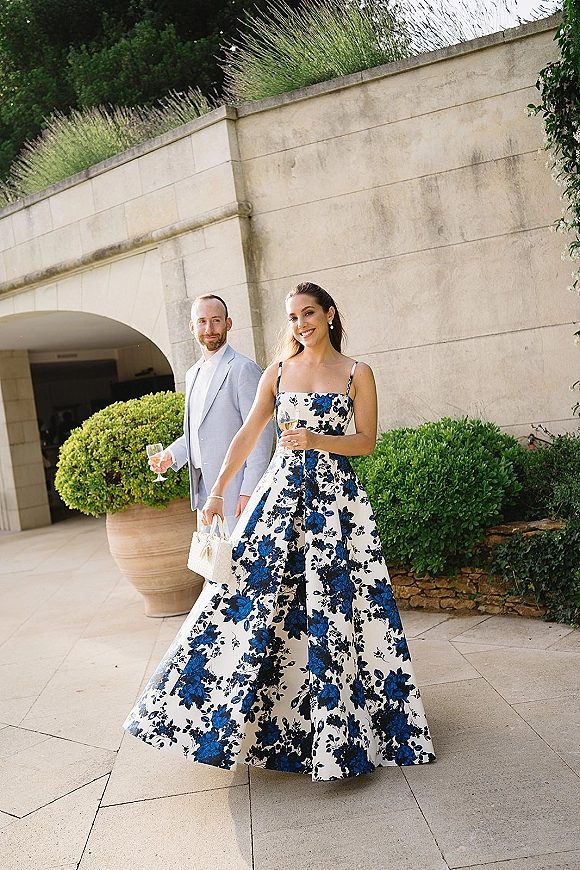
Painted and printed florals. Blue blooms brushed or printed onto organza or silk, usually densest at the hem and thinning toward the waist. These put more blue on the gown than any other accent and look like part of the cloth rather than something applied to it. At a distance they register as pattern. In portraits, the brushwork is what people notice.
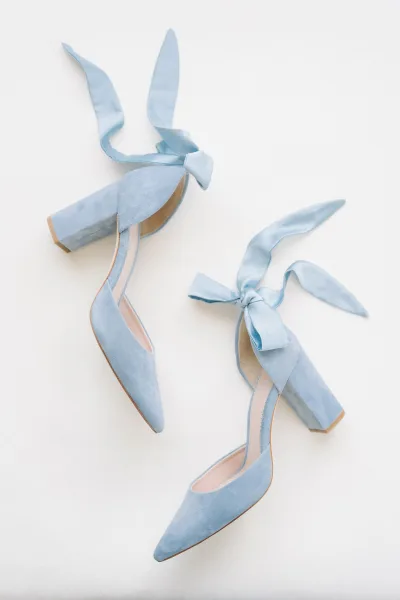
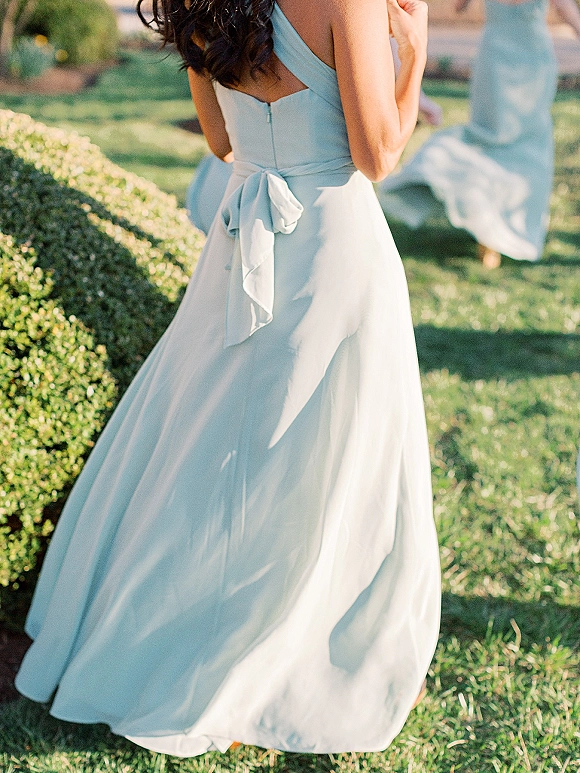
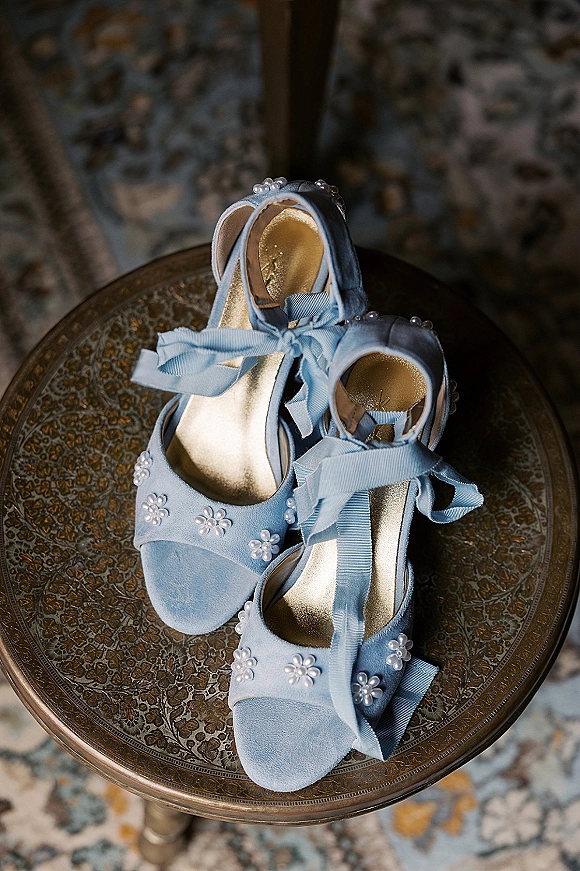
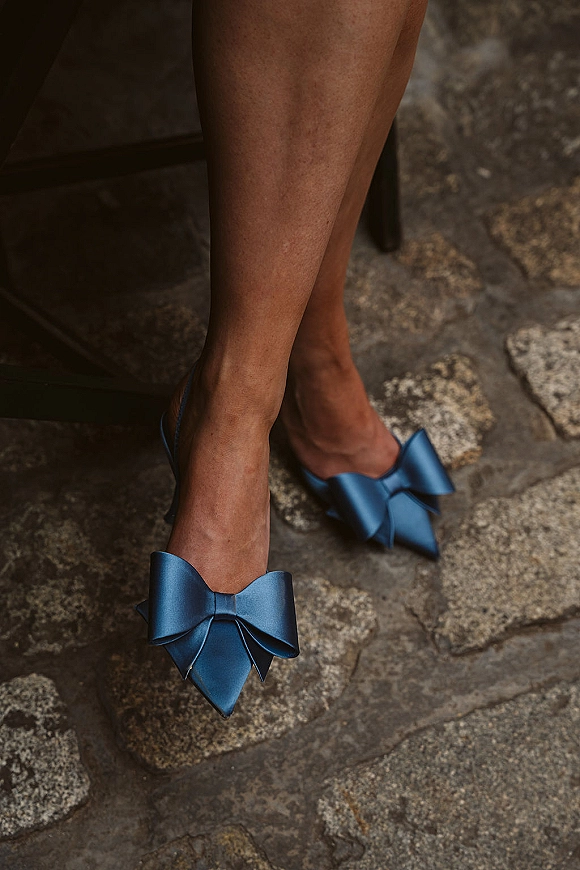
Sashes and bows. A band of blue ribbon at the natural waist, or blue bows at the shoulders and trailing down a buttoned back. The line is graphic and stays fixed while the skirt moves. It is the one accent you can take off between the ceremony and dinner.
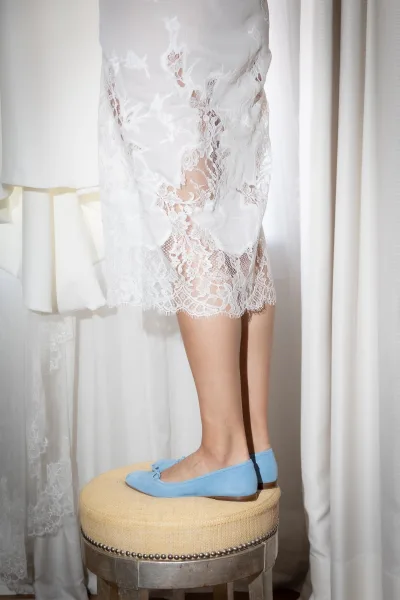
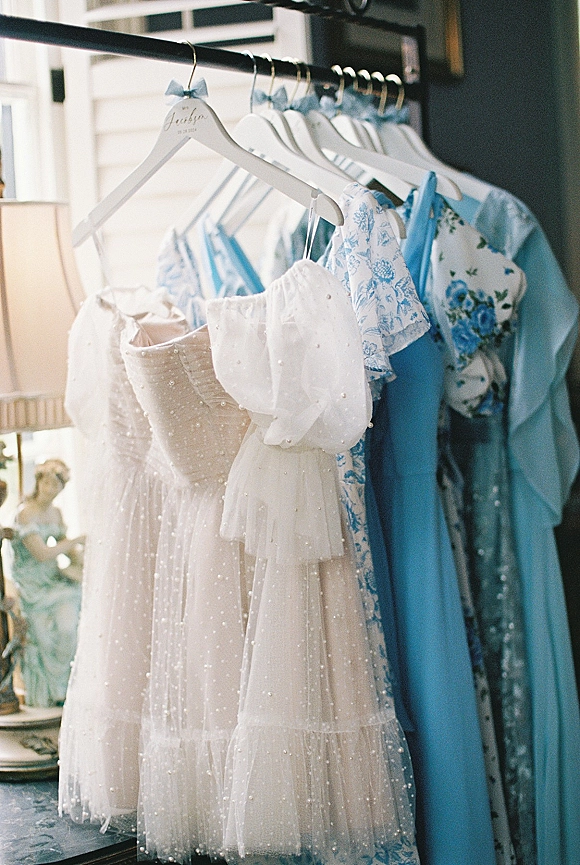
A tinted underlayer. Pale blue lining or a blue tulle petticoat beneath white lace. Head-on the gown looks white. The blue shows only at the edges, in the scallops of the lace and in a flash of hem when she walks. It is the subtlest version and the hardest to judge from a swatch.
An ombre hem. White at the bodice deepening to blue at the floor. On a full tulle skirt the gradient looks like watercolor bleeding upward. On a slim column it looks like a dipped hem. Where the fade begins changes the whole dress, so ask for that measurement in inches from the floor.
The veil. A blue-edged or blue-embroidered veil over an all-white gown frames her face in every ceremony photograph and comes off before the first dance.
Scroll the gallery below and sort what you see by where the color sits, then decide how much of it you want.
Porcelain, Toile, and Wedgwood: Which Blue and White Look You Mean
Blue and white covers several decorative traditions, and naming the one you are picturing tells a maker how to build the gown.
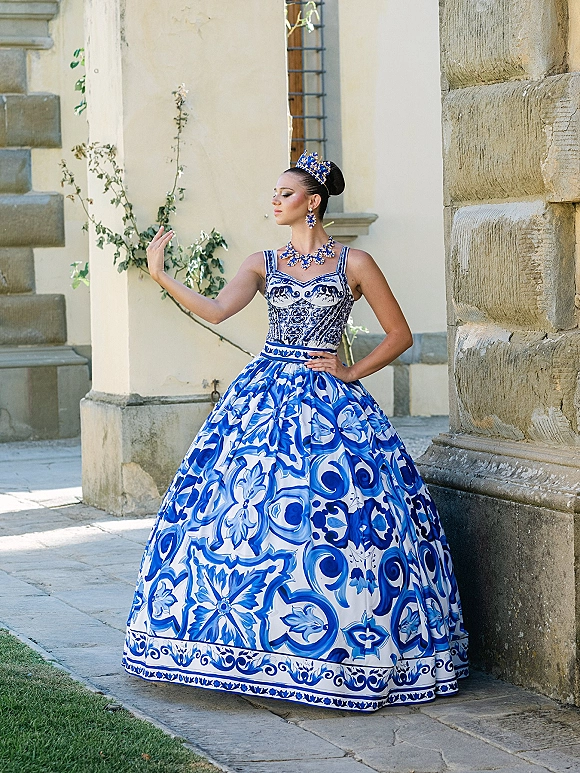
Porcelain and Delft. Deep cobalt painted densely on bright white, in scrolling vines and open peony blossoms. This is the look of Chinese blue and white porcelain and of the Dutch Delftware that copied it. On a gown it means heavy embroidery or a printed or painted skirt, and it needs a true deep blue. Porcelain rendered in powder blue looks faded rather than soft.
Toile. One blue printed in fine, engraved-looking scenes on a pale ground, with pastoral figures and garlands repeating across the cloth. Toile only exists as a print, so it belongs on a skirt, an overskirt, or a reception dress rather than on lace. Up close it rewards attention. Across a room it softens into a blue texture.
Wedgwood. The inverse of porcelain: a pale, slightly grayed blue ground with white decoration raised on top of it. On a gown this becomes white lace or white applique laid over a pale blue lining. If the dress you are picturing is white lace floating on blue, this is the word to use.
Coastal and nautical. Stripes, crisp linen, navy piping, a bow at the back. No pattern at all, just clean contrast. This is the rehearsal dinner and beach ceremony version of the pairing, and it works best short.
Bring pictures to the first appointment instead of adjectives. "Blue floral" means porcelain to one maker and watercolor to the next, and the two are built in entirely different ways.
White Wedding Dress With Blue Flowers: Painted, Printed, or Embroidered
Blue flowers reach a white wedding dress in three ways, and they look alike only in a thumbnail: embroidery stitched on top of the fabric, a print transferred onto the cloth before the gown is cut, or paint brushed onto the fabric or the finished dress. Each method behaves differently at a fitting and at the cleaner, and the price climbs with the hours of handwork.
Embroidery sits on the surface. It is raised and slightly glossy. It is also heavier than it looks. Dense blue embroidery on a sheer skirt pulls the tulle straight down instead of letting it float, so ask to see the skirt move before you commit to full coverage. It is the most forgiving of the three at alterations, because a motif sitting over a seam can be unpicked and restitched once the seam moves.
A print is flat and repeats. Look for the same cluster of blooms returning at regular intervals, which is the giveaway. Printing is the cheapest way to put a lot of blue on a gown and the hardest to alter. Taking in a side seam cuts through the pattern, and the flowers on either side no longer line up. If a printed bodice needs real fitting, ask the seamstress to take it in at the center back, where a zipper or buttons already interrupt the pattern.
Hand-painting shows the brush. Color pools where a stroke began and thins where it ended. No two petals match. The paint sits on the surface of organza or silk and stiffens it slightly where it is heaviest, which gives a painted skirt more body than the same fabric plain. It is the slowest route and the most expensive, and it cannot be corrected once the brush has touched the fabric.
Navy, Royal Blue, or Light Blue: Choosing the Shade, and the White Beside It
Choose the blue by how far away it has to register. Navy and royal blue keep a clean edge against white from the back of a ballroom. Light blue and powder blue soften into it within a few rows.
The white matters as much as the blue, because the two change each other. Set beside a saturated blue, ivory looks warmer and yellower than it does on its own, while a bright white looks cleaner and colder.
Navy with soft ivory looks rich and slightly vintage. Royal blue with bright white looks crisp and graphic. Powder blue beside a deep ivory tends to look faded, and pale blue tulle over an ivory lining tips toward seafoam. Judge the white against the actual blue, in daylight, never on its own.
Layering changes the blue again. A navy lining under two or three layers of white tulle arrives as slate gray rather than blue, because each white layer scatters light across the color beneath it. Ask to see the lining under the real number of layers before anything is ordered.
Our pick: deep blue embroidery on a soft white. It is the one version that holds up at every distance and in every light. Deep blue survives open shade, warm reception lighting, and a guest's phone camera. Embroidery can be added to a gown you already love, and it is the easiest version to alter when the fit changes.
The trade-off is that it looks like porcelain, and it will surprise nobody. If you want the gown to feel soft and romantic up close, a pale blue underlay is prettier at arm's length. Take it knowing that in shaded and candlelit photographs it will look like a white dress.
A gown that is blue from bodice to hem is a blue wedding dress rather than a two-tone one, and royal blue worn solid is a different look again: see the royal blue wedding dress.
How a Blue and White Gown Photographs in Shade, Sun, and Candlelight
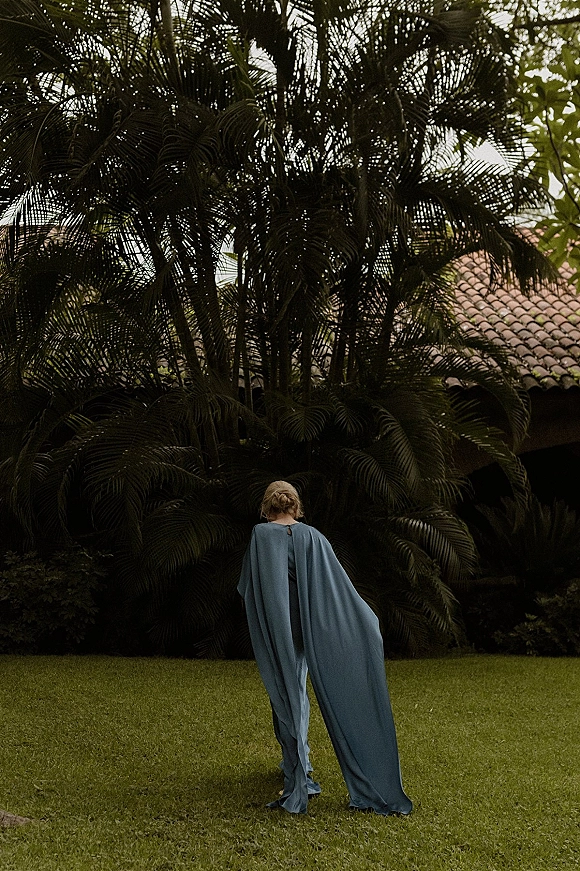
A blue and white gown photographs on contrast, and the light either widens or closes the gap between the two colors. Open shade and overcast sky are lit by blue skylight, which tints the white of the gown blue and pulls it toward the accents, so powder blue embroidery that was obvious in the fitting room can vanish from a shaded portrait. Direct sun pushes the white brighter and holds deep blue sharp. Warm reception light turns the white creamy and drags pale blue toward gray.
Standard editing corrects the blue cast out of white gowns shot in shade, and on a blue and white gown that same correction drains the blue details. Send your photographer a daylight close-up of the gown before the wedding, with a note on which blue is supposed to be there.
Flash has its own habits. Satin ribbon flares white under direct flash and loses its color in the highlight, while raised embroidery holds its blue because the stitching breaks up the reflection. If bows or a sash carry most of your blue, choose grosgrain or matte silk over high-shine satin.
As you scroll the gallery, look past the placement and at the light each gown was photographed in, and watch which blues survive the shaded frames.
What Goes Wrong With Blue on a White Gown
The problems specific to this pairing start with blue color traveling onto the white.
The blue bleeds. Blue embroidery thread and blue lining fabric can run onto the white around them when they get wet or hot: a steamer on the wedding morning, rain at an outdoor ceremony, a spilled drink blotted with water, a long night on a hot dance floor. Ask the maker whether the blue is colorfast, then test it yourself by pressing a damp white cloth against a hidden motif and checking the cloth. Tell whoever steams the gown that it carries blue.
The blues do not match each other. Satin ribbon, embroidery floss, and tulle dyed the same named blue arrive as different blues, because each fiber takes dye in its own way. Ask to see every blue component together, in daylight, before any of it is attached.
The dye bath moves the fit. If you are having a white gown dyed, the lab should test a swatch cut from an inside seam first. Sequins and metallic thread can pick up a tint while glass stones stay clear, and some fabrics stretch or shrink in the bath. Book alterations after the gown comes back, never before.
The cleaner does not know. After the wedding, tell the cleaning and preservation specialist that the gown carries blue. Steam and solvent are both ways for dye to move, and a stain treated near the blue with water is how a white skirt ends up with a blue tide line.
What a Blue and White Wedding Dress Costs, and Where to Find One
The price of a blue and white wedding dress follows the handwork, not the amount of blue. Adding ribbon, bows, or a trimmed veil to a white gown is the cheapest version and can happen weeks before the wedding. Hand-added embroidery is priced on coverage and hours, so a scatter of motifs and a fully worked bodice sit far apart. Dyeing a finished gown is quoted on silhouette, fabric, and the number of colors.
Hand-painting sits at the top of the range and is the slowest route, so it is the one to order first. Weigh those routes against what a wedding dress typically costs before choosing one.
A seamstress or embroiderer. The route for adding blue to a gown you already own. Bring the actual ribbon, thread, or fabric to the appointment rather than describing the shade, and look at it against the gown by a window before anything is cut or stitched.
A bridal dye lab. The route for an ombre hem or a tinted underlayer on a finished gown. Expect a swatch test before the full dye, and treat a lab that skips it as a lab to skip.
A made-to-order maker. Online bridal makers carry finished two-tone gowns and cut them to your measurements. Before it ships, ask for daylight photographs of the gown made for you, since the listing image was shot under studio light.
Samples and resale. Designer blue and white gowns, painted ones included, turn up as sample and resale listings. Check the areas where blue meets white for any bleed or tide marks, and ask for photographs taken outdoors.
A designer who takes custom color. For hand-painted or fully custom embroidery, start with wedding dress designerswho accept color commissions, and ask to see a finished blue piece rather than a sketch.
Sequence matters more than any single choice. Blue goes on before alterations, because dye can shift fabric and embroidery adds weight, and either one undoes a fitting that came first. Gown, then blue, then alterations, then the final press.
Does a Blue and White Wedding Dress Count as Something Blue?
Yes. The rhyme asks for something blue and sets no rules about size or placement, so blue embroidery, a blue sash, or a blue underlayer on the gown satisfies it outright. A blue and white gown puts the tradition in plain sight instead of hiding it in a garter or a stitch inside the hem.
For families who expect white, it is also the easiest compromise to make. A blue and white gown is a white wedding dress first, and the blue can be as quiet as a lining or as visible as a painted skirt. The history of blue as a bridal color, and why the rhyme asks for it, is covered in our guide to light blue wedding dresses.
Bridesmaids, Flowers, and a Second Look With a Blue and White Gown
Let the gown own the pairing, and give the rest of the wedding one of its two colors rather than both, so the bride stays the only place where blue and white meet.
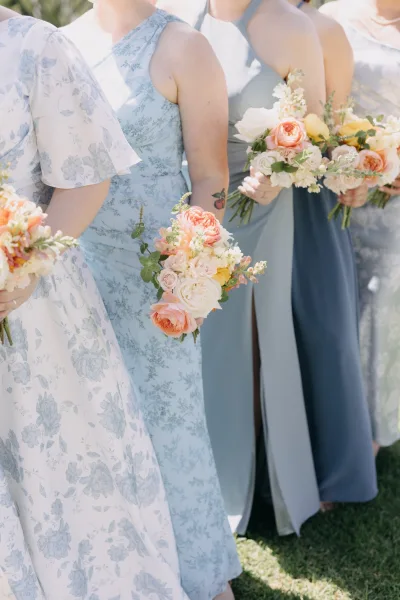
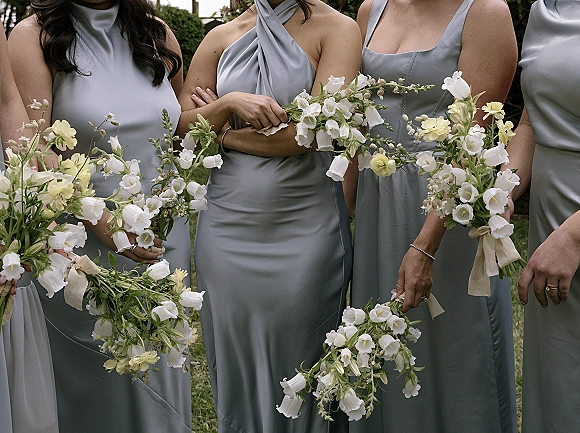
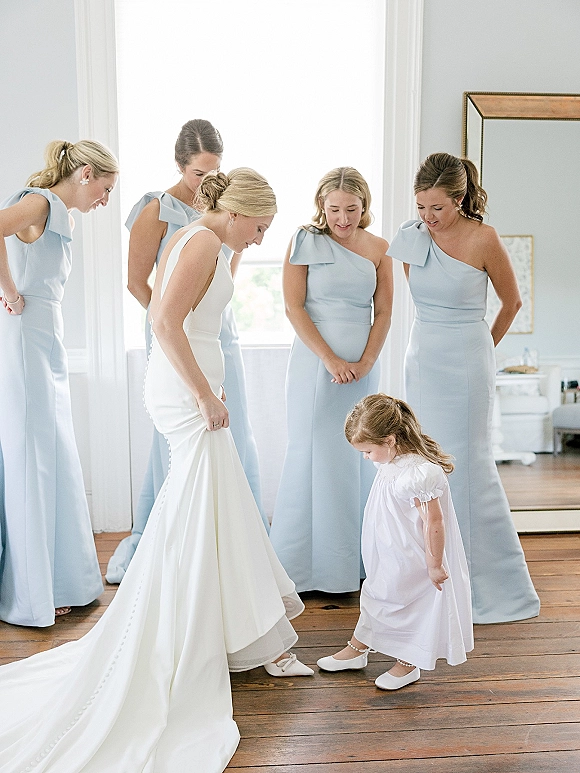
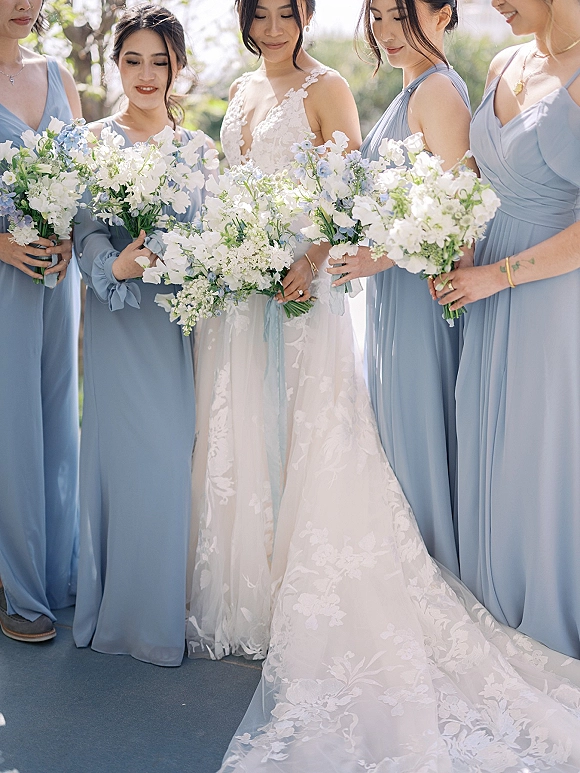
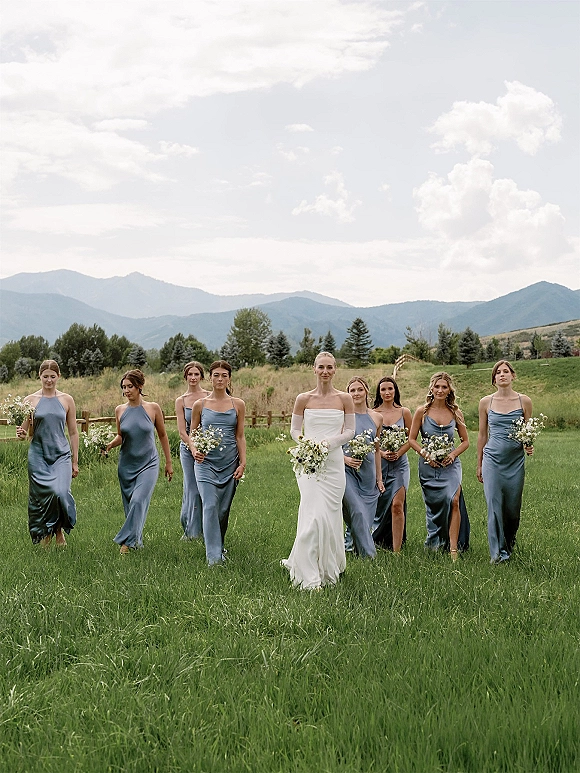
Bridesmaids. Dressing attendants in the exact blue of the gown's embroidery flattens the bride into the group, because the one thing that set her apart is now on everyone. Go a step deeper instead. Navy bridesmaid dresses beside royal blue or porcelain-blue embroidery look deliberate, and they keep the bride the lightest figure in every group photograph.
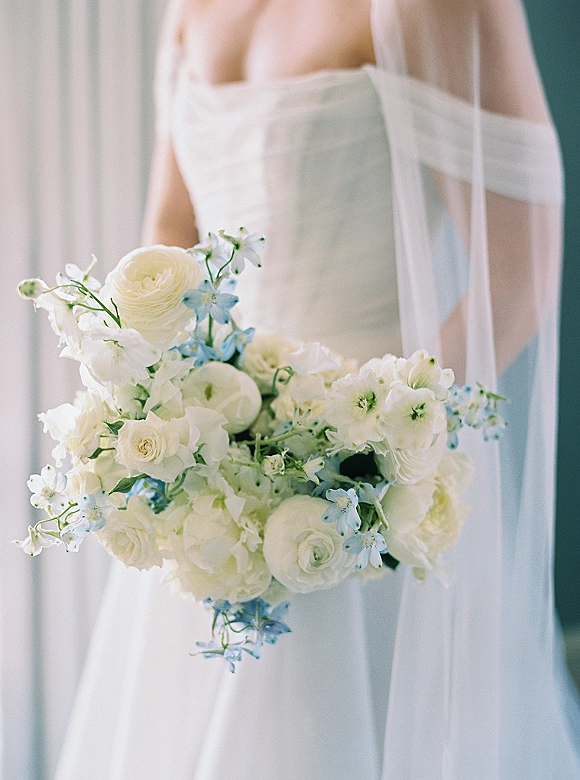
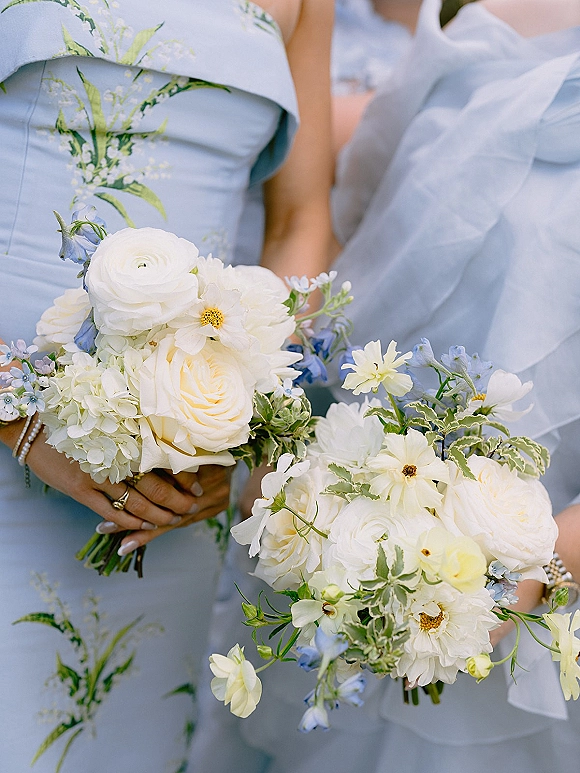
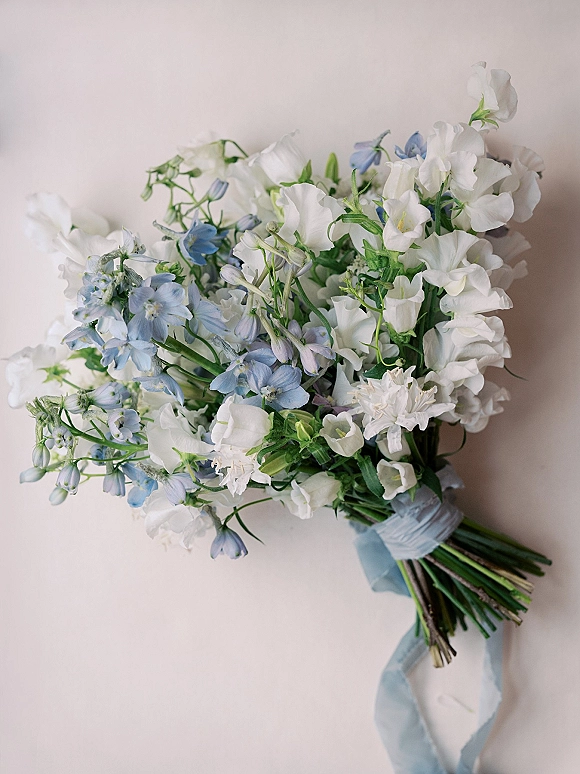
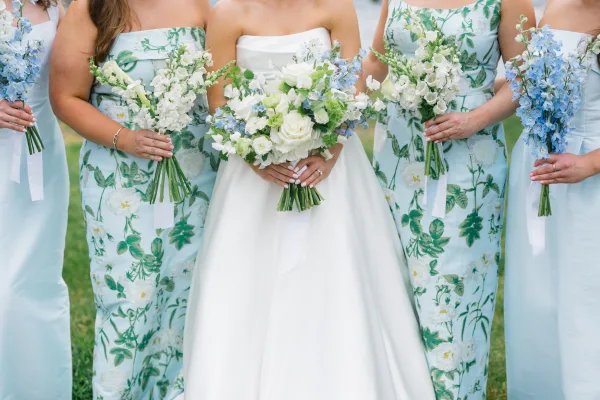
Flowers. White flowers keep the blue on the gown, where it belongs. For blue in the bouquet, true blue flowers are few, and hydrangea is the most dependable of them; blue hydrangea bouquets echo a porcelain gown without competing with it. Avoid pale blue flowers held against pale blue accents, since the two blur into one soft patch in photographs.
A second look. Removable blue gives you two looks from one gown: take the sash and veil off after the ceremony, or do the reverse and add blue bows for the reception. A short toile or printed blue and white dress also makes a strong change for the party, and second looks are the place to be bolder than the gown that came before.
The rest of the wedding. If the goal is the palette rather than the gown, a dusty blue wedding puts the color into the linens and florals while the dress stays white.
Frequently Asked Questions
Can a wedding guest wear a blue and white dress?
Yes, as long as blue is the dominant color. The guest rule is about white: a dress that looks white from across the room, even with a small blue print, sits too close to the bride. A mostly blue dress with white pattern is fine at a typical wedding.
Can you add blue to a white wedding dress you already own?
Yes. A seamstress can add a blue sash, bows, or a blue-edged veil, and an embroiderer can stitch blue motifs onto lace or tulle. Tinting an underlayer or dyeing an ombre hem goes to a bridal dye lab. Do all of it before alterations, since dye and embroidery both change how the gown hangs.
Can you dye a white wedding dress blue?
Yes. Bridal dye labs dye finished gowns, starting with a swatch test cut from an inside seam. Sequins and metallic thread can pick up a tint while glass stones stay clear, and some fabrics shift in the bath, so alterations come after dyeing.
Will blue embroidery bleed onto a white wedding dress?
It can, if the thread or fabric is not colorfast and gets wet or hot. Test a hidden motif by pressing a damp white cloth against it before the wedding. Warn anyone steaming the gown, and never let a stain near the blue be treated with water.
What flowers go with a blue and white wedding dress?
White flowers are the safest choice, because they leave the blue on the gown. Hydrangea and delphinium are the most reliable true blues for the bouquet. Avoid pale blue flowers against pale blue accents, which blur together in photographs.