What Makes a High Neckline
A high neck wedding dress closes the neckline at the base of the throat, replacing the open chest of a strapless or V-neck with a panel that rises to the collar. It arrives in two constructions: a sheer illusion panel of tulle matched to the skin, or a solid mock-neck cut from opaque fabric.
Sheer tulle matched to the skin behaves one way against the light, and a solid band collar behaves another. The two constructions also work differently against the body. The illusion version relies on fine net, often scattered or edged with lace, so the coverage stays airy and the pattern can climb from the bodice onto the throat in one continuous run without adding any visual weight. Because the chest is covered either way, the eye travels to the face, the shoulders, and whatever the design does at the back rather than to the neckline itself.
Where a solid mock-neck reads sharp and graphic, it holds a clean vertical line that suits a minimalist crepe or a satin column with the neckline as the only statement. A solid collar reads architectural and asks for restraint elsewhere, since a stiff band against a busy skirt fights for attention. Illusion, by contrast, keeps the height without the weight, so the lace can run uninterrupted from bust to collar.
That structural fork carries downstream, and it decides how the gown holds itself. A sheer illusion neck contributes almost no support, so the bodice underneath does the structural work, while a fabric mock-neck can share a little of the load. Choosing between illusion and solid shapes fabric weight, sleeve, and back all at once, which is why it comes first.
High Neck With Long Sleeves
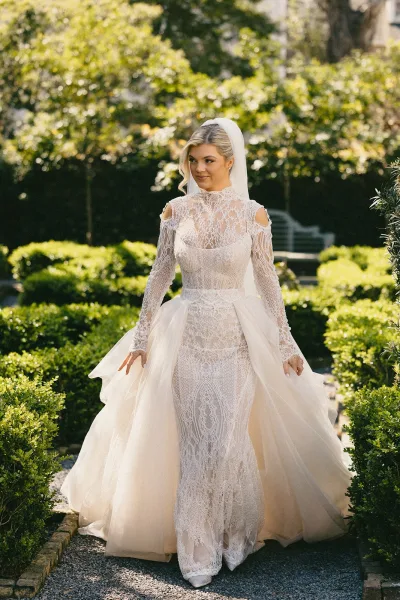
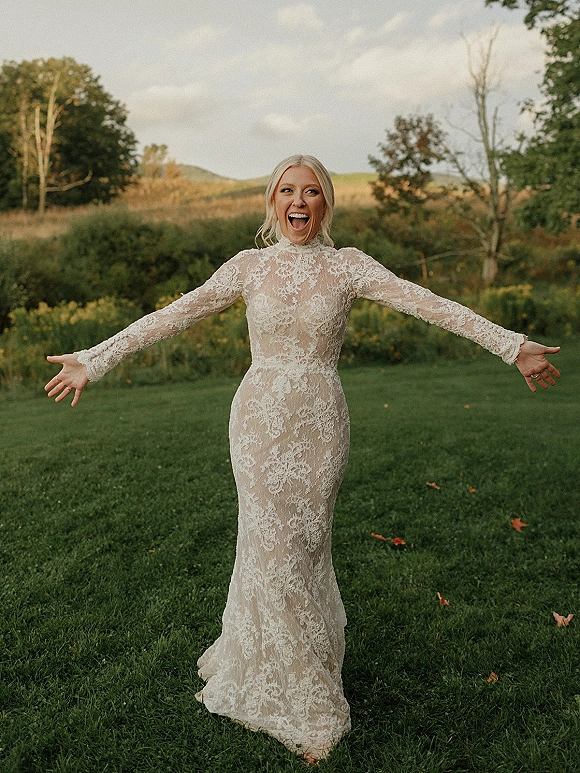
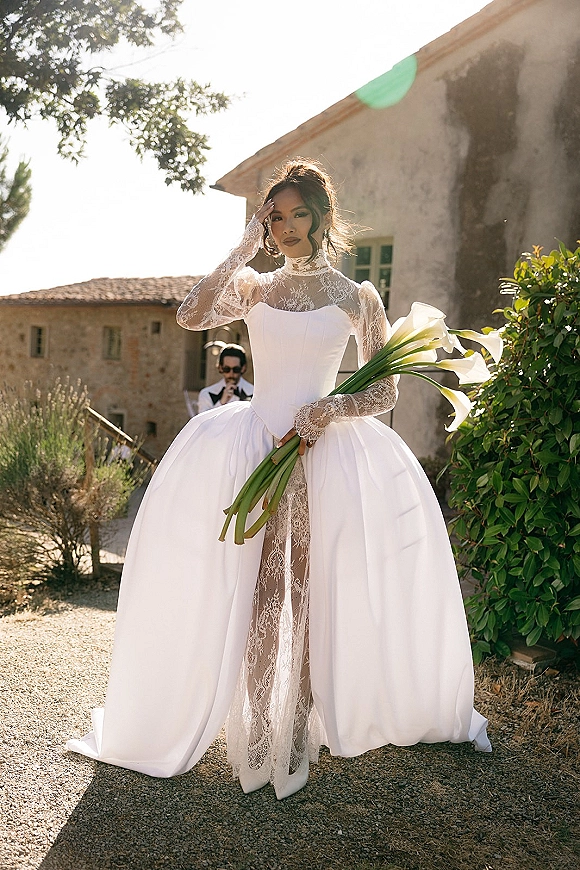
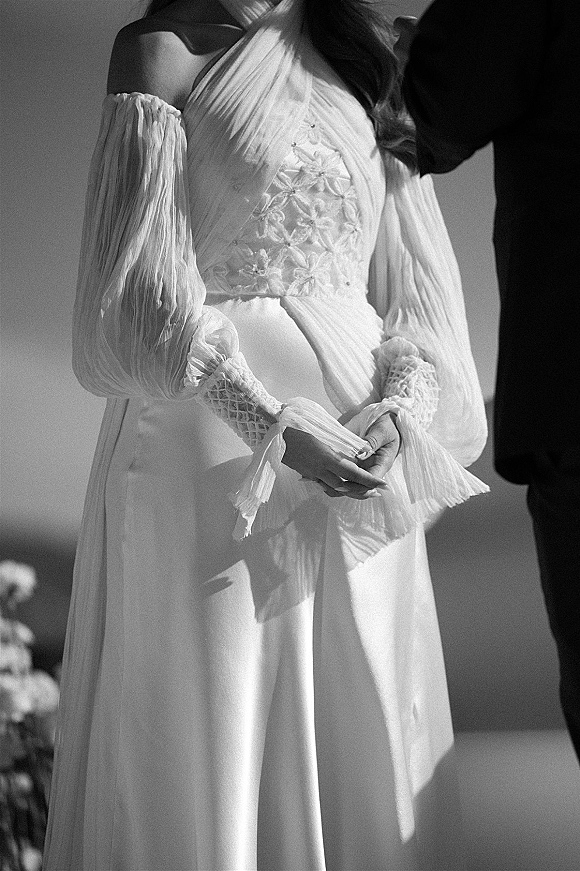
Long sleeves are the dominant partner to this neckline, and a high neck long sleeve wedding dress is the single most-searched version of the look. The two coverage choices reinforce each other, extending the closed line of the neck down the arms for a gown that stays cohesive from throat to wrist. In illusion, the sleeve and neckline are often one continuous sheer panel traced in lace, so the arms read as lace over skin rather than solid fabric, and the seam between neck and shoulder disappears.
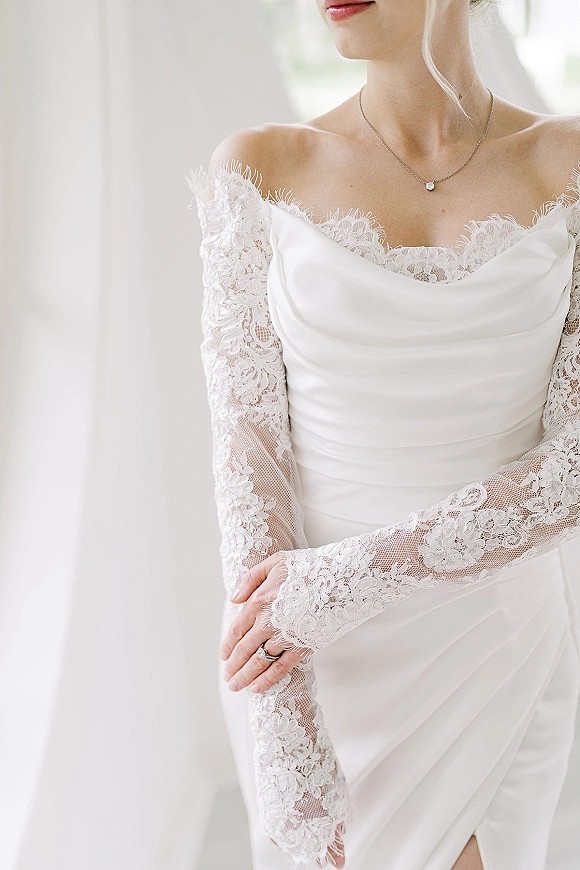
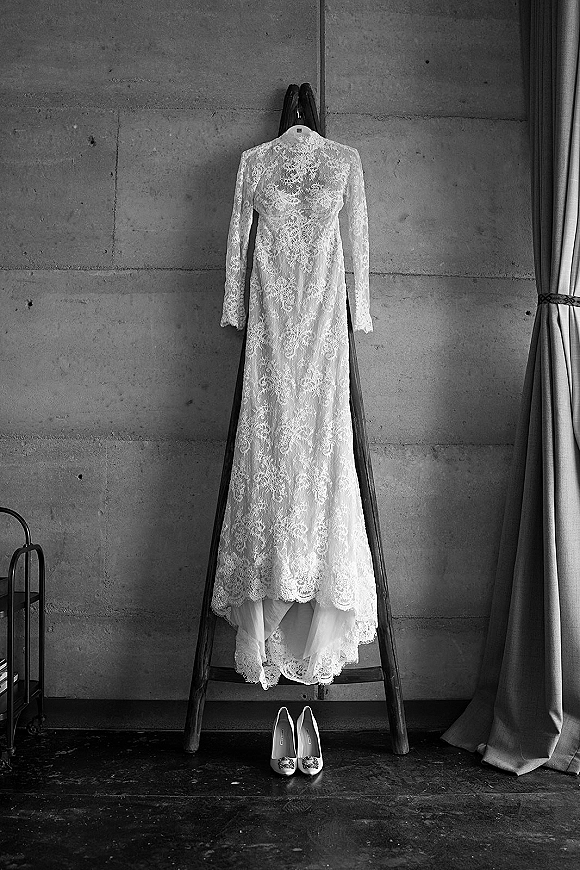
A long sleeve high neck wedding dress handles cool weather and formal or religious settings that ask for coverage, and it gives lace room to run the full length of the arm. Sleeve construction changes the formality more than any other single detail. A fitted point cuff tapers over the wrist and ends in a small extension over the back of the hand, which reads vintage and precise. A bell sleeve widens from the elbow and swings loose. A bishop gathers fullness from shoulder to a fitted band at the wrist for a softer, fuller line. A sheer illusion cuff keeps the arm covered while showing skin, so the sleeve looks weightless. Paired with a high neck, a fitted lace sleeve reads stately while a plain illusion sleeve keeps things current, and the wedding dress with sleeves gallery shows how far the sleeve alone can shift a gown.
Sleeve fabric matters as much as sleeve shape. A lace sleeve holds its own texture and reads ornate, while a plain tulle sleeve nearly vanishes and lets the arm show through, so two gowns cut to the same pattern can land in different registers depending on which cloth runs down the arm.
Fit is the quiet variable that separates a covered gown from a stiff one. A well-cut illusion sleeve follows the arm with a curved seam and a little ease at the elbow, so it moves when the bride raises her arms, whereas a sleeve cut too straight pulls at the shoulder and wrinkles at the inner elbow. A long sleeve high neck also changes how a veil and hair sit, since the covered arms ask for a cleaner upper line, and it grounds the gown for a ceremony that runs from a cool morning into an evening reception without a second layer to add or remove.
Lace High-Neck Gowns
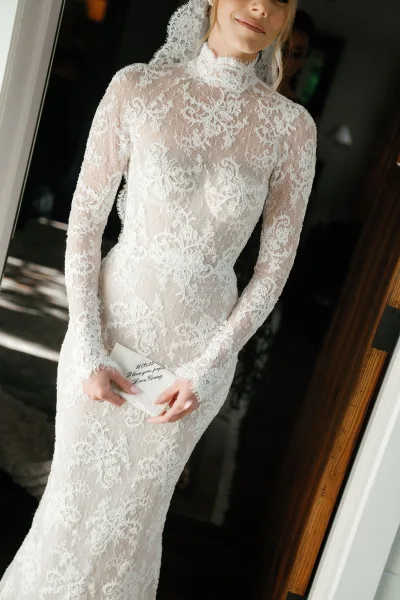
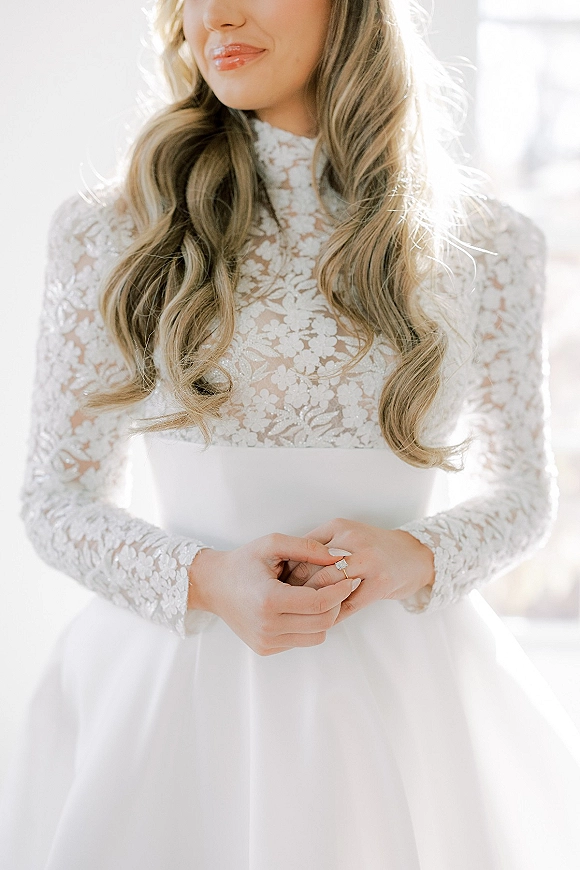
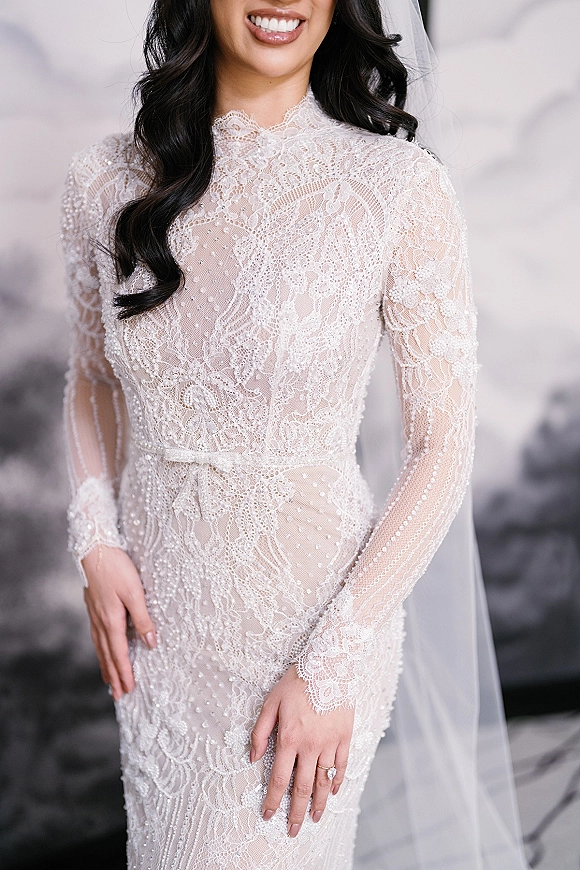
A high neck lace wedding dress is where the neckline turns romantic. Lace worked over an illusion panel lets the pattern climb from the bodice up the throat and often down the sleeves, so the coverage reads as decoration rather than fabric. A high neck long sleeve lace wedding dress is the fullest expression of that idea, tracing lace continuously from neck to wrist with no break in the design, so the coverage and the ornament become the same thing.
The type of lace controls how ornate the gown feels, and the names describe real differences in weight and texture. Chantilly is a fine bobbin lace with a delicate floral pattern and a scalloped edge, so it stays soft and close to the skin. Alencon carries a corded outline around each motif on a net ground, which gives it more definition and a slight raised line. Guipure, sometimes called Venetian lace, has no net ground at all; its motifs connect directly, so it reads bold and graphic at the neck. Corded and re-embroidered laces build dimension that catches light near the face, while a scattered appliqué lifts individual motifs off a net base and fades the pattern toward the shoulders so the coverage feels light. How the lace is placed matters as much as which lace it is: an unbroken sheet of Chantilly reads soft and even, while motifs hand-placed along the collar let a seamstress fade the coverage from dense at the bodice to sparse at the throat, and the sheer net between them shows skin so the panel never looks like a fabric collar. At the edges, a scalloped Chantilly border traces the collar and cuff softly, while a guipure edge cuts a firmer, cleaner line. Because the pattern already carries up to the face, a lace high neck wants restrained jewelry and a quiet skirt, and it is where the neckline earns its heirloom feel without naming a period.
Fabric Behavior Under a High Neck
Fabric decides how a high neckline sits, folds, and photographs, and each material brings a different behavior to the same closed line. Satin uses its weight and sheen to hold a smooth column, so the collar stands clean and the light reads as one long sweep from throat to hem, though it shows every seam and puts the burden on fit. Crepe is matte and slightly weighty, so it skims the body and gives a mock-neck a modern, pared-back finish that never shines. Mikado, a heavier blend with a subtle luster, holds structure and lets a band collar stand away from the neck in a more sculptural line. Organza is crisp and translucent, building volume in a skirt while a sheer high panel above stays light. Tulle and fine net are the base of most illusion necklines, disappearing against the skin so the lace appears to float. Matching fabric to construction is the point: a stiff mikado suits a solid collar, soft tulle belongs under an illusion panel, and pairing them the other way makes the neckline fight the cloth instead of settling into it.
Vintage and Victorian High-Neck Styles
Few necklines carry as much bridal history, and a vintage high neck wedding dress leans into that association with a band collar, a covered button back, or fine lace worked close to the throat. A vintage style high neck wedding dress reads romantic and composed, drawing on the Edwardian and Victorian habit of covering the neck and arms while letting delicate detail do the work. The effect is stately without tipping into costume, especially in ivory tones and aged lace. What holds the look together is restraint in the silhouette: a high collar pairs best with a clean skirt and soft, structured lace so the neckline reads as the period reference and the rest stays wearable.
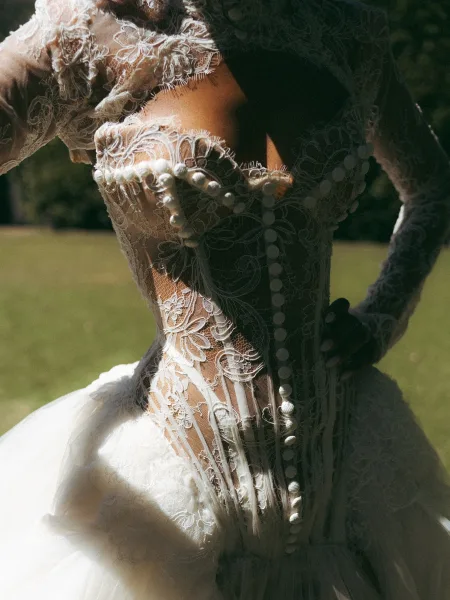
Covered buttons down the back, a subtle stand collar, and long fitted sleeves ending in a point cuff are the details that signal the style, and Alencon or Chantilly lace suits the era better than a bold guipure. A row of covered buttons running from the nape down the spine turns the closure into a design feature, and a narrow stand collar edged in scalloped lace gives the throat a soft frame without the stiffness of a full band. Aged ivory and champagne tones read older than a bright white, so the fabric color does part of the period work on its own before a single detail is added. Because the reference is a general period rather than any single gown, the style stays personal and adapts to a modern fit through the torso, and the skirt usually stays calm so the detail at neck, wrist, and back keeps the balance from tipping to costume.
High Neck Front With a Low or Open Back
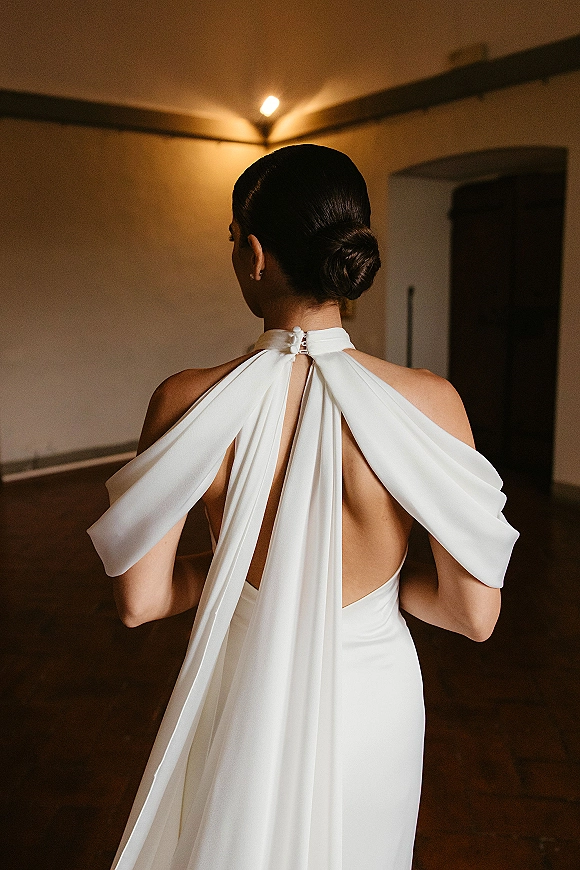
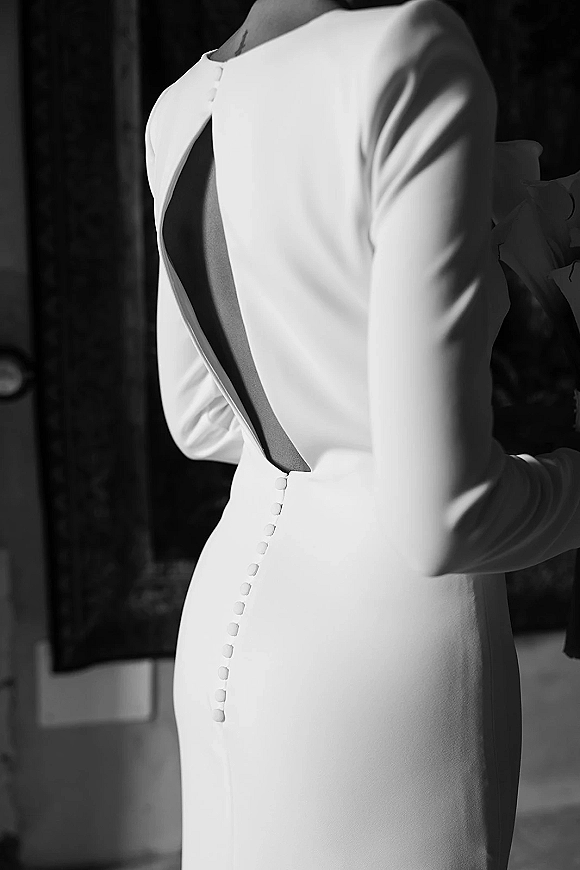
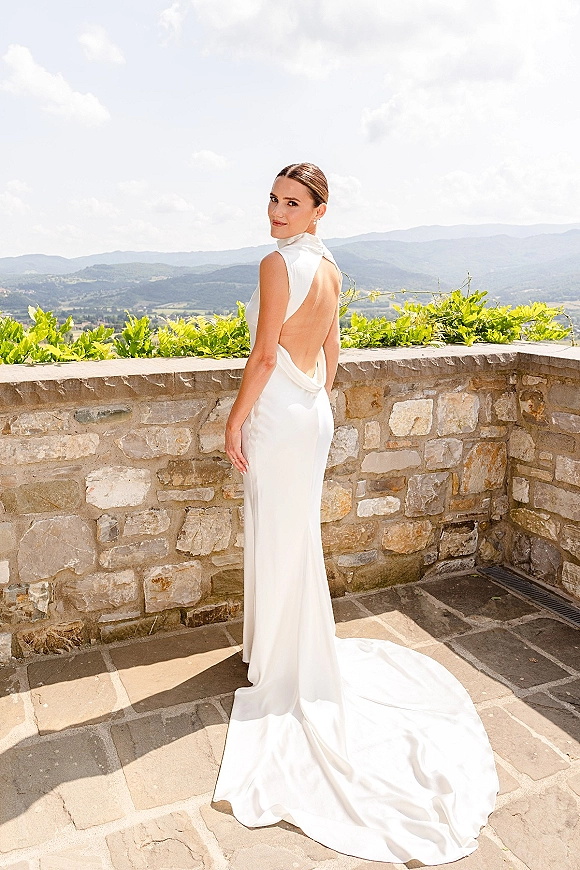
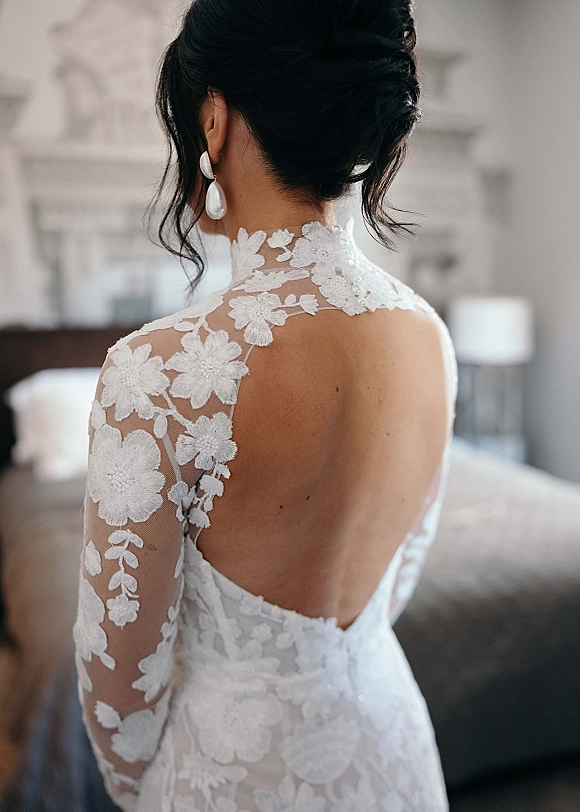
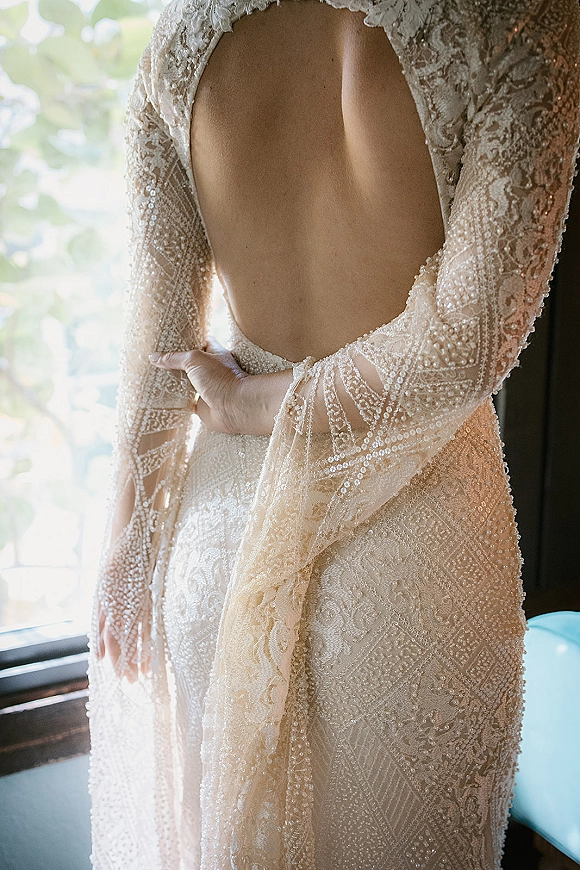
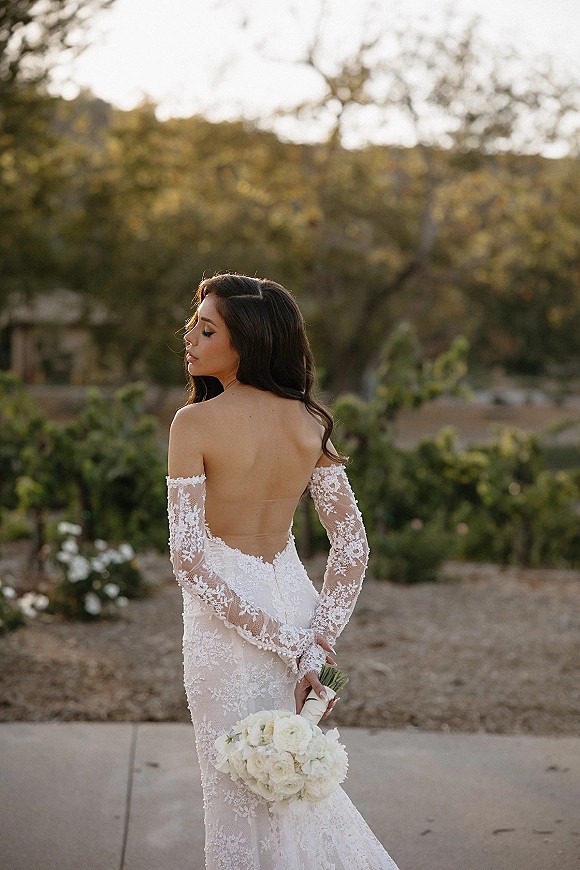
One of the high neck’s best tricks is the contrast between a closed front and an open back. A high neck low back wedding dress covers the chest to the throat and then drops away behind, so the gown reads modest from the front and dramatic from behind. This front-covered, back-bare balance gives a covered neckline a reveal without exposing the chest, which appeals to brides who want coverage and drama in one gown rather than choosing between them.
The reveal can finish with a keyhole, a deep scoop, or a sheer illusion panel that keeps the line unbroken. Construction carries real weight here. A solid high neckline paired with a deeply open back cannot lean on the neck panel for support, because a mock-neck holds almost none of the gown’s weight on its own. The bodice has to be anchored through the side seams, usually with internal boning and a fitted underlayer that carries the load down the torso rather than up to the collar.
An illusion back needs the same anchoring, since the sheer panel is decorative rather than structural and adds nothing to the support the open back gives up. Done well, the effect is composed walking down the aisle and striking walking away.
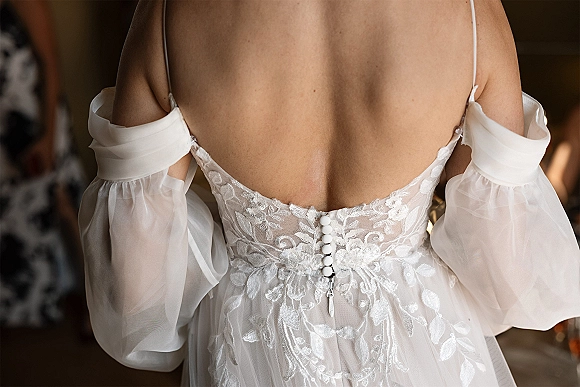
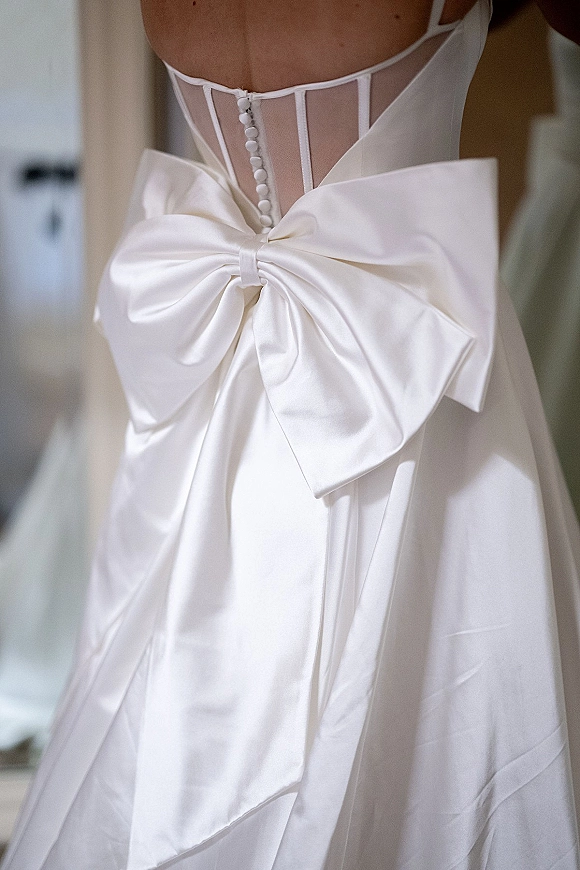
Buttons down a covered back give the walk-away its focal point. A strand of them along a keyhole draws the eye down the spine, a knotted tie holds a soft drape at the waist, and a scatter of beading catches light when the bride turns. The depth of the drop is a fit decision more than a style one: the lower the back, the more the support has to move into the side seams and an internal band that sits at the natural waist. Pairing a closed illusion or lace front with an open back is the high neck’s signature move, letting one gown read modest from the pew and dramatic from behind without changing a stitch.
Sleeveless High-Neck Gowns
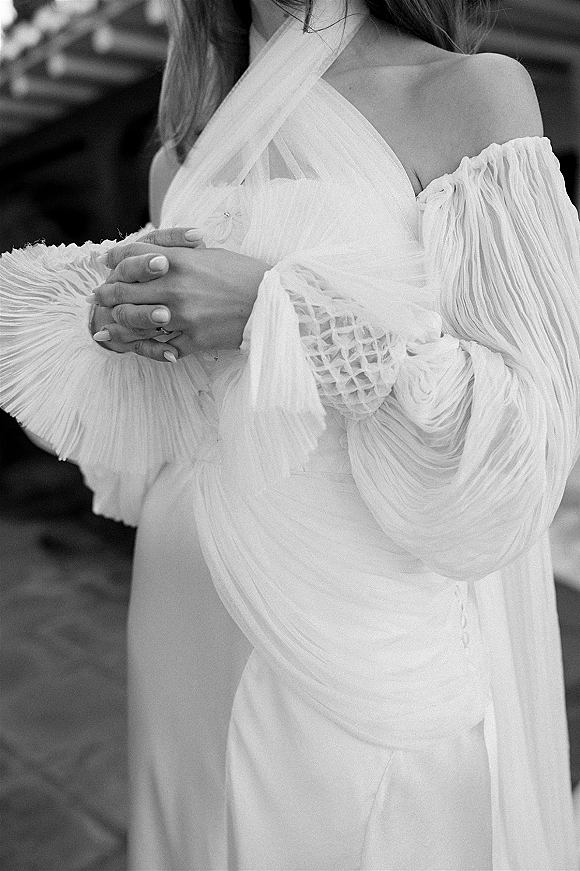
Not every high neck covers the arms. A high neck sleeveless wedding dress keeps the closed throat but bares the shoulders and arms entirely, a combination that reads clean and a little unexpected. Sometimes described as a mock-neck sleeveless look, it pairs the graphic high line with open shoulders for a gown that feels covered at the neck and cool everywhere else.
This version suits a minimalist bride and a warm-weather setting, since it offers the composure of a high neck without the heat of sleeves. In a solid crepe it is architectural and pared back, the collar doing all the work against bare arms, while an illusion sleeveless high neck keeps the delicacy with more skin showing through the panel. The open arms balance the closed neckline, which stops the look from feeling heavy or covered-up. With no sleeve to soften the line, the edge where fabric meets the shoulder has to sit clean and flat, so a solid mock-neck relies on a precise armhole and a supportive inner bodice to hold the neckline upright on its own. In a fluid crepe the effect is spare and modern, and the collar becomes the only detail the eye lands on. The look pairs naturally with a low or open back, since the bare shoulders already signal a gown built around skin at the back rather than the front, and it carries earrings and an updo cleanly because nothing crowds the neck and shoulders. For brides weighing an open shoulder against a covered one, the halter wedding dress shows the fuller shoulder-baring version of the same instinct.
The High Neck by Silhouette
Every skirt takes the high neck, and the pairing shifts its formality. A high neck a line wedding dress is the most versatile, grounding the closed neckline in a widely flattering skirt that narrows at the waist and widens gently to the hem, which suits most figures and most venues. A high neck mermaid wedding dress is the most dramatic, tracing the body through the hip before the skirt breaks, and in a heavier satin or mikado it carries structure that a solid collar matches. A sheath or column in a fluid fabric reads the most minimal, all vertical and quiet, and wants the least ornament so a plain mock-neck does the talking. Ball gowns take the neckline too, balancing a full skirt with a composed, covered top so the gown reads formal rather than sweet. A satin high neck in a clean A-line or column is the pared-back version of the look, using shine and line with no other ornament, while a lace-and-illusion bodice reads gentler because the skirt gives the eye somewhere to travel after the covered top. Because the neckline draws the eye up to the face, it keeps the visual weight high on a fuller skirt and lengthens the frame on a column, and the rule holds across shapes: the more dramatic the skirt, the more a covered, quiet neckline earns its place by keeping the balance high and the line clean.
Modest Brides and Coverage
Brides who want real coverage, whether for personal, cultural, or religious reasons, reach for the high neck first. A modest high neck wedding dress closes the chest to the throat and pairs easily with long sleeves and a fuller skirt for head-to-hem coverage that still feels considered rather than plain. Illusion is what makes modest coverage feel light, since a sheer lace panel covers the skin without adding weight or opacity, and the arms can stay covered in a matching sheer sleeve.
Coverage is adjustable across the whole gown, so a bride can dial it up or down without leaving the neckline. A solid high neck with long sleeves and a closed back gives the most, reading fully covered from every angle. An illusion high neck with a lined bodice and sheer sleeves reads covered but airy, meeting a coverage requirement while keeping the gown delicate. The neckline works for a house of worship and a formal ceremony without alteration, which is part of why modest brides return to it. It shows that coverage and design are not a trade-off, since the closed neckline is often where the most detailed lace and construction live.
Fabric choice does a lot of the modest work quietly. An opaque crepe or satin mock-neck reads fully covered and needs no lining at the neck, while an illusion panel meant for coverage should sit over a bodice lined to the point where the sheer section begins, so the skin shows only where the design intends. A modest high neck can still hold a low or open back if the bride wants coverage at the front and shape at the back, and the two requests do not conflict as long as the bodice is anchored to carry the gown. The result is a neckline that meets a real coverage need and still reads as a considered design rather than a compromise, giving a modest bride the same range of lace, fabric, and construction that any other neckline offers.
Styling a High Neckline
With the space a necklace would occupy already filled, most high-neck brides skip the necklace entirely and let the neckline stand alone. Earrings become the key piece of jewelry, and a pair that sits close to the face balances the height of the neckline without cluttering it. A bracelet or cuff works with a sleeveless or short-sleeve high neck where the wrist shows, and rings carry small detail when the neck and arms are covered. Removing the necklace from the equation shifts the whole jewelry plan upward, toward the ears and the face, which is exactly where a high neckline already sends the eye.
Hair is the deciding styling choice. An updo or a swept style shows the full neckline, the collar or lace detail, and any open back, which is why the high neck and the updo pair so often. Worn down, hair softens the neckline but can hide the collar detail and the back reveal that give the gown its whole effect. A veil drapes cleanly from a high crown, sitting above the collar so it frames the covered neckline rather than crowding it. A cathedral or chapel veil set high on the head trails behind an open back and lets the reveal show through its sheer edge, while a shorter veil keeps the focus on the collar itself. For adjacent covered-neckline looks, compare the sheer panels of an illusion neckline wedding dress or the soft curve of a sweetheart neckline wedding dress, and browse makers in the wedding dress directory.
Frequently Asked Questions
What is the difference between an illusion and a solid high neckline?
An illusion high-neck uses sheer tulle or net, often traced with lace, so the panel reads as covered but shows skin beneath and stays light. A solid high-neck, including a mock-neck or collar, uses opaque fabric for full coverage and a cleaner, more graphic line. Illusion feels airy and romantic, solid reads sharper and more architectural.
Is a high neck wedding dress good for a modest look?
The high neck is one of the most popular choices for modest brides. It closes the chest to the throat and pairs easily with long sleeves and a fuller skirt for head-to-hem coverage that still feels bridal. Illusion versions keep modest coverage feeling light, and a solid high neck works for a house of worship without alteration.
Can a high neck dress have an open back?
Yes, and the contrast is one of its signatures. A high neck covers the chest and can drop to a keyhole, deep scoop, or open back behind, so the gown reads modest from the front and dramatic from behind. A fully open back needs the bodice anchored carefully through the sides, since the neck panel alone does not hold the gown.
Why are high neck and long sleeves so often paired?
The two coverage choices reinforce each other, extending the closed line of the neck down the arms for a cohesive, covered gown. In illusion, the neckline and sleeve are often one continuous sheer panel traced in lace. The pairing suits cool weather, formal and religious settings, and gives lace room to run from throat to wrist.
What jewelry works with a high neckline?
Most high-neck brides skip the necklace, since the neckline fills the space a necklace would occupy and the two compete. Earrings become the key piece, ideally sitting close to the face to balance the height. A bracelet or cuff suits a sleeveless or short-sleeve version. An updo shows the neckline and any collar or back detail.
Is a high neckline flattering on everyone?
The high neck draws the eye up to the face and creates a long, composed line, which flatters most figures. It lengthens the neck on a fitted silhouette and balances a fuller skirt by keeping visual weight high. A softer illusion panel tends to suit a fuller bust better than a stiff band collar, which reads best on a longer neck.