What Defines a Halter Neckline
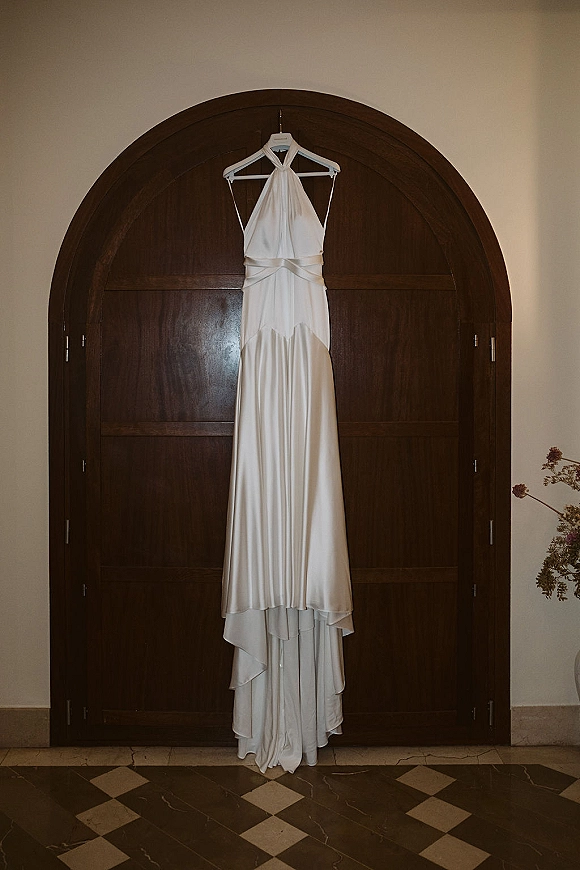
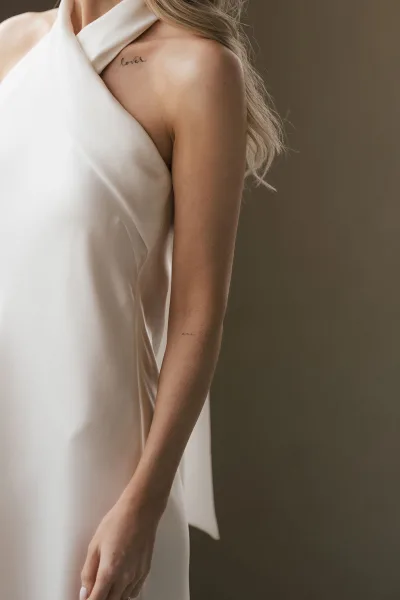
Suspended from a strap, band, or panel that fastens behind the neck, a halter neckline leaves the shoulders and most of the upper back bare. It splits into two forms: a halter-neck of narrow straps that meet high at the nape, and a halter-top that carries a wider panel of fabric from bust to throat.
That split matters because it changes how the gown carries weight and how much skin shows. A narrow halter-neck tie routes the full load of the bodice through the back of the neck, so it favors lighter fabrics and a well-boned bodice underneath to keep the front from dragging down over a long day. The halter-top spreads that same load across a broader band and covers more of the chest, which lets it hold heavier beadwork and a structured skirt without pulling at the nape. Both forms clear the shoulders and arms completely, so the neckline photographs as one of the most graphic from the front and reads almost strapless from the side.
Where the strap meets the bust changes the whole effect. A high-set band that sits close to the throat gives a covered, composed front and a strong vertical line up the center. Angle the straps out toward the shoulders and the chest opens into a shallow V that lets more of the collarbone show.
Knowing which version you are looking at tells you how the neckline will feel through a reception, how it sits when you raise your arms, and how it pairs with your back treatment. Read as a single deliberate choice from every angle, the halter has stayed a reference point for brides who want the upper body, rather than the skirt, to lead the look.
Lace Halter Wedding Dresses
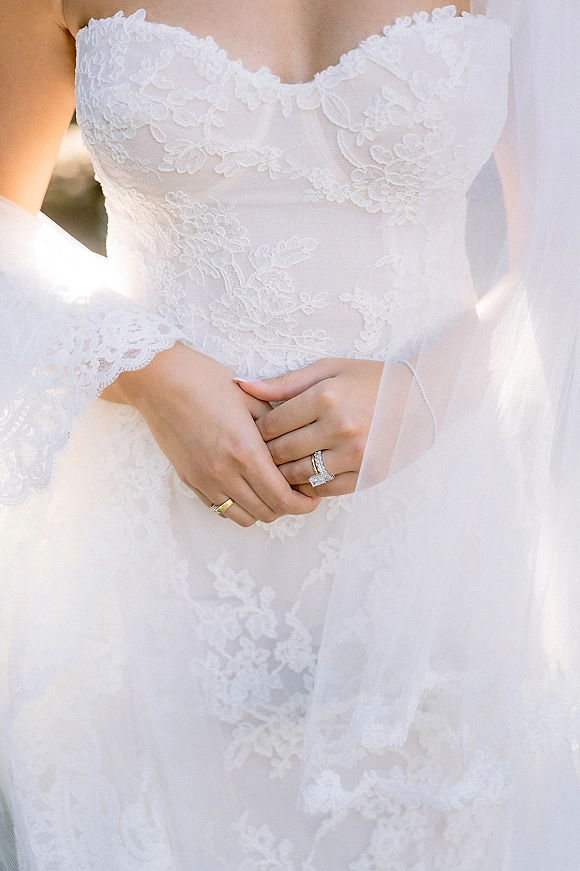
A lace halter wedding dress softens the neckline’s clean geometry with texture, tracing the strap and bodice in Chantilly, Alencon, or guipure so the bare shoulders read romantic rather than sporty. The lace can climb the halter band as a solid panel or scatter as appliqué that fades toward the shoulders, which keeps the open back light. Corded and re-embroidered laces raise the pattern off the surface and catch light along the collarbone, while a finer floral Chantilly stays flat and delicate against the skin.
The lace type sets the mood as much as the silhouette does. Chantilly is the lightest and most fluid, a fine net ground with a scalloped floral pattern that suits a soft, unstructured halter and a garden setting. Alencon builds a corded outline around each motif, so it holds a crisper edge and photographs with more definition, which reads formal on a structured bodice. Guipure, sometimes called Venise, drops the net ground entirely and connects its motifs with bars, giving a heavier, more graphic lace that stands away from the skin and works on a modern, pared-back cut. Re-embroidered lace adds beadwork or thread over an existing pattern for the most dimension, and it wants the least jewelry alongside it.
A lace halter top wedding dress in particular bridges coverage and detail. The wider panel gives the lace room to build a real pattern across the chest, so the design does the work a necklace otherwise would, and the appliqué can be placed by hand to follow the halter line up toward the nape. Brides drawn to a boho or garden mood lean toward unlined or lightly lined lace that shows a hint of skin through the pattern, while a formal look leans on denser lace over a solid lining. Because the lace already carries the eye, it usually wants a quiet skirt: a plain satin column, a soft tulle A-line, or a bias slip that keeps the bodice the focal point.
Satin and Silk Halter Gowns
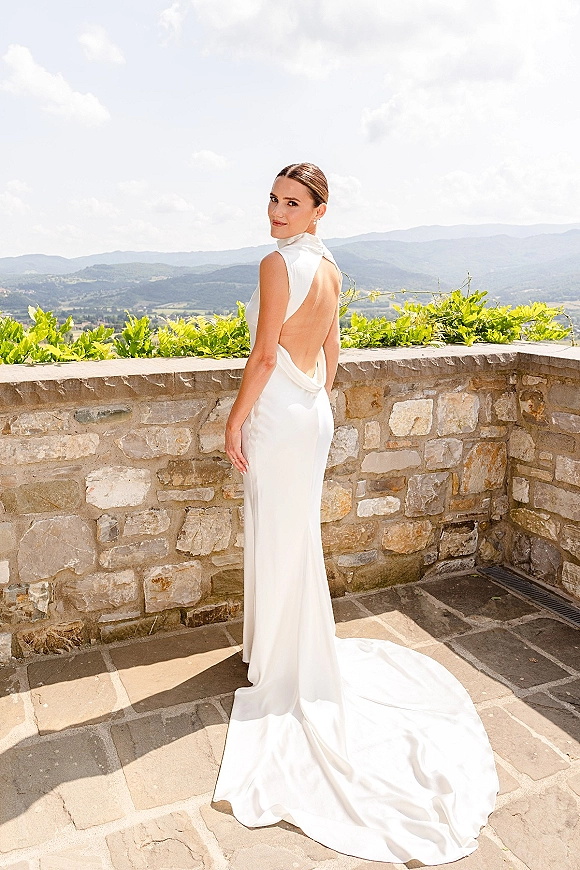
Where lace adds pattern, a satin halter wedding dress or a silk halter wedding dress leans on line and light. Charmeuse and silk crepe fall in a fluid column that follows the body, so the vertical strap and the skirt read as one uninterrupted line from neck to hem. The fabric choice governs how the strap behaves, how the gown catches light, and how forgiving it is of a seam, which makes it the first decision on a minimalist cut.
Charmeuse is the shiniest and most liquid of the group, a satin weave with a high-gloss face that pours over the body and reflects light in long ribbons, so it flatters a lean line and shows every curve and every stitch. Silk crepe turns the fabric over to its matte, pebbled side: it drapes with the same weight but reads quiet and modern, hides construction better, and photographs without hot highlights.
Duchess and mikado satin behave in the opposite direction, holding a crisp, sculptural shape that lets the halter panel stand away from the chest and gives a full skirt real body. A satin halter neck wedding dress cut as a bias slip is the cleanest reading of all, with nothing but the fabric’s shine to carry it.
Both silk and satin reward simplicity. A silk halter shows every seam, so the bodice construction and the fit carry the whole look, and a self-tie cut from the same satin as the gown keeps the eye moving smoothly from neck to hem. A heavier duchess strap can support beading or a structured cup without collapsing, while a lightweight charmeuse strap needs an interior stay or a hidden clasp to keep the weight of the skirt from tugging the neckline forward. These fabrics photograph as sculpture in daylight and glow under warm reception light, which is a large part of why the fluid satin halter reads as modern shorthand for a pared-back bride.
Backless and Low-Back Halter Pairings
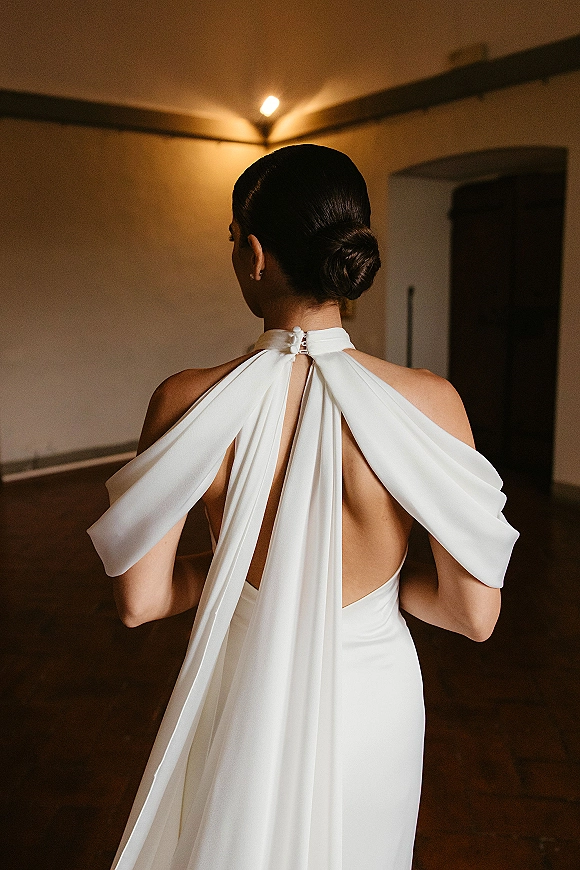
A neckline that already frees the shoulders leaves the back as the obvious place for interest, which makes the halter and the open back natural partners. Drop the fabric to the waist or lower and the front reads modest and covered while the back does the reveal. That front-covered, back-bare balance is one of the halter’s signatures and a large part of why brides choose it over a strapless cut.
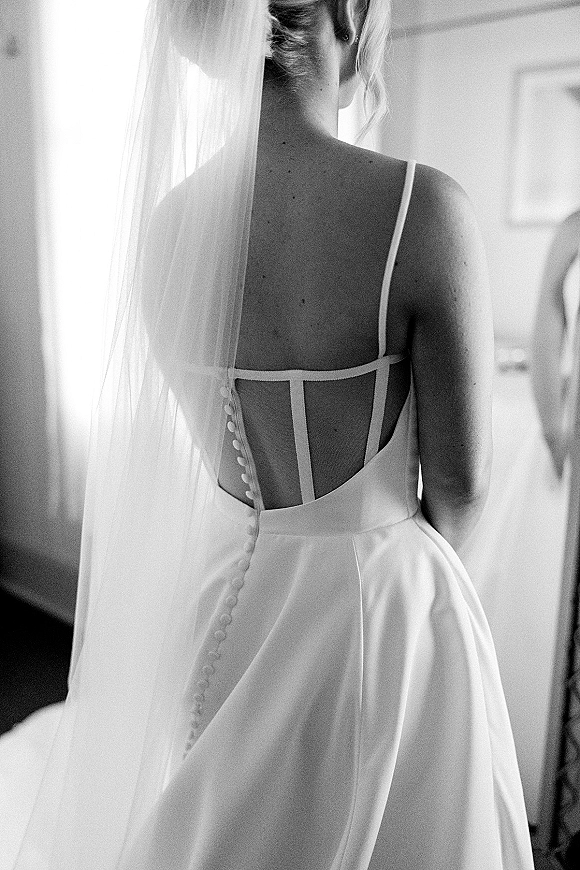
How low the back goes is a structural decision as much as an aesthetic one. A deep drape needs the bodice anchored through the side seams and often a longer-line or built-in support so the gown stays put through dancing, because once the back is open no zipper line does the holding. Where a tie loads the nape, the straps carry the front weight and leave the spine free, which makes the low back easier to engineer but asks more of the fit at the side seams and underbust. Designers turn the reveal into a focal point in a handful of ways: a strand of covered buttons down the spine gives the eye a line to follow, a knotted self-fabric tie echoes the halter at the nape, and a scatter of beading or a lace edge frames the opening when you turn. If a fully open back feels like too much, a keyhole cut leaves a small teardrop of skin, and a sheer illusion panel keeps the halter’s spirit with coverage that photographs as bare. The lower the back sits, the more the side seams and any internal corselet take over the job the back normally does, so match the depth to your comfort and your movement rather than chasing the lowest possible cut.
The Halter by Silhouette
Nearly every skirt shape takes the halter, and the pairing changes its personality. An a line halter wedding dress is the most balanced reading, with the fitted bodice flowing into a gently widening skirt that suits most figures and most venues. A halter mermaid wedding dress is the most overtly glamorous, tracing the torso through the hip before the skirt breaks, so the neckline and the silhouette both emphasize a long, continuous line. A sheath or column halter is the quiet minimalist option, all vertical and unadorned.
Each silhouette asks something different of the neckline. The a line halter carries weight well because the skirt’s volume balances the framed shoulders, so it takes a wider halter-top panel or a beaded bodice without looking top-heavy. The halter mermaid concentrates every seam on line, so it reads best in a fabric that holds shape through the hip, like mikado or a bonded crepe, and it wants a bodice with real internal structure to support the fitted torso. A column or sheath halter has nowhere to hide, so it depends most on the drape of the fabric and the precision of the fit.
Ball gowns take the halter too, using the bare shoulders to lighten a full skirt that would otherwise feel heavy, which keeps a formal gown from tipping into costume. Because the neckline draws attention upward, it flatters a fuller skirt by keeping the visual weight balanced between the framed shoulders and the volume below. Choosing the silhouette under a halter is a decision about where you want the eye to rest: on line, on the shoulders, or on the sweep of the skirt.
The Halter by Bust and Support
The right halter for a given bust comes down to where the weight lands and how the bodice is built underneath. A wider halter-top panel and a boned, structured bodice carry the load through the torso and suit a fuller bust, while a narrow single strap loads the nape and reads cleanest on a smaller bust or over strong internal structure. Cups and side boning do the real work here, not the strap.
A smaller bust has the most freedom, since a single narrow tie and a light, unlined bodice hold their shape without much internal support, and a deeper front V or a low-set strap opens the chest cleanly. Sewn-in cups add a soft, rounded line without adding coverage, and a low-set strap sits well because there is less weight asking to be held. A fuller bust is better served by a bodice with a built-in corselet, side seams boned to stop the neckline from spreading, and a strap wide enough to distribute weight, whether that is a broad halter-top band or a doubled tie. A single thin tie under real weight tends to slide and to mark the neck by the end of the night, which is exactly the trade the wider band solves. Molded or seamed cups give lift and separation that a bare strap alone cannot, and they keep the neckline from pulling forward when you move.
Comfort comes down to construction more than fabric: a good halter lets you raise your arms and lean in for a hug without the front dropping or the strap sawing at your neck. A back closure that fits precisely, a strap that adjusts or ties rather than sitting at a fixed length, and an underbust seam that grips the ribcage all keep it secure through a full day. Fit the bodice first and let the neckline follow, because the halter that is comfortable at the fitting is the one that stays put through dancing.
Beach and Destination Halters
For a beach or destination wedding, the halter earns its place for practical reasons as much as visual ones. A halter beach wedding dress in light chiffon or crepe stays cool, moves in wind, and needs no shoulder straps that shift or leave a tan line, while the open back and bare shoulders suit warm air and outdoor light. Chiffon is the airiest, a sheer weave that catches a breeze and layers over a slip for movement without weight, and a washed or matte crepe holds a little more shape and resists wrinkles through a suitcase. Both survive humidity better than a heavy structured satin, which can feel warm and hold creases in a damp climate. On sand, on a dock, or up stone steps, a shorter or tea-length cut clears the ground without a train to catch, and the secure neck strap gives more confidence than a strapless bodice in a gust off the water. That anchored neckline is the quiet reason so many waterfront and garden gowns land on the halter: it stays where you put it while you move.
Boho Halter Gowns
A boho halter wedding dress leans into the neckline’s relaxed, unstructured side, usually in soft lace, cotton-blend, or crepe with little internal boning so the gown drapes rather than sculpts. It often ties at the nape in a self-fabric knot, sometimes with trailing ends down the open back, and pairs with a low back, a slip skirt, or a subtle godet for movement. Crochet-effect and floral laces, unlined panels, and a slightly undone finish are the markers of the look.
The lace here tends toward the graphic and the open. Guipure and crochet-effect laces, with their bold motifs and visible gaps, carry the earthy, handmade feeling the style wants, and an unlined panel that shows a hint of skin keeps it soft rather than formal. This version suits garden, vineyard, and outdoor ceremonies where the mood is easy and the light is natural, and it layers well with loose waves, minimal jewelry, and bare or sandaled feet. A raw or tasseled edge on the tie leans further into the undone finish, and trailing ends down the spine catch the wind on an outdoor aisle. The neckline gives an otherwise soft silhouette just enough structure at the top to keep it from looking shapeless, which is why the boho halter holds its form in photographs even when the rest of the gown moves.
Plus-Size Halters, Support, and Fit
A plus size halter wedding dress works with the neckline’s natural strengths: it frames the shoulders and decolletage, draws the eye up, and creates a long vertical line through the strap and bodice. The key to a flattering, comfortable fit is support. Because a narrow tie loads the back of the neck, a fuller figure is better served by a wider halter-top panel or a halter built over a boned bodice that carries the weight through the torso rather than the nape.
Coverage across the chest is adjustable, so a halter can sit high and modest or open into a deeper V while still holding the shoulders secure. A wider band across the upper chest reads clean and gives the fabric a smooth surface for lace or beading, while a boned corselet inside the bodice keeps the waist defined and stops the neckline from spreading under weight. Duchess satin and structured crepe hold their shape against a fuller frame better than a thin charmeuse, and a lined lace over a firm base gives pattern without clinging. A back that closes with a zipper and an inner hook-and-eye stay lets the fit be dialed in precisely, so look for real internal structure, boned side seams, and a strap wide enough to sit flat on the shoulders rather than dig in.
Short and Tea-Length Halters
A short halter wedding dress trades the sweep of a train for ease of movement, keeping the framed shoulders and open back while cutting the skirt to the knee, the tea-length calf, or higher. The shorter skirt shifts the balance of the gown upward, so the neckline and bodice carry even more of the look, which suits a courthouse ceremony, a rehearsal dinner, a reception second look, or a warm-weather setting. Fabric decides whether it reads crisp or soft: a structured mikado or duchess satin in an A-line holds a defined, retro shape that stands away from the leg, while a bias-cut charmeuse slip falls close and fluid, and a tea-length tulle skirt adds light, playful volume. Because the skirt shows the legs and shoes, the shoe becomes part of the outfit rather than an afterthought. Nothing drags on sand, grass, or a dance floor, a packable crepe or chiffon version travels light, and the bare shoulders and open back stay the story while the skirt steps back.
Styling a Halter Neckline
Because the halter clears the neck and shoulders entirely, it styles almost opposite to a strapless gown. A necklace competes with the strap and usually disappears against it, so most halter brides skip it and let the collarbone and the neckline’s line stand on their own. Statement earrings and a bracelet or cuff carry the jewelry instead, keeping the focus where the neckline already leads. A pair of drop earrings that catches the light echoes a beaded or lace halter without crowding it.
Hair is the biggest styling lever. An updo, a chignon, or a swept-back style shows the full neckline, the bare shoulders, and any detail on the halter band or open back, which is why so many halter brides wear their hair up. Worn down, hair softens the look but can hide the back reveal that makes the neckline distinct, so a half-up style is a middle path that keeps some coverage while still opening the shoulders. A veil works well too, since it drapes from the crown and frames rather than covers the open shoulders, and a sheer, unadorned veil lets a lace or beaded halter show through until it lifts.
The neckline pairs cleanly with the rest of a bridal look because it asks for so little alongside it. A bare back takes no adornment, an earring does the sparkle, and the fabric of the halter itself sets the tone. If you want to explore how the neckline reads against an open back or a fluid column, the strapless wedding dress and mermaid wedding dress galleries show adjacent looks, and you can find makers in the wedding dress directory. For related covered-shoulder options, compare a high neck wedding dress or the deeper front of a v-neck wedding dress.
Frequently Asked Questions
What is the difference between a halter neck and a halter top wedding dress?
A halter-neck ties or clasps with narrow straps that meet behind the neck, showing more of the chest and shoulders. A halter-top wraps a wider panel of fabric from the bust up to the neck, giving more coverage across the chest and spreading the bodice's weight over a broader band. Both leave the shoulders and upper back bare.
Is a halter wedding dress flattering for a larger bust?
Yes, with the right support. A wider halter-top panel or a halter built over a boned, supportive bodice carries the weight through the torso rather than the neck, which keeps a fuller bust comfortable and secure. A narrow single-strap tie offers less support and suits a smaller bust or a gown with strong internal structure.
Can you wear a halter wedding dress with a low or open back?
The halter pairs naturally with a low or backless design. Because the neckline carries the front from the back of the neck, it leaves the spine free for a deep drape, a keyhole, or a fully open back. A low back usually needs the bodice anchored through the side seams and built-in support so it stays secure while dancing.
What jewelry works with a halter neckline?
Most halter brides skip a necklace, since the strap and the neckline's line already fill the space and a necklace competes with them. Statement earrings, a cuff, or a bracelet carry the jewelry instead. An updo or swept-back hair shows the full neckline and any detail on the band or open back.
Is a halter dress good for a beach or destination wedding?
The halter is one of the most popular necklines for beach and destination weddings. In light chiffon or crepe it stays cool, moves with the breeze, and needs no shoulder straps that shift, and the secure neck strap gives more confidence than a strapless bodice in wind. Soft, packable fabrics also travel well.
What silhouettes suit a halter neckline?
The halter sits on nearly every silhouette. An a-line gives the most balanced, widely flattering read, a mermaid or fitted cut reads most glamorous, and a sheath keeps it minimal. Ball gowns use the bare shoulders to lighten a full skirt. The neckline draws the eye upward, so it balances volume well below the waist.