What Defines a V-Neck
A v-neck wedding dress angles the bodice down from the shoulders or straps to a point at the center of the chest, forming a V. That downward vertical line is the defining feature, and it elongates the neck and torso while leading the eye down the center of the body rather than across it.
The lines can run sharp or soft, and the point can sit shallow or deep, but the direction stays the same. That downward angle is what separates the V from its neighbors. A sweetheart curves across the bust in two soft scallops, and a square neck cuts a flat horizontal line, so both read as width. The V reads as height. It opens the chest into a point instead of framing it with a curve or a straight edge, and that single change in direction is why the neckline behaves the way it does in a photograph and against a figure.
Elongation is also why the V flatters so widely. The vertical line lengthens the upper body, narrows and defines the frame, and creates the impression of added height, which is part of why it suits shorter figures and fuller busts especially well. On a fuller bust it opens and separates rather than flattening or covering, and on a shorter frame it stretches the visual line from collarbone to waist. The depth of the point controls the drama, from a subtle dip that reads clean and classic to a deep plunge that reads bold and modern. Because the eye follows a central axis, the V pairs naturally with back interest and with vertical silhouettes, and it carries fabric and lace along its edges in a way that reinforces the elongation instead of fighting it.
Deep-V and Plunging Necklines
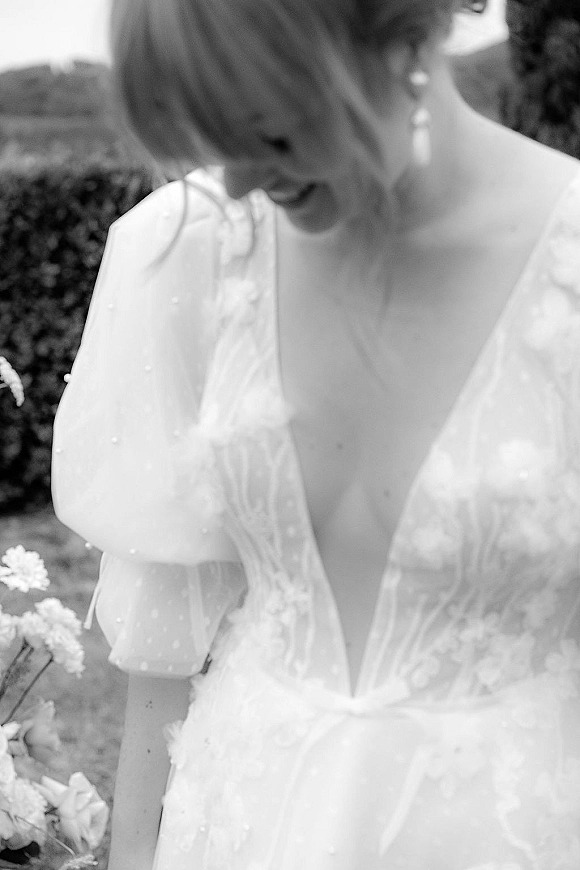
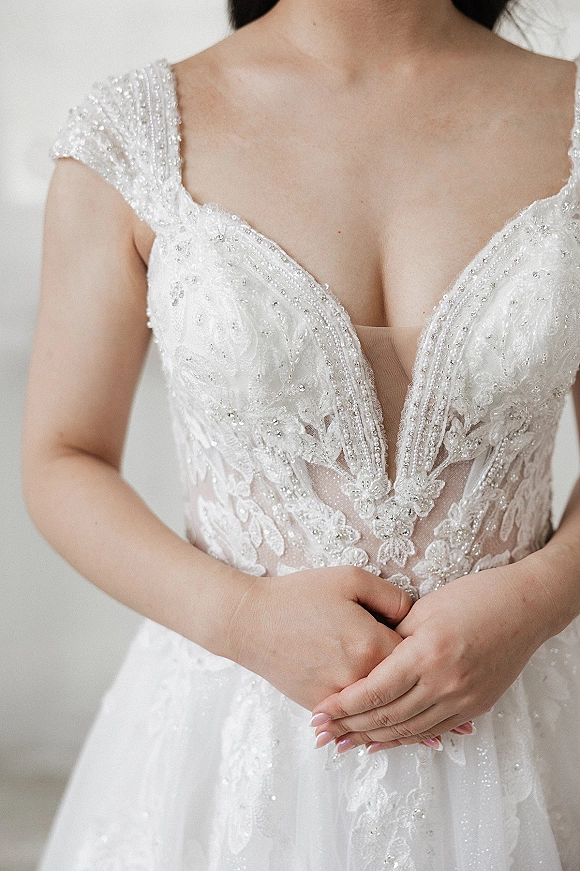
The deep-V and the plunging neckline are the boldest members of the V family, and they raise the practical question of how low is too low. A deep v-neck wedding dress or a plunging neckline wedding dress runs the V well below the bust, sometimes toward the waist, for a dramatic, elongating line that bares the center of the chest. A wedding dress with plunging neckline reads striking and architectural, and how far it plunges comes down to comfort and setting as much as style.
Depth sits on a continuum. A shallow V dips just below the collarbone and reads soft, a moderate V opens to the top of the bust, and a deep plunge or plunging v-neck drops between the breasts and down toward the natural waist, baring a long strip of skin at the center. A low v-neck wedding dress lives at the deeper end of that range, and the deep plunge is the most exposed version of all. Moving down the continuum trades coverage for line: the lower the point, the longer and more dramatic the vertical, and the more the gown depends on structure to stay secure. Where a bride lands on that scale tends to follow the setting as much as taste, since a shallow dip reads calm in a place of worship and a deep plunge reads at home in an evening or reception look.
Support is what makes a plunge wearable. A sheer illusion panel or fine mesh often fills the V for security while preserving the look of bare skin, and strong fashion tape paired with a well-boned bodice anchors the sides of the opening on gowns that skip the panel. Cups sewn into the bodice hold shape, boning along the seams keeps the fabric from gaping, and anchoring the V at the sides stops it from shifting as the body moves. The deeper the point, the more these pieces work together, since a plunge that reaches the natural waist has no fabric of its own to fall back on and depends entirely on the structure built beneath and beside it.
A modest deep-V keeps the elongating line while stopping higher or backing the opening with illusion, which suits a ceremony that asks for more coverage. Because the depth is adjustable at the fitting stage, a bride can take the vertical drama of the V with as much or as little skin as she wants.
V-Neck and the A-Line
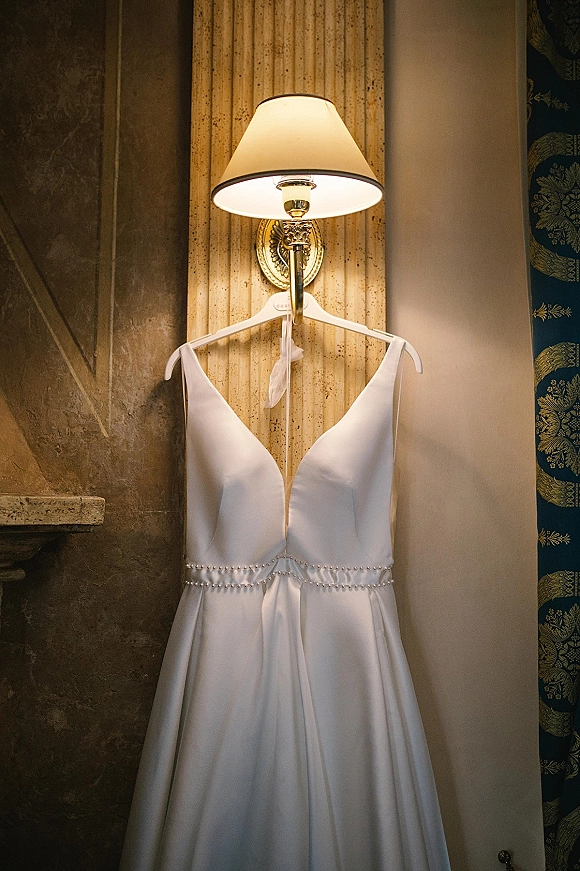
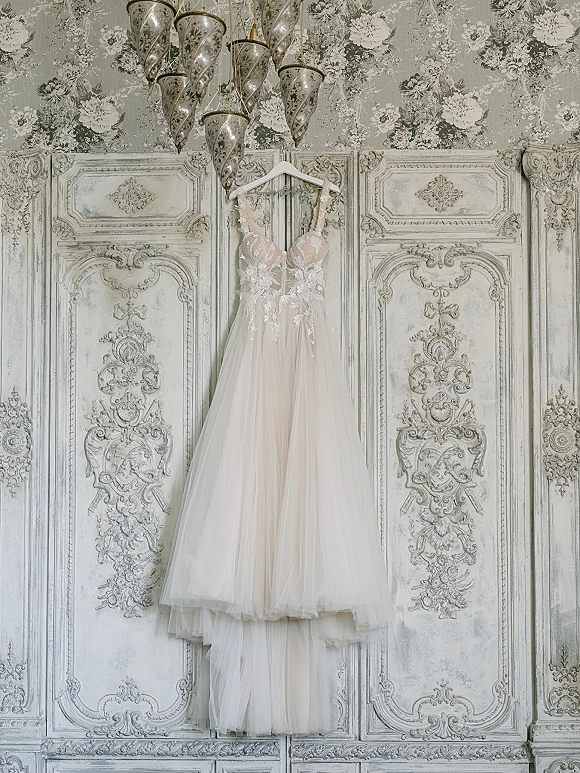
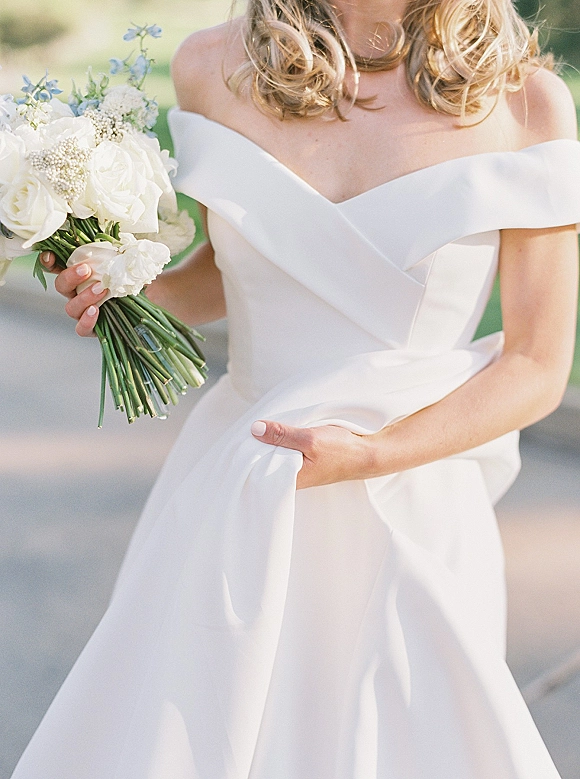
Pair the V with an a-line skirt and you get a balanced, flattering silhouette, and a v-neck a-line wedding dress is one of the most-searched versions of the neckline. The V defines and lengthens the bodice while the a-line skims the hips and suits nearly every figure, so the gown reads classic and easy without leaning dramatic. The pairing works because the two shapes pull in complementary directions: the V draws the eye up and down the center, the a-line widens gently from the waist, and the fitted point at the top balances the fuller skirt below. The result reads as an hourglass without asking the body to be one, photographs cleanly from every angle, and moves easily, since the a-line gives room to walk and dance while the V keeps the bodice fitted and defined.
This combination also carries across fabrics and depths without losing its character. A clean satin a-line reads smooth and modern, a lace-covered one reads romantic, and a soft chiffon skirt over a V bodice reads airy for a garden or destination setting. The V can sit shallow for a demure look or drop into a plunge for drama, and the a-line absorbs either without tipping the gown off balance. That range is why the pairing recurs so often in real weddings: it flatters a wide span of figures and adapts to nearly any venue.
Lace V-Neck Gowns
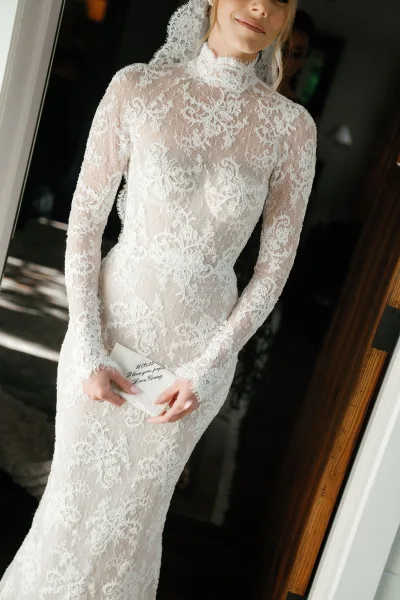
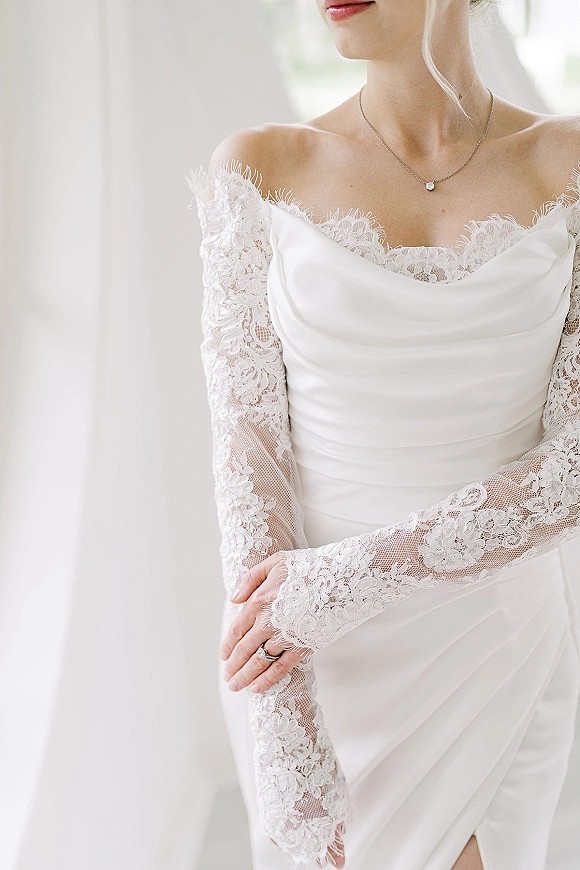
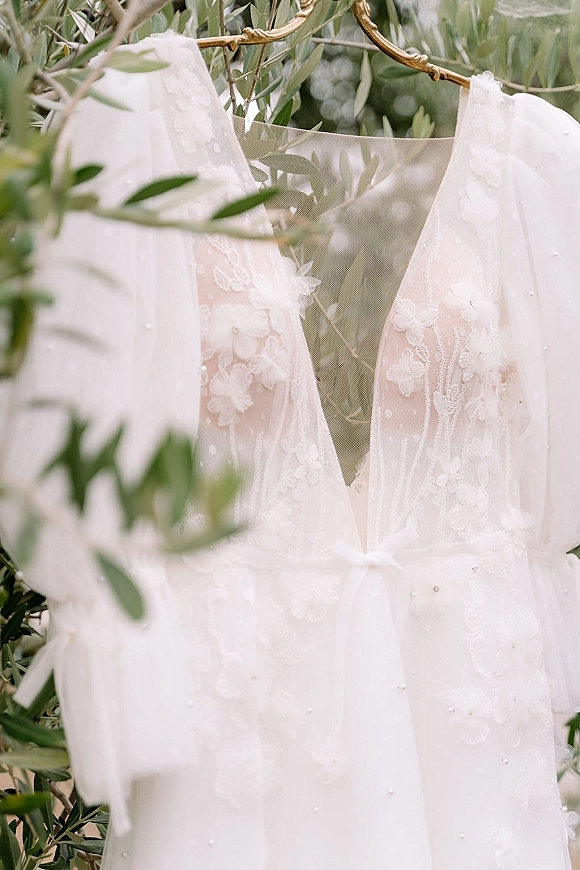
Lace traces the downward lines of the V so the elongating point reads romantic and detailed, outlining the V edge in a fine border, filling the whole bodice, or extending above the neckline as an illusion panel that softens a deep V while keeping its shape. The type sets the tone, and each behaves differently along the V. A heavier corded lace holds a bold, raised edge that traces the point with weight, while a fine floral or chantilly stays delicate and lets the V read soft, almost transparent at the edges. Motif laces such as guipure sit as individual blooms placed to follow the neckline exactly, so the pattern travels down the V rather than across it, and Alençon, with its corded outline around each motif, holds a defined edge that traces the point cleanly. Appliqué scattered along the opening reinforces the vertical and draws the eye toward the center, and a scalloped lace border along the V edge finishes the line without a hard seam. Because the lace follows and emphasizes the elongating line instead of cutting across it, this ranks among the more figure-lengthening ways to use lace on a bodice, and it softens a deep plunge in a way plain fabric cannot. The lace and the V both draw attention, so the version usually wants restrained jewelry, a bare throat or a single fine chain, so the neckline stays the focus.
Long-Sleeve and Mermaid V-Necks
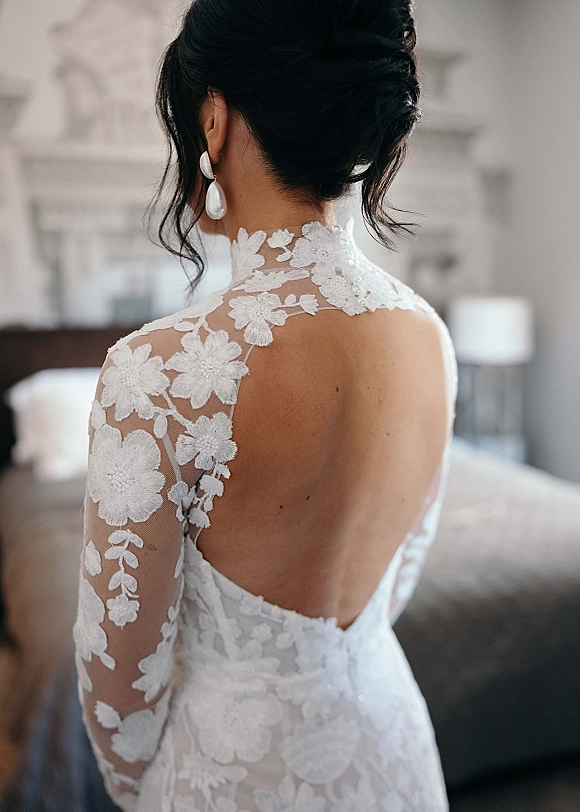
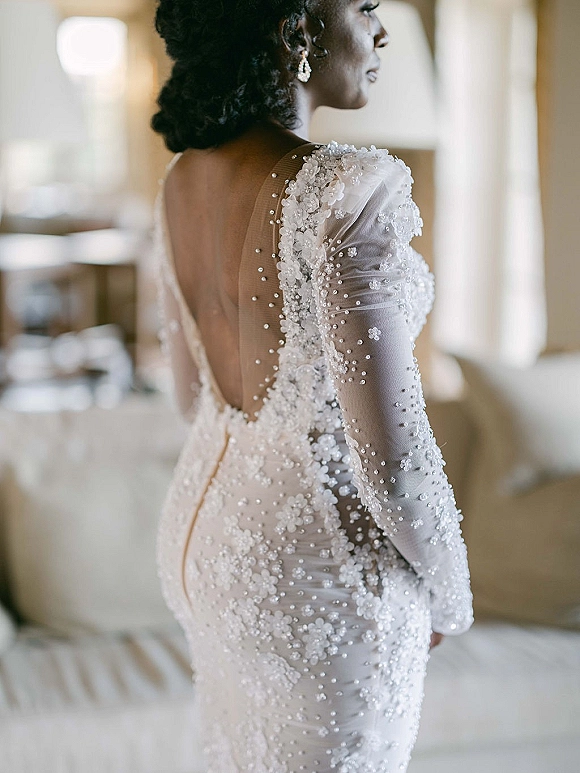
The V pairs with sleeves and with fitted silhouettes for its most dramatic looks. A long sleeve v-neck wedding dress balances the open, plunging front with covered arms, a contrast that reads modern and a little bold. The sleeve can be fitted lace that follows the arm and keeps the look sleek, sheer illusion tulle that adds coverage without visual weight so a deep plunge still reads bare through the center, or a soft bell that flares at the wrist. Bell sleeves in particular read bohemian and romantic, softening the sharp point of the neckline with movement at the arms, which suits an outdoor or free-spirited setting where the fabric can catch the air. Each sleeve style lets a bride cover the arms and shoulders while keeping the open, elongating front, the reason the long-sleeve V has such wide appeal.
A v-neck mermaid wedding dress is the most overtly glamorous pairing, since the V lengthens the torso and the mermaid traces the body, so both the neckline and the silhouette emphasize line. The elongation of the V and the fitted sweep of the mermaid reinforce each other for a tall, dramatic read, and the mermaid wedding dress gallery shows how the silhouette carries different necklines. A satin version in a column or mermaid keeps the line clean and lets the fabric shine follow the V down the body, so the neckline and the silhouette read as one continuous vertical.
Satin, Silk, and Straps
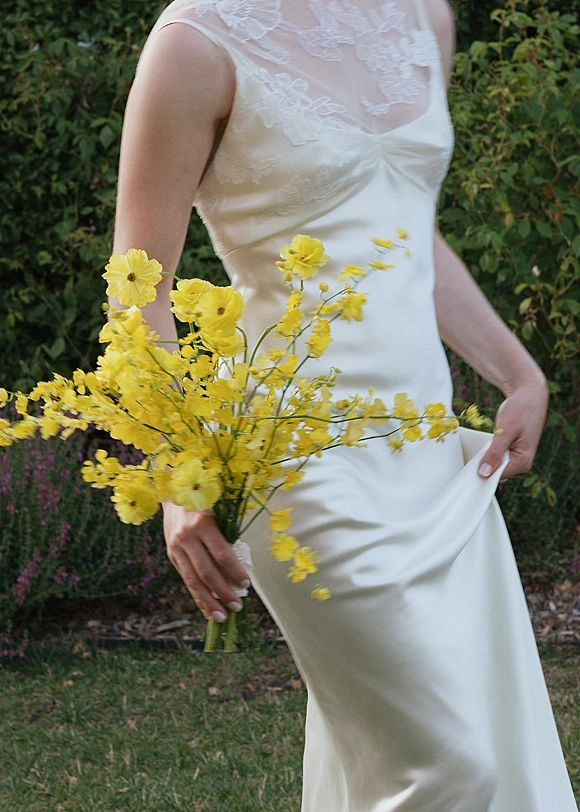
Fabric decides how a V behaves along its edge and how a plunge holds its shape. A satin v-neck wedding dress reads smooth and reflective, with the fabric shine running straight down the point and reinforcing the vertical. Charmeuse and silk drape soft against the body and follow the V in a fluid line, which suits a column or a slip-style gown, while silk crepe holds a matte, structured edge that keeps a clean V without gaping, so it flatters a deeper plunge that needs the sides to stay put. Chiffon adds airy movement and layers well over illusion, softening the neckline into something light for a garden or beach setting. The stiffer the fabric, the sharper and more stable the V: a crisp satin or crepe holds a defined point and supports a plunge on its own structure, while a fluid charmeuse or chiffon wants a boned foundation or an illusion fill to keep the opening from shifting, a difference worth knowing at the fitting stage.
The strap sets the frame around the V. A wide strap or a shoulder-covering band gives the neckline more coverage and more support for a fuller bust, while a v-neck spaghetti strap wedding dress does the opposite, framing the V with two thin delicate straps for a light, minimal look that keeps the focus on the open point. Spaghetti straps suit a shallower V or a plunge backed by illusion, since thin straps carry less weight than a wide band. Straps can also cross or wrap at the back, adding interest behind while the front stays clean, so the choice of strap shapes both the support and the mood of the gown, and a strap that carries some weight lets the front sit lower without straining the seams.
Plunging Front Versus Plunging Back
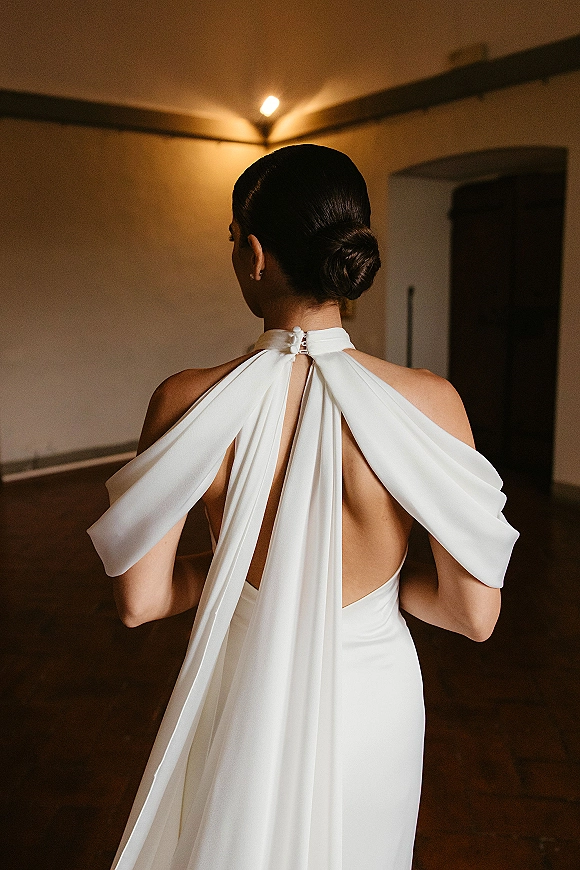
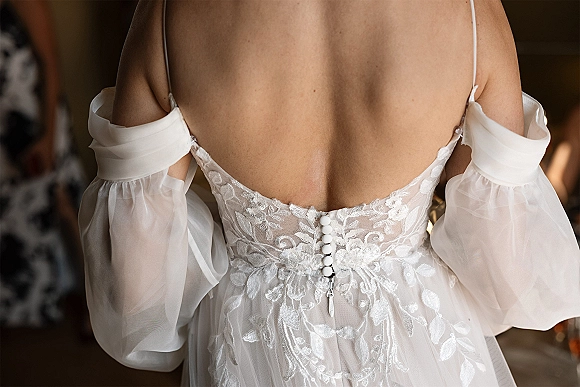
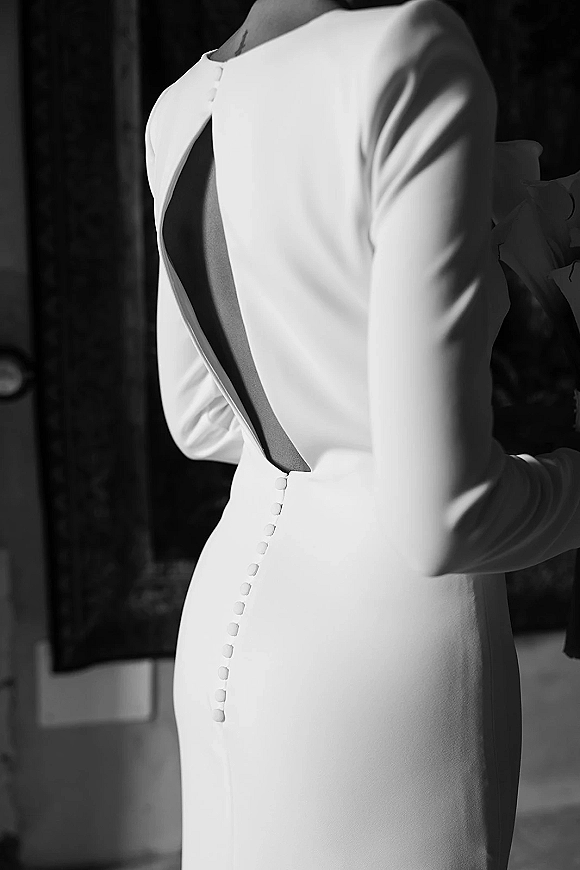
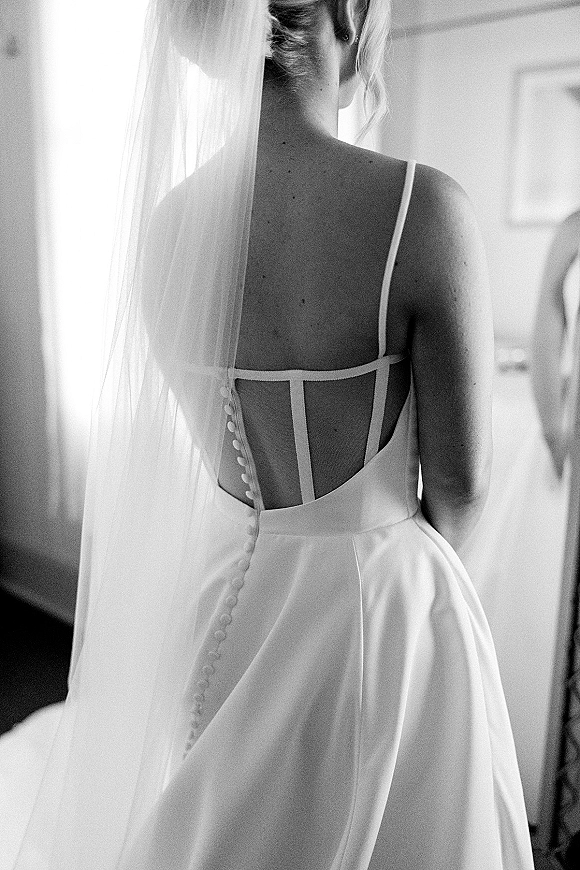
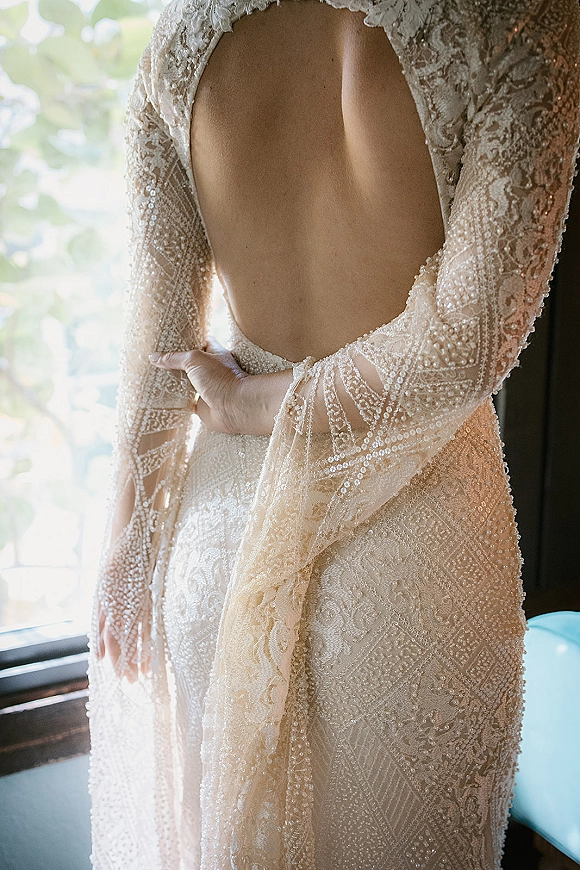
A V can lead down the front, the back, or both, and the choice changes how much skin shows where. A plunging front bares the center of the chest and makes the boldest statement, the version that needs the most support and often an illusion fill, since it fights gravity and the movement of the bust and leans hard on boning, cups, and tape to stay closed. A plunge at the back offers the same elongating line with more front coverage, so the gown reads modest walking down the aisle and dramatic walking away, and it wears more securely because the spine and shoulder blades hold a stable shape over a flatter part of the body. Many gowns split the difference, pairing a moderate front V with a deeper back V, which frees the front bodice to be fully supportive while keeping a reveal where it draws the eye as the bride turns. Deciding between the two comes down to where you want the drama and how much support you need.
Fit, Bust, Support, and Styling
The V flatters most figures, and the fit question centers on the bust and the depth of the neckline. On a fuller bust, the V lengthens and narrows the frame and opens and separates the chest rather than flattening it, ranking among the most flattering necklines available, though a deeper plunge needs an illusion panel or a supportive, boned bodice to stay secure. On a smaller bust, the V can drop deeper more comfortably and draws a long, defined line down the center, since there is less weight for the opening to hold and less risk of the sides pulling apart. Fashion tape, sewn-in cups, and internal boning are what keep a plunge in place through a full day of movement, and the same neckline can read demure on one figure and bold on another depending only on where the point lands.
Depth and support move together, so the fitting is where the two get balanced. A shallower V flatters comfortably with standard bodice support and thin or wide straps alike, while a deep plunge asks for a boned foundation, side anchoring, and sometimes an illusion fill, and it pairs more securely with a wider strap than a thin one. Bringing a plunge up an inch or backing it with mesh at the fitting is a small change that makes a bold neckline wearable without losing its line, and most gowns leave that decision open until the final appointment, when the bride can see the depth on her own frame and in the shoes she plans to wear.
Placement of the boning matters too, since a channel run along each side of the opening holds the V closed against the ribs and keeps the point from spreading as the bride raises her arms. For styling, the neckline leads the eye down, so a pendant on a longer chain that follows the line works well, tracing the point instead of sitting above it. A shorter necklace or a choker can compete with the line and cut the vertical short, so a bare neckline with statement earrings is often the cleanest option on a deep V.
Hair worn up or swept to one side shows the neckline and any back V, while hair left down softens a bold front plunge. For adjacent looks, compare the framed shoulders of a halter wedding dress or the soft curve of a sweetheart neckline wedding dress, and browse makers in the wedding dress directory.
Frequently Asked Questions
What is a V-neck wedding dress?
A V-neck angles down from the shoulders or straps to a point at the center of the chest, forming a V. The defining feature is that downward vertical line, which elongates the neck and torso and draws the eye toward the center. It differs from a sweetheart's curve and a square neck's straight cut by leading down rather than across.
How do you keep a plunging neckline in place?
A plunging neckline usually relies on a sheer illusion panel or mesh that fills the V for security while preserving the look of bare skin, or on fashion tape and a well-boned bodice that anchors the sides. A deeper plunge needs more internal structure, and a back V frees the front bodice to be fully supportive, which is the easiest plunge to wear.
Is a deep-V too much for a church or formal ceremony?
It depends on the setting, and the depth is adjustable. A modest deep-V keeps the elongating line while stopping higher or backing it with a sheer illusion panel, which reads covered enough for a house of worship or a formal ceremony. Many brides wear a moderate front V with a deeper back V to balance drama and coverage.
Is a V-neck flattering on a fuller bust?
The V is one of the most flattering necklines for a fuller bust. The downward line lengthens and narrows the frame and opens the chest rather than covering it. A deeper plunge needs an illusion panel or a supportive, boned bodice to stay secure, while a shallower V flatters comfortably with standard bodice support.
What silhouettes pair best with a V-neck?
The a-line is the most balanced and widely flattering pairing, the mermaid is the most glamorous since the V and the fitted silhouette both emphasize line, and long sleeves add a modern contrast to an open front. The V also pairs naturally with a back V or plunge for drama with more front coverage.
What necklace works with a V-neckline?
A pendant on a longer chain that follows the downward line of the V works beautifully, echoing the neckline rather than cutting across it. A shorter necklace can compete with the line, so on a deep V many brides go bare and let statement earrings carry the look. Hair worn up or to one side shows the neckline and any back V.